Printed Circuit Board Assembly (PCBA) consists of a Printed Circuit Board (PCB), electronic components, and structural elements, assembled through precision soldering and mounting processes.
With continuous technological innovation and performance demands in airborne products, PCBA design and manufacturing processes are becoming increasingly complex.
For instance, component miniaturization and high-density integration are becoming increasingly common.
At the same time, high-speed signal transmission rates continue to rise.
These trends demand more refined PCB design. Multilayer PCBs have therefore become standard to accommodate a greater number of traces and components.
However, miniaturization and multilayer structures complicate PCB manufacturing processes.
Advances in PCB design and high-integration component technologies are driving PCBA toward higher-density component layouts.
This trend significantly increases design complexity and difficulty.
It also imposes greater technical demands and challenges on manufacturing processes.
Airborne products operate in extremely harsh environments. Designing printed circuit board assemblies that meet performance requirements under these conditions is challenging.
At the same time, manufacturability and reliability must be ensured. Achieving all these objectives requires systematic research into collaborative design methodologies.
In particular, such research should address PCBA and PCB manufacturability during the design phase.
Application of DFM Technology in Printed Circuit Board Assemblies
Design for Manufacturability (DFM) is a design philosophy and practical methodology that considers manufacturing feasibility during the product design phase.
The manufacturability of airborne electronic modules encompasses both PCB (bare board level) and PCBA (component level) manufacturability.
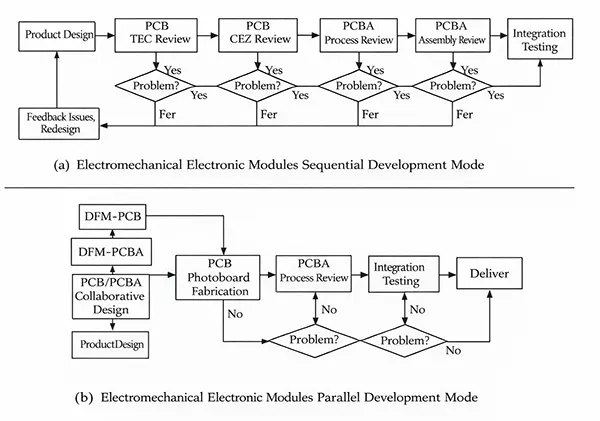
In traditional product development, design and manufacturing are two independent processes—that is, design and manufacturing proceed sequentially.
The design phase focuses solely on design speed and product functionality, neglecting DFM requirements for production processes such as PCB fabrication, electronic assembly, conformal coating, and machining.
This sequential model creates a disconnect between design and manufacturing.
As airborne products grow increasingly complex, the urgent need arises to introduce a parallel, collaborative DFM design philosophy.
Traditional DFM approaches feature isolated, specialized design processes that address only single disciplines or product tiers (PCB, PCBA, or machined parts).
This fragmented feedback mechanism fails to support multidisciplinary collaborative design.
Establishing a parallel collaborative DFM development model organically integrates multidisciplinary and multi-specialty DFM processes, creating effective coordination and communication mechanisms.
This ensures product designs simultaneously account for manufacturing capabilities across multiple domains.
Concurrent advancement of design and manufacturability assessment enables early identification of potential design flaws and quality risks arising from component assembly and soldering processes during the initial design phase.
This facilitates timely optimization of design solutions and determination of optimal manufacturing routes, precisely addressing deficiencies in product manufacturability requirements during design and achieving optimal product design.
The two development models described above are illustrated in Figure 1.
Application of DFM Technology in PCB Design
Airborne products feature highly complex PCB designs, encompassing large dimensions, high layer counts, dense trace widths/spacings, high hole aspect ratios, specialized back-drilling processes, and novel surface treatments.
Design for Manufacturability (DFM) must account for PCB manufacturers’ processing capabilities, including substrate materials, laminate design, via ring design, surface finishes, minimum hole sizes, minimum trace widths/spacings, and solder mask openings.
This ensures design requirements remain within the manufacturer’s processing limits, facilitating efficient mass production.
PCB Laminate DFM
PCB laminates adhere to the principle of central symmetry.
The thicknesses of all layers in the upper half (copper layers, dielectric layers, prepreg layers) must be symmetrical to those in the lower half.
If the thicknesses of symmetrical layers differ, it will cause varying degrees of warpage in the printed circuit board.
The copper area ratio within a symmetrical layer is termed the residual copper ratio.
Excessive variation in residual copper ratios across symmetrical layers poses a warpage risk.
Deformation resulting in bowing/twisting may exceed military acceptance quality thresholds, and this risk is largely unmitigable through panelization layout adjustments.
Standard copper-clad laminate materials procured and used by PCB manufacturers typically feature identical copper thickness on both sides.
Using laminates with differing copper thicknesses (known as “yin-yang copper”) prolongs the manufacturing cycle and induces warpage during PCB processing.
Therefore, yin-yang copper should be avoided whenever possible during stackup design.
PCB Routing DFM
PCB traces primarily serve to provide electrical connections between components, forming the core structure of the PCB.
During routing design, traces on the same layer should be distributed evenly, with relatively balanced conductive areas across all trace layers.
This prevents internal stresses caused by uneven metal conductor distribution, which can lead to board warping.
Additionally, ensure no excess wire ends (stubs or antenna effects) remain at trace junctions to avoid signal crosstalk, interference, and attenuation that compromise overall board signal integrity.
PCB Solder Mask DFM
When designing solder mask openings for pad patterns, the area covered by solder mask ink between two pads is referred to as the solder mask dam.
This is a critical design element for preventing soldering short circuits.
During the etching process of the top copper layer, side etching occurs, causing the solder mask ink to collapse and fall off during printing.
This results in dam collapse, leading to pin bridging, short circuits, and other issues.
Therefore, when designing solder mask dams, the concept of minimum dam width must be considered.
This refers to the smallest width of solder mask between pads required to prevent molten solder from flowing over the dam.
Application of DFM Technology in PCBA Design
PCBA design must meet the manufacturability requirements of the electronic assembly process.
Design considerations encompass component package selection, pad design, layout and routing design, stencil design, auxiliary process margins, fixture design, and inter-board assembly design.
This ensures surface mount devices (SMDs) and through-hole devices (THDs) can be assembled quickly and efficiently, ensuring robust component structures and ease of assembly.
This approach reduces production costs and enhances manufacturing efficiency.
Component Placement DFM
The rationality of component placement directly impacts PCB routing, soldering, and maintenance outcomes.
Optimal placement must balance convenience across soldering, assembly, testing, and repair processes.
Therefore, ensure components are evenly distributed during layout design.
For electronic modules incorporating both surface-mount and through-hole components, avoid routing other components beneath the body or flange of through-hole devices.
For example, When through-hole components are mounted on both sides of a PCB, the body of one side’s component or the connector flange may obscure the fastening screws or pins of through-hole components on the opposite side.
This creates soldering difficulties during assembly, hinders conformal coating application, and complicates solder joint inspection.
Furthermore, this design compromises serviceability.
Repairing the obscured component pins requires disassembling either the component or flange, resulting in high maintenance costs and reduced solder joint reliability.
Component Connection Pads DFM
Connection pads are conductive patterns used for securing and connecting components, including solder pads, wire bonding pads, and crimp pads.
Component leads connect to solder pads on the PCB via solder to establish electrical connections.
During soldering, the pads assist in conducting and dissipating heat, preventing component damage from excessive heat.
Joint strength primarily depends on solder volume, so the toe, heel, and sides of the component lead must ensure a reliable connection.
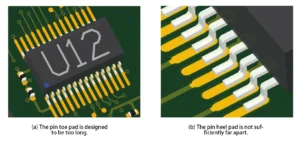
As shown in Figure 2, a mismatched pad design for gull-wing components results in insufficient distance between the pin heel and pad (IPC-7351B standard requires 0.25–0.45 mm), leading to inadequate solder wetting and defective joints.
Conversely, if the pad at the toe tip is excessively long (IPC-7351B standard requires 0.15–0.55 mm), it may cause excessive solder volume, leading to pin bridging or solder accumulation on the pin shoulder, resulting in brittle fracture.
This compromises both soldering quality and long-term joint reliability.
PCBA Via DFM
PCB vias primarily serve interlayer electrical connections, component positioning, and thermal conduction.
During layout and routing, if through-hole design is adopted (see Figure 3) and vias on solder pads are left unfilled—meaning their upper and lower surfaces lack solder mask coverage—molten solder may flow into the vias during soldering.
This results in insufficient solder on the pads, causing cold solder joints and compromising assembly quality.
Therefore, for vias on solder pads, common fill methods include ink filling, resin filling, or the plated over filled via (POFV) process.
When using solder mask ink for via filling, there is a risk of surface concavity due to ink shrinkage after curing.
Insufficient via filling may cause defects such as solder void and cold solder joints during assembly soldering, thereby reducing joint reliability.
Resin-based via filling offers high filling integrity, effectively enhancing PCB quality and reliability.
Additionally, positioning a via with a solder mask opening beneath a component body allows airflow during reflow soldering to displace the component, affecting assembly soldering quality.
During wave soldering, solder may flow through the via to the bottom of the component body via capillary action.
If a gap exists between the component and the PCB, solder balls rolling on the component’s lead surface may cause short-circuit failures.
For components with metal housings, this may also result in short circuits between the via and the component.

DFM-Based PCB and PCBA Collaborative Design and Application Examples
DFM for PCBA typically involves multi-disciplinary collaborative optimization of the design process, minimizing design defects and rework costs to meet the functional and performance requirements of the overall product.
Thermal Isolation (Flower Pad) Design
For pads extending from ground planes or power planes on multilayer boards with large copper areas (≥625 mm² or 25 mm × 25 mm), the pads must share a locally opened window with the large copper area.
Implement thermal isolation while maintaining electrical connectivity.
This process, termed thermal isolation rings, prevents excessive heat conduction during soldering.
It avoids excessive heat accumulation within the substrate without extending soldering time, thereby preventing substrate blistering or delamination.
For small surface-mount devices (0402 and smaller), directly connecting one pad to a large copper-clad area causes uneven heating, creating inconsistent solder surface tension and potentially leading to tombstoning.
Solder Mask Bridge Design
When performing PCB layout and routing, designers must pay attention to the spacing between surface-mount device pads and routing between pads.
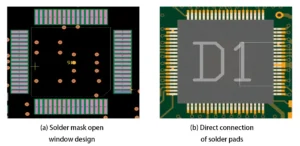
When pad spacing is ≥0.1778 mm (7 mil), use a single-pad solder mask window design instead of a solder mask open window design.
As shown in Figure 4, using a solder mask open window design leaves pads uncovered, potentially causing bridging between fine-pitch device leads during assembly.
This increases repair frequency, PCB scrap rates, and quality risks.
When adjacent pads within the same network require electrical connection, directly connecting adjacent SMD device pads forms a large pad.
After hot air leveling, this PCB is prone to solder balls, causing fine-pitch SMD component pins to bridge easily during assembly.
This repeatedly triggers faults and errors during automated optical inspection (AOI), X-ray inspection, and assembly verification, thereby affecting product appearance and assembly production schedules.
Therefore, when adjacent pads within the same network require electrical connection, designers should route connections outside the pad area.
Board-Level Interconnect Design
To facilitate PCB assembly with structural components and enable board-level interconnections between modules, the PCB outline drawing specifies height restrictions for different areas and clearly defines no-placement zones for components and routing.
When placing tall components, ensure compliance with the outline diagram’s height restrictions to prevent interference or wear between structural components/other modules and PCB contact areas.
Such issues may cause assembly failures, copper short circuits/open circuits, and necessitate repeated design iterations.
Therefore, during PCB layout and routing design, consider component height restrictions and no-placement zones.
Conclusion
This paper primarily discusses collaborative design methods for airborne printed circuit board assemblies based on DFM (Design for Manufacturing) technology, covering its applications in PCB and PCBA design as well as their integrated design.
Establishing a parallel collaborative DFM development model integrates naturally.
This creates effective collaboration and communication mechanisms, ensuring product designs accommodate manufacturing capabilities across multiple domains.
Conducting design and manufacturability assessments simultaneously allows for the early identification of potential design flaws and quality risks during component assembly and soldering.
This enables timely optimization of design solutions and the establishment of reasonable process routes.
Such an approach effectively addresses the issue of missing manufacturability requirements during the design process, ultimately achieving optimal product design.