As the functionalization of multilayer printed circuit boards (PCBs) continues to advance, multilayer PCBs are often designed with stepped structures featuring varying board thicknesses.
These internal steps are termed blind vias, whose bottoms frequently contain copper cladding or traces.
The blind via structure optimizes internal space allocation within the board.
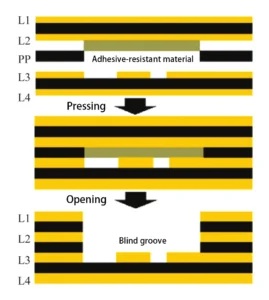
Currently, the primary method for creating blind vias employs a half-via process: first, the pattern within the blind via is etched on the inner layer sub-board.
Then, the resist material protects the pattern at the bottom of the blind via.
Through controlled depth etching on the outer layer, the connection between the inner and outer layers is established.
Finally, excess inner layer material is removed (also known as “opening the lid”) to complete the blind via.
Lid opening is the standard method for producing blind vias.
However, when PCBs use polytetrafluoroethylene (PTFE) substrates, lid opening for blind vias can easily damage the substrate.
The core cause of PTFE core substrate damage is that a PTFE film layer exists on the substrate surface.
During lamination, resin flows between the resist material and the blind via the bottom pattern, causing adhesion between the lid and the substrate at the blind via the bottom.
This adhesion leads to substrate damage. Substrates with softer materials are more prone to damage, making the material itself the primary cause of substrate failure.
During the lid removal process for blind slot boards, substrate damage results in significant scrap rates.
Currently, no particularly effective avoidance methods exist.
Therefore, it is necessary to conduct experiments to explore the prerequisites for substrate damage and develop preventive measures.
Experimental Design
Laminate Design
A four-layer laminate design was employed (see Figure 1), with common adhesive tape used as the barrier material.
Process Design
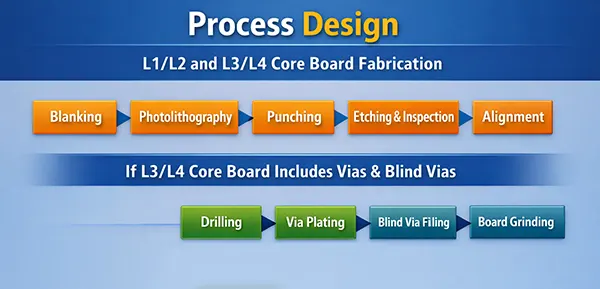
1. L1/L2 and L3/L4 Core Board Fabrication
The fabrication process is: blanking → photolithography → punching → etching inspection → alignment → blackening.
If the L3/L4 core board includes via and blind via processes, drilling, via plating, blind via filling, and board grinding steps are added.
2. 4 Layer Board Assembly
Prepreg (PP): Cutting → Drilling → Auxiliary Material Matching; Tape Application on L1/L2 Core Boards.
L1 to L4 Assembly: Laminate → Drill holes → Bake boards → Punch holes → Photolithography → Outer layer pattern etching → Controlled-depth milling of blind vias → Blind via glue repair.
Graphic Design
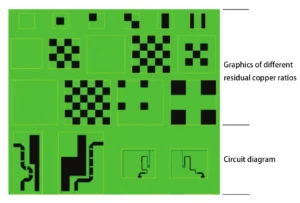
Different blind slot sizes were employed, with varying copper coverage areas at the bottom of each blind slot.
Designs were selected based on patterns that exhibited significant substrate damage during actual manufacturing, as shown in Figure 2.
Test Results
Damage to Substrate with Different Lid Thicknesses
Lid thicknesses of 0.5 mm and 1.0 mm were selected, with the groove bottom configuration shown in Figure 2.
Results indicate that damage to the substrate caused by different lid thicknesses is comparable, with no significant difference.
Therefore, lid thickness does not affect the extent of substrate damage.
Damage Conditions of Different Prepreg Substrates
Two materials were selected: PTFE prepreg and FR-4 prepreg. The slot bottom patterns are shown in Figure 3.
Results indicate that substrate damage occurred in both prepreg types.
This demonstrates that when fabricating blind vias using conventional reverse-tape lamination, substrate damage at the blind via bottom primarily relates to the substrate dielectric type at the bottom, not directly to the prepreg type used.
To address this, apply resistive tape (i.e., affix it to the blind via the cover side).
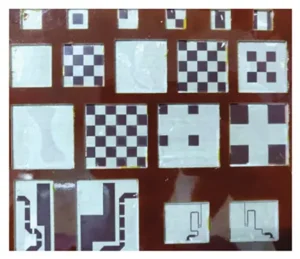
Damage to Base Material in Different Processes
(1) L3/L4 without via filling, inner layer without copper plating process; no significant differences observed upon opening.
(2) L3/L4 with via filling, featuring inner layer processes including drilling, copper plating, resin via filling, and board grinding.
Substrate damage was present but limited in scope.
Results indicate: Substrate damage at blind slot bottoms shows no substantial correlation with outer layer processes but exhibits a certain degree of correlation with inner layer processes.
Improvement Directions and Experiments
Problem Analysis
Damage to substrate materials on production lines is concentrated on PCBs with PTFE at the bottom of blind vias.
The primary cause is the tearing and peeling of the PTFE film on the surface of the PTFE substrate.
Experimental results indicate that substrate tearing occurs when the tape itself adheres to the PTFE film (via PTFE flux) and pulls it away.
Therefore, the following two improvement approaches are proposed:
(1) Reduce the adhesive bond between the tape and the substrate to lower the risk of tape-induced substrate tearing.
(2) Both the polyimide (PI) tape and the PTFE substrate surface in the adhesive barrier material exhibit hydrophobic properties.
Releasing tape stress by altering the initial pull-off position or causing the tape to detach from the cover earlier can prevent substrate tearing.
Comparison of Adhesive Tape Application Effects on Different Prepreg Sheets
Using the same F**8 prepreg sheet and adhesive-blocking PI tape, the tape was applied directly to two substrates (Material 1 and Material 2).
Results showed no substrate damage in either case, indicating that the direct tape application process effectively prevents substrate damage.
Effects of Cover-Opening Milling and Milling Platform Methods
(1) Cover-opening milling involves cutting along the blind groove edge.
After completing the milling path, the cover is opened, leaving it bonded to the anti-adhesive material (PI tape) and substrate.
During cover removal, the tape pulls the substrate, directly causing damage to the substrate.
(2) The milling platform method involves covering the entire lid area with the milling tool path to remove the lid as a whole.
This exposes the underlying adhesive barrier material (PI tape), which is then peeled away. This approach effectively reduces damage.
Conclusion
(1) When using the lid-opening method to create blind slots in PTFE substrate boards, damage to the PTFE substrate at the bottom of the blind slot is likely to occur during the lid-opening process.
The mechanism causing substrate damage is adhesive flow bonding between the adhesive tape used for blocking and the substrate, leading to peeling when the PTFE film is pulled during lid removal.
(2) When PTFE sheets serve as blind slot bottoms, damage to the substrate caused by lid removal is not directly related to sheet thickness, prepreg type, or external process flows.
(3) When PTFE sheets are used as blind slot bottoms, employing a positive-side adhesive barrier process and milling the lid using a milling platform method can effectively mitigate substrate damage issues.