Flexible printed circuit boards (FPCBs) are core components that enable modern electronic devices to achieve lightweight designs and high-density interconnections;
Their via plating technology is a key process for ensuring electrical connectivity and mechanical reliability.
In FPCB via metallization, there are two main electroplating methods: full-board electroplating and patterned electroplating.
Full-board electroplating involves copper plating across the entire surface;
Patterned electroplating, on the other hand, uses a dry film to selectively plate only specific circuit patterns—a process known as selective plating.
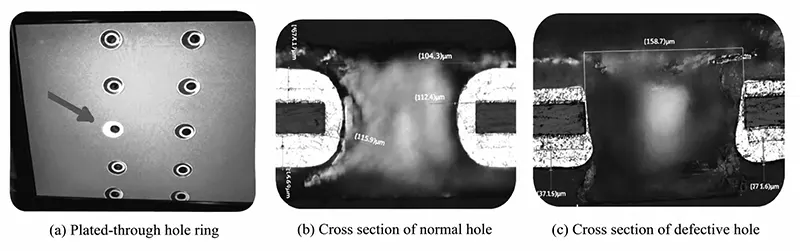
In actual FPCB production, plating defects in via rings primarily manifest as the absence of a copper layer at specific via ring locations, with a statistical defect rate ranging from 2.36% to 5.00%, as shown in Figure 1(a).
Analysis of cross-sections of both good and defective products revealed that the copper thickness within the via rings of defective products was also significantly insufficient, as shown in Figures 1(b) and (c).
It is evident that via ring plating defects not only affect the integrity of the surface plating but also pose a serious risk to the quality of the copper plating inside the vias.
Therefore, this issue must be addressed to mitigate potential quality risks within the vias.
Analysis and Verification of the Causes of Missed Plating in Selected-Plated Hole Rings
Analysis of Factors Affecting Missed Plating in Selected-Plated Hole Rings
The investigation examined the missed-plating issue in the hole rings of selected-plated products from five perspectives: personnel, machinery, materials, methods, and environment (see Table 1).
The team reviewed 24 potential influencing factors and systematically analyzed production records, operating procedures, equipment inspection records, and chemical solution inspection records.
This analysis identified four key factors that were most likely to affect the defect.
The following sections provide a more detailed examination of these four factors.
| No. | Influencing Factor | Screening Result |
|---|---|---|
| 1 | Clamp head contacted the dry film during panel loading | Operation checked; no abnormality, eliminated |
| 2 | Panel loading overtime stop | No abnormal equipment alarm; eliminated |
| 3 | Incorrect chemical solution added | Chemical analysis showed no abnormality; eliminated |
| 4 | Copper tank spray not turned on | Equipment inspection showed no abnormality; eliminated |
| 5 | Damaged clamp head | Equipment inspection showed no abnormality; eliminated |
| 6 | Spray nozzle clogged | Equipment inspection showed no abnormality; eliminated |
| 7 | Copper plating line carded with “flying tail” | No abnormal equipment alarm; eliminated |
| 8 | Pretreatment time too short | Stopwatch timing check showed no abnormality; eliminated |
| 9 | Flying-tail current did not reach the set value | Equipment inspection showed no abnormality; eliminated |
| 10 | Excessive contamination in post-degreasing rinse tank | Equipment maintenance inspection showed no abnormality; eliminated |
| 11 | Copper plating tank temperature too high | Equipment parameter inspection showed no abnormality; eliminated |
| 12 | Copper tank spray flow rate | Equipment parameter inspection showed no abnormality; eliminated |
| 13 | Insufficient Cu²⁺ ion concentration | Chemical analysis showed no abnormality; eliminated |
| 14 | Developer chemical system | Further confirmation required |
| 15 | Contaminated pretreatment filter cartridge of the copper tank | Equipment maintenance inspection showed no abnormality; eliminated |
| 16 | Pretreatment chemical system | Further confirmation required |
| 17 | Copper plating chemical system | Further confirmation required |
| 18 | Brightener concentration effect | Chemical analysis showed no abnormality; eliminated |
| 19 | Degreasing concentration or immersion time too short | Equipment parameter inspection showed no abnormality; eliminated |
| 20 | Spray enabled when producing selective-plating panels in the pretreatment tank | Equipment inspection showed no abnormality; eliminated |
| 21 | Copper tank spray flow rate too high / too low | Further confirmation required |
| 22 | Copper ion concentration in the copper tank too low | Chemical analysis showed no abnormality; eliminated |
| 23 | Influence of panel stacking in the post-development storage area | Product traceability inspection showed no abnormality; eliminated |
| 24 | Excessive time from black-hole/black-film process to copper plating | Product dwell-time inspection showed no abnormality; eliminated |
Table 1. Fishbone Diagram Influencing Factors Screening Results
Validation of Different Pre-Treatment Baths and Copper Plating Bath Chemical Systems
A specialized test evaluated the effects of pre-treatment baths and copper plating bath chemical systems on plating defects in through-holes and hole rings.
The team kept all other process parameters constant and compared different degreasing solutions and copper plating bath chemical systems.
The comparison quantified the variation in defect rates attributable to these process factors.
The test results are shown in Table 2. The defect rate for missed plating on the hole rings ranged from 3.52% to 3.57% across different chemical systems, with very little variation.
Therefore, the chemical compositions of the pretreatment bath and the copper plating bath are not the primary factors contributing to missed plating on the hole rings.
| No. | Degreasing Chemical | Copper Plating Chemical | Hole-Ring Plating Void Defect Rate (%) |
|---|---|---|---|
| 1 | MK-606 | AM-108 | 3.52 |
| 2 | LP-200 | AM-108 | 3.57 |
| 3 | LP-200 | HV-606 | 3.53 |
| 4 | MK-606 | HV-606 | 3.57 |
Table 2. Validation Results of Different Pretreatment and Copper Plating Chemical Systems
Analysis and Validation of the Effects of Different Developer Solutions on Selective Plating and Plating Defects
The team carried out a series of crossover experiments on the developing and pickling processes.
The experiments strictly controlled all other process variables while testing different combinations of developer solutions (potassium carbonate and sodium carbonate) and pickling solutions.
The team evaluated both the individual effects of each solution and its combined effects on the process.
Table 3 summarizes the test results.
After changing the main component of the developer (potassium carbonate/sodium carbonate), the defect rate for missed plating in the hole rings ranged from 2.25% to 2.95%, with minimal fluctuation.
Therefore, it can be concluded that the developer is not the primary factor causing missed plating in the hole rings.
| No. | Main Component of Developer Solution | Main Component of Acid Rinse Solution | Hole-Ring Plating Void Defect Rate (%) |
|---|---|---|---|
| 1 | Potassium Carbonate (K₂CO₃) | Sulfuric Acid (H₂SO₄) | 2.95 |
| 2 | Sodium Carbonate (Na₂CO₃) | Sulfuric Acid (H₂SO₄) | 2.77 |
| 3 | Potassium Carbonate (K₂CO₃) | DI Water | 2.34 |
| 4 | Sodium Carbonate (Na₂CO₃) | DI Water | 2.25 |
Table 3. Validation Results of Different Developer Chemical Systems
Analysis and Verification of the Effect of Copper Bath Spray Flow Rate on Selective Plating and Plating Defects
The team adjusted the copper bath spray flow rate while maintaining a fixed copper plating cycle and recorded the corresponding defect rates for plating defects in the hole rings.
The team then compared the defect rates under different flow rate settings to evaluate the effect of spray flow rate on plating defects.
Table 4 presents the test results.
Based on the test results in Table 4, within the same copper plating cycle, adjusting the spray flow rate in the copper tank significantly reduced the defect rate of missed plating on the hole rings from 6.77% to 1.25%, demonstrating a marked improvement.
This indicates a significant correlation between the copper tank spray flow rate and the occurrence of missed plating on the hole rings.
To verify the causal relationship between the copper tank spray flow rate and plating defects in the hole rings, the team conducted a reverse test.
Setting the spray frequency to 35 Hz reduced the defect rate for plating defects in the hole rings to 0.78%–1.09%.
In contrast, reducing the spray frequency to 15 Hz increased the defect rate significantly to 4.16%–4.51%, demonstrating a marked deterioration in plating quality.
| No. | Copper Plating Cycle (min) | Copper Bath Spray Frequency (Hz) | Through-Hole Annular Ring Skip Plating Defect Rate (%) |
|---|---|---|---|
| 1 | 13 | 10 | 6.77 |
| 2 | 13 | 15 | 4.69 |
| 3 | 13 | 20 | 3.64 |
| 4 | 13 | 25 | 3.38 |
| 5 | 13 | 30 | 2.50 |
| 6 | 13 | 35 | 1.25 |
| 7 | 20 | 35 | 1.30 |
Table 4. Validation Results for Different Spray Flow Rates
Corrective Actions and Effect Tracking
After identifying the copper tank spray as the primary factor influencing plating defects in the hole rings, the team optimized and verified the spray parameters. Table 5 summarizes the optimization process and verification results.
The team adjusted the copper tank spray frequency during production and evaluated production stability by monitoring whether board jams occurred under different parameter settings.
The evaluation yielded the following two findings:
(1) When the copper tank spray frequency in the front and rear sections was ≤17 Hz, no board jamming occurred;
(2) When the spray frequency in the middle section was <30 Hz, no board jamming occurred; however, board jamming defects occurred when the frequency was ≥30 Hz.
| No. | Copper Plating Cycle (min) | Front & Rear Copper Tank Spray (Hz) | Middle Copper Tank Spray (Hz) | Board Jamming Defect Rate (%) |
|---|---|---|---|---|
| 1 | 13 | 15 | 30 | 0 |
| 2 | 13 | 17 | 30 | 0 |
| 3 | 13 | 19 | 30 | 6.67 |
| 4 | 13 | 25 | 30 | 6.67 |
| 5 | 13 | 17 | 27 | 0 |
| 6 | 13 | 17 | 30 | 0 |
| 7 | 13 | 17 | 32 | 6.67 |
| 8 | 13 | 17 | 35 | 13.33 |
Table 5. Validation Scheme for Copper Tank Spray Parameters
The team ultimately set the copper tank spraying parameters to 17–0–30–17 Hz (corresponding to the segments from front to back).
Using these parameters, production successfully plated the selected products and effectively eliminated plating defects in the hole rings.
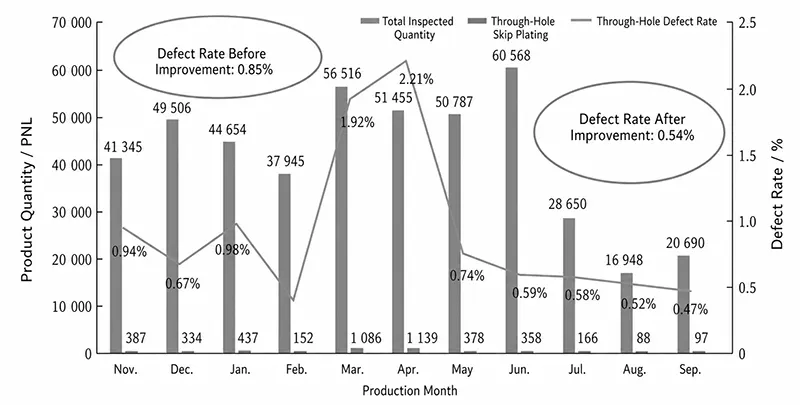
In subsequent production, through adjustments to and monitoring of the copper bath spray parameters, the defect rate for missed plating on the hole rings decreased significantly, as shown in Figure 2.
Conclusion
Underpowered conditions, the copper plating process relies on contact between the copper surface of the product and the plating solution to form a conductive circuit.
In areas where plating defects occur around holes, foreign residues often adhere to the surface, preventing adequate contact with the plating solution.
This prevents the circuit from forming properly, thereby affecting copper deposition and resulting in thin copper layers or even complete plating defects.
Therefore, adjusting the copper bath spray can effectively resolve plating defects around holes.
Based on our company’s internal validation conditions, we conducted a systematic investigation and verification of the factors influencing hole ring plating defects in selected products.
The results indicate that the copper bath spray is a key factor causing these defects.
Based on this analysis, we formulated corresponding improvement measures and implemented control measures, which effectively reduced the defect rate associated with hole ring plating defects and, consequently, improved the product yield.