Traditional battery management systems (BMS) use FR-4-based printed circuit boards (PCBs), which have a maximum long-term operating temperature of only 85 °C, a voltage rating of less than 600 V, and experience significant temperature rise under high current conditions.
As such, they cannot meet the high-temperature, high-voltage, high-current, and high-precision operational requirements of all-solid-state batteries.
PCBs specifically designed for all-solid-state batteries must simultaneously possess four core performance characteristics: high-temperature stability, ultra-high-voltage insulation, low-impedance current-carrying capability, and high-precision signal transmission.
These are key to ensuring the safe, stable, and long-term operation of battery systems.
Currently, Chinese PCB companies have entered this field, with some products entering the sample verification and small-batch supply stages.
However, the industry still faces challenges such as reliance on imported high-end materials, low process yield rates, a lack of standardized technical advantages, and an incomplete reliability system.
Based on this, this paper systematically discusses the materials, processes, and reliability systems of PCBs specifically designed for all-solid-state batteries.
Through multidimensional comparisons, it demonstrates their technical advantages, with the aim of providing both theoretical and practical support for the industry’s large-scale application.
Overview of Challenges in All-Solid-State Battery PCB Operating Conditions and the Advantages of Specialized Technology
By analyzing the four key operational challenges, this overview highlights the differentiated technical advantages of specialized PCBs and provides a clear comparison of performance.
Advantages in Extreme High-Temperature Environments
The typical operating temperature range for all-solid-state batteries is 80–120 °C, with peak local hotspots reaching up to 150 °C.
The glass transition temperature (Tg) of traditional FR-4 substrates is only 130–150 °C.
Long-term operation at high temperatures can lead to substrate softening, delamination, and a sharp decline in insulation performance.
When temperatures exceed 100 °C, insulation resistance drops by three orders of magnitude, posing risks of leakage and short circuits.
The PCB selected for this paper uses a modified polyphenylene oxide (MPPO) substrate with a Tg of 200 °C.
Capable of withstanding prolonged extreme temperatures up to 150 °C, the printed circuit exhibits no deformation or delamination while maintaining stable insulating performance.
It is well suited to the high-temperature operating conditions of all-solid-state batteries, addressing the high-temperature failure issue of conventional PCBs.
Advantages of Ultra-High-Voltage Insulation Protection
Currently, all-solid-state batteries are generally equipped with 800–1,000 V high-voltage fast-charging platforms, which place extremely high demands on the dielectric strength of PCBs.
Traditional FR-4 substrate materials have a dielectric strength of only 10 kV/mm;
In high-voltage environments, they are prone to electrical aging and dielectric breakdown.
Furthermore, severe crosstalk occurs between high-voltage and low-voltage signal circuits, affecting battery sampling accuracy.
Specialized PCBs, through substrate upgrades, slot isolation, and optimized shielding processes, can increase dielectric strength to 18 kV/mm and achieve a maximum withstand voltage of 1,800 V.
This significantly enhances high-voltage insulation stability, effectively preventing high-voltage breakdown and signal crosstalk, and aligns with the development trends of high-voltage fast-charging technology.
High Current-Carrying Capacity with Low Temperature Rise
All-solid-state batteries can reach peak operating currents of up to 600 A.
The heat generated by high currents can easily cause excessive temperature rises, circuit aging, and resistance drift in traditional PCBs.
Conventional 35 μm thin copper foil has limited current-carrying capacity and poor temperature rise control;
The specialized PCB employs thickened copper foil combined with embedded copper pillar vertical heat dissipation technology to create a highly efficient heat dissipation system.
When operating at a sustained high current of 600 A for 2 hours, the temperature rise is only 4.2 °C—significantly lower than that of traditional PCBs.
At the same time, circuit impedance is significantly reduced, effectively eliminating issues such as fuse blowouts and aging under high-current conditions.
Advantages of High-Precision Signal Transmission
All-solid-state batteries are sensitive to solid-solid interface impedance, requiring BMS voltage sampling accuracy of ±0.02 V, temperature sampling accuracy of ±0.5 °C, and a response time of <1 ms.
Traditional PCBs have high parasitic parameters, significant signal delay, and weak interference immunity, making them prone to signal distortion and system misjudgments.
Specialized PCBs, utilizing high-density micro-blind-via technology, low-loss substrate materials, and shielding and noise-reduction designs, significantly reduce interference from parasitic resistance, capacitance, and inductance.
This results in low signal transmission latency and high precision, thereby meeting the high-precision monitoring and control requirements of all-solid-state batteries.
Innovations in Key Material Systems and Comparison of Performance Advantages
Material performance forms the foundation of the technical advantages of specialized PCBs. See Table 1 for a comparison of substrate properties.
| Substrate Material | Tg (°C) | Dielectric Strength (kV/mm) | Volume Resistivity at 150°C (Ω·cm) | Suitable Applications | Performance Advantages and Limitations |
|---|---|---|---|---|---|
| Standard High-Tg FR-4 (Traditional) | 150 | 12 | 10⁹ | Low-temperature, low-voltage liquid-state batteries | Poor high-temperature resistance and insulation performance; unsuitable for extreme operating conditions. |
| Modified Polyphenylene Ether (PPE, PCB Grade) | 200 | 18 | 10¹² | High-voltage, high-temperature solid-state battery applications | High-temperature resistance, excellent insulation, low signal loss, and optimal cost-performance ratio. |
| Polyimide (PI) | 260 | 22 | 10¹³ | Specialized high-temperature aerospace applications | Excellent performance but excessively high cost and difficult to scale up production. |
| Alumina Ceramic (Al₂O₃) | >1,000 | 25 | 10¹⁴ | Ultra-high-power energy storage equipment | Excellent heat dissipation and insulation properties, but high brittleness and unsuitable for multilayer circuit routing. |
Table 1. Performance Comparison of Different High-Temperature-Resistant Substrate Materials
Note: Tg = Glass Transition Temperature. The values are translated directly from the original table and should be verified against material-specific datasheets before engineering use.
As shown in Table 1, the modified polyphenylene oxide substrate selected in this paper is the optimal material solution for all-solid-state battery PCBs.
Compared with traditional FR-4 substrates, this material has a 50 °C higher glass transition temperature and 50% higher dielectric strength.
Its high-temperature insulation resistance rises by three orders of magnitude. It supports stable long-term service under 150 °C and 1000 V conditions.
Compared to polyimide and ceramic substrates, it strikes a balance between performance and cost, making it suitable for mass production and serving as the foundation for the core performance advantages of specialized PCBs.
In terms of conductive materials, specialized PCBs innovatively employ a composite system of nano-silver paste and thickened copper foil to replace traditional single-layer electrolytic copper foil.
The material’s resistivity has been reduced from 1.7×10⁻⁸ Ω·m to 1.5×10⁻⁸ Ω·m, resulting in a 15% decrease in internal resistance and a 20% improvement in heat dissipation efficiency.
Additionally, the use of copper foil with a thickness of 0.14–0.21 mm (4–6 oz) significantly enhances high-current carrying capacity.
In terms of insulating and protective materials, the system replaces conventional epoxy solder mask ink with high-temperature-resistant modified resins and polyimide ink, combined with an ultra-thin poly(p-xylene) protective coating.
This configuration can withstand prolonged exposure to temperatures of 150 °C, significantly improving moisture resistance, insulation, and aging resistance.
Innovative Manufacturing Processes and Core Technological Advantages
Special-purpose PCBs offer differentiated advantages in routing precision, heat dissipation efficiency, insulation protection, and reliability, effectively addressing the technical shortcomings of traditional processes.
High-Density Micro-Blind Via Process: High-Precision Routing Advantages
Specialized PCBs utilize a laser micro-blind via + via-filling electroplating process to produce ultra-micro vias as small as 0.1 mm, raising routing precision to 25 μm and doubling I/O interface capacity.
Operators adopt the plasma resin removal process. This greatly improves the adhesion of via walls.
The via resistance variation rate stays below 3% after 1000 temperature cycles. Signal acquisition accuracy rises by 8%.
This realizes high-density, high-precision, and highly stable interlayer interconnections.
Precision Etching Process for Thick Copper Foil: Advantages in Stable High-Current Transmission
By employing a combined process of horizontal segmented spray etching and the semi-additive method, the side etch rate of thick copper is controlled to within 10%, with line width accuracy of ±5 μm.
The resulting thick-copper circuits feature vertical sidewalls and uniform impedance, capable of stably carrying ultra-high currents of 600 A.
This eliminates issues such as localized circuit overheating and resistance fluctuations, making them suitable for ultra-fast charging applications.
Embedded Copper Pillar Heat Dissipation Technology: High Efficiency and Low-Temperature Temperature Control Advantages
Specialized PCBs utilize an embedded copper pillar vertical heat dissipation structure.
Engineers electroplate copper pillars. These copper pillars link heat dissipation channels between the upper and lower substrate layers.
This achieves thermal conductivity of 50 W/(m·K). The value exceeds that of conventional PCBs by more than ten times.
The PCB runs continuously under 600 A working current. Its maximum temperature only reaches 78.2 °C.
Operators control temperature rise within 4.2 °C. This restrains high-temperature warping. The design balances heat dissipation and structural stability.
High-Voltage Isolation and Shielding Process: Safety Advantages Against Interference
To address the risks of high-voltage crosstalk and breakdown, the specialized PCB employs a four-pronged process: zoned layout, ground shielding, slot isolation, and embedded capacitors for noise reduction.
Physical isolation between high- and low-voltage circuits, combined with a slotted structure that doubles the breakdown voltage of the circuits and a shielding layer that effectively blocks electromagnetic interference, results in significant power supply noise filtering.
This thoroughly resolves the issues of insufficient high-voltage insulation and severe signal interference found in traditional PCBs, ensuring circuit safety and signal accuracy during high-voltage fast-charging operations.
Demonstrating the Reliability Advantages of Dedicated PCBs
Comparison of Reliability Between Dedicated PCBs and Traditional Automotive PCBs
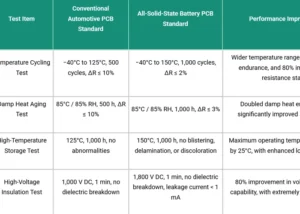
We established rigorous reliability testing standards specifically for all-solid-state batteries and conducted a quantitative comparison with traditional automotive PCB standards to visually demonstrate the long-term reliability advantages of dedicated PCBs.
The comparison results are shown in Table 2, where ΔR represents the change in resistance.
Test Item | Conventional Automotive PCB Standard | All-Solid-State Battery PCB Standard | Performance Improvements |
|---|---|---|---|
Temperature Cycling Test | −40°C to 125°C, 500 cycles, ΔR ≤ 10% | −40°C to 150°C, 1,000 cycles, ΔR ≤ 2% | Wider temperature range, doubled cycling endurance, and 80% improvement in resistance stability. |
Damp Heat Aging Test | 85°C / 85% RH, 500 h, ΔR ≤ 10% | 85°C / 85% RH, 1,000 h, ΔR ≤ 3% | Doubled damp heat endurance and significantly improved aging stability. |
High-Temperature Storage Test | 125°C, 1,000 h, no abnormalities | 150°C, 1,000 h, no blistering, delamination, or discoloration | Maximum operating temperature increased by 25°C, with enhanced long-term stability. |
High-Voltage Insulation Test | 1,000 V DC, 1 min, no dielectric breakdown | 1,800 V DC, 1 min, no dielectric breakdown, leakage current < 1 mA | 80% improvement in voltage withstand capability, with extremely low leakage risk. |
High-Current Carrying Capacity Test | 300 A, 2 h, temperature rise < 10°C | 600 A, 2 h, temperature rise < 5°C, no fusing | Doubled current-carrying capacity with significantly improved temperature-rise control. |
Table 2. Reliability Comparison Between Specialized Solid-State Battery PCBs and Conventional Automotive PCBs
Note: ΔR represents the change in electrical resistance, RH stands for Relative Humidity, and DC stands for Direct Current. All specifications are translated from the original image and should be validated before use as engineering standards.
Table 2 shows the performance comparison. PCBs customized for all-solid-state batteries exceed conventional automotive PCBs in multiple indicators.
These indicators include high-temperature resistance, high-voltage resistance, high current-carrying capacity, aging resistance and anti-deformation performance.
Researchers optimize materials, upgrade processes and innovate structures.
This fully solves typical drawbacks of traditional PCBs. The drawbacks include insulation failure, overheating, aging, signal distortion and short service life.
These defects appear under extreme working conditions of all-solid-state batteries.
The new PCBs achieve excellent condition adaptability and long-term reliability.
Failure Mechanism Optimization: Risk-Resistance Advantages Come to the Fore
Addressing the four core failure issues in traditional PCBs, specialized PCBs achieve precise optimization:
First, low-CTE modified PPO substrate effectively reduces thermal stress, thereby eliminating via cracking failures;
Second, high-insulation substrate combined with shielding processes mitigates the risk of localized breakdown in high-voltage electric fields;
Third, plasma surface treatment enhances interfacial adhesion, thereby resolving delamination issues caused by high temperature and humidity;
Fourth, a protective layer of nanosilver paste inhibits copper foil oxidation, ensuring stable resistance over the long term and significantly reducing the probability of battery system failures, resulting in notable safety advantages.
Advantages of Industrialization and Prospects for Technological Development
Advantages of Industrial Applications
Currently, the manufacturing processes of some specialized PCB manufacturers in China have reached internationally advanced levels.
These companies have completed sample validation and small-batch deliveries, with product yield rates exceeding 98%.
Compared to imported products from Japan and South Korea, domestically produced specialized PCBs in China offer lower costs and shorter delivery cycles, while also being compatible with China’s 800-volt high-voltage fast-charging platform for all-solid-state battery vehicles.
Although high-end substrate materials still rely on imports, Chinese materials companies have initiated R&D for domestic production, and cost advantages are expected to increase further in the future.
Advantages in Future Technological Iterations
Specialized PCB technology for all-solid-state batteries is evolving toward integration, wireless connectivity, multifunctionality, and environmental sustainability.
Embedded component integration can reduce volume by 30 percent; a wireless BMS architecture can eliminate the risk of wiring harness failures;
An integrated thermal management and sensing structure enables multifunctional integration; and halogen-free, biodegradable materials facilitate environmentally friendly production.
Consequently, specialized PCBs for all-solid-state batteries possess exceptional capacity for technological iteration and can adapt to the continuous upgrades of future battery technologies.
Conclusion
This paper systematically discusses the material systems, innovative processes, and reliability frameworks for specialized PCBs used in all-solid-state batteries.
Through multidimensional and quantitative comparisons, it fully validates the technical advantages of these specialized PCBs.
Researchers adopt a modified polyphenylene oxide (PPO) substrate system for these specialized PCBs.
They also apply innovative processes. These processes include embedded copper pillars, thick-copper precision etching and high-voltage shielding.
Compared with conventional automotive PCBs, these technologies realize four major breakthroughs in core performance.
First, significantly enhanced high-temperature resistance, capable of withstanding extreme temperatures of 150 °C over the long term;
Second, significantly enhanced high-voltage insulation capability, with a maximum withstand voltage of 1,800 V, suitable for high-voltage fast-charging conditions;
Third, excellent high-current carrying stability, with a temperature rise of only 4.2 °C under 600 A ultra-fast charging conditions;
Fourth, outstanding long-term reliability, with resistance drift of less than 3% after 1,000 temperature cycles, demonstrating exceptional resistance to aging and failure.
This technological system can thoroughly resolve the challenges posed by extreme operating conditions in all-solid-state batteries, balancing performance, cost, and industrialization value.
Currently, Chinese manufacturing processes have achieved international benchmarking standards.
Domestic manufacturers will realize local production of high-end substrate materials in future work.
Specialized PCBs will deliver comprehensive technical support for multiple industries.
These industries include new energy vehicles, energy storage and aerospace.
They provide core technological backing for large-scale, high-quality development of the all-solid-state battery industry.