When designing printed circuit boards, PCBA designers often include process margins.
Do you know why they do this? What are the benefits of including process margins?
Today, I’ll explain why process margins are included in PCBA design.
In the design of printed circuit board assemblies (PCBAs), the provision of process margins is a critical factor in ensuring the smooth progression of mass production and the achievement of product quality standards.
As a key process element linking the design concept to actual manufacturing, the proper planning of process margins directly impacts the operational efficiency and stability of subsequent processes such as surface mount technology (SMT) and through-hole soldering.
Consequently, the design principles and application standards for process margins have become essential professional knowledge for PCBA designers.
Basic Concepts and Core Characteristics of Craft Edging
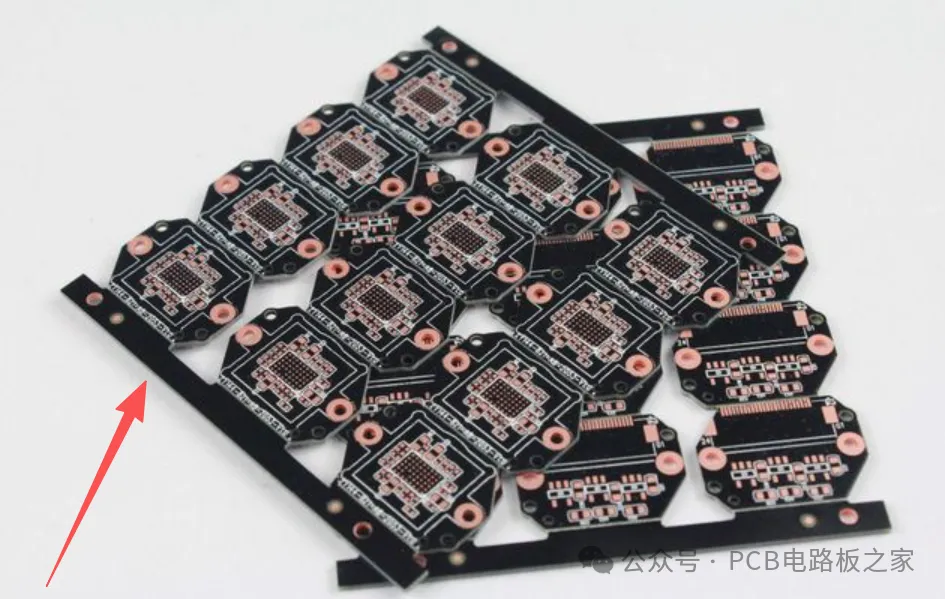
The PCBA process margin, also known as the working margin, is essentially a long, narrow blank area reserved along the edge of the PCB.
It is designed to accommodate the operational requirements of automated production equipment.
This area typically does not contain any components, pads, or traces.
Its primary function is to provide a stable gripping and transport reference for equipment such as SMT placement machines and wave soldering machines.
It also serves as the mounting area for panelization reference points (mark points), ensuring accurate optical alignment by the equipment.
From a design specification perspective, the width of the process margin must match the parameters of the production equipment.
Under normal circumstances, the width on a single side should not be less than 5 mm; however, for precision circuit boards or special equipment scenarios, the width must be increased to 8 mm or more.
The edges of the process margins must remain flat and free of notches, and corners should be rounded to prevent board jamming during conveyance.
These design requirements must comply with international electronics assembly standards such as IPC-A-610C to ensure process compatibility.
The Key Reasons for Including Process Margins in PCBA Design
Including process margins does not increase design costs; rather, it is a critical measure for enhancing efficiency throughout the entire production process by mitigating manufacturing risks in advance.
Its core value lies primarily in three areas: ensuring the stability of automated manufacturing, protecting components, and improving the reliability of the testing phase.
Meeting the Conveyance Requirements of SMT Production Lines
SMT assembly is one of the core processes in PCBA production. On SMT production lines, PCBs are primarily conveyed and positioned using equipment guide rails.
This requires that PCBs reserve a pair of edges—where no components are placed—as conveyance edges.
In actual production, the two long edges of the PCB itself or of a panelized board are typically designated as conveyance edges.
If no process margins are reserved or if there is insufficient available space along the edges, the guide rail’s clamping mechanism will be unable to securely grip the board, potentially causing issues such as transmission stuttering or positional misalignment, which directly impact placement accuracy and quality.
For small-sized or irregularly shaped PCBs, process margins are an essential prerequisite for automated production—they extend the board’s effective dimensions to meet the equipment’s minimum clamping requirements.
Preventing Component Damage During Production
When an SMT placement machine performs component pickup and placement operations, if electronic components are positioned near the edges of the PCBA, the placement nozzle is highly susceptible to mechanical collisions with these components.
This can result in component damage or placement failure, preventing the production process from proceeding normally.
Therefore, reserving a certain width of process margin can effectively resolve such issues.
Similarly, in the wave soldering process for DIP components, the process margin plays a crucial role in preventing interference between the components and the conveyor mechanism, ensuring the stability of the soldering process.
It is important to note that the process margin is not an integral part of the PCBA board itself and can be removed once the entire PCBA manufacturing process is complete.
Providing Stable Support for Alignment and Testing
The process edge not only facilitates the transfer process but also serves as the ideal location for placing panelization marks.
As the optical alignment reference for placement machines, mark points must be located at least 3 mm from the board edge, with no interfering elements such as vias or test points within a 5 mm radius, to ensure precise placement machine alignment.
Additionally, during quality inspection processes such as ICT (In-Circuit Testing) and FCT (Functional Testing), test fixtures can utilize the process edge to securely hold the PCBA in place, ensuring precise contact between test probes and test points and enhancing the reliability of test data.
Methods and Key Considerations for Removing Process Edges from PCBA
After surface-mount assembly is complete, the removal of process edges is equally critical.
During this process, it is essential to ensure that the cut edges are smooth to prevent damage to the PCBA board and components.
Currently, the industry commonly uses three main methods for removing process edges.
These methods differ significantly in terms of their applicable scenarios and results, so the appropriate method must be selected based on actual production requirements.
Milling and Cutting Method
This method uses a high-speed milling cutter to precisely cut along the process edges.
Its primary advantages include smooth, flat cuts and high dimensional accuracy.
Furthermore, it exerts minimal mechanical stress on the PCBA during the cutting process, effectively preventing component malfunctions caused by stress.
This method is not limited by the shape of the cut and can efficiently handle even complex process edges, making it the optimal choice from a quality perspective.
However, its drawback is the relatively high cost of equipment acquisition and maintenance, making it more suitable for high-volume production scenarios.
V-Cut PCB Separation Method
A V-cut PCB separator uses a specialized blade to cut along a pre-marked V-shaped groove on the PCB, applying mechanical force to separate the processed edge from the board.
The key advantages of this method include affordable equipment costs, high operational efficiency, and a cutting process that produces no dust pollution.
Additionally, the blade angle can be adjusted to accommodate PCBs of varying thicknesses.
However, due to its cutting principle, the V-cut panel saw is limited to straight-line cutting and requires high precision in the machining of the V-groove—the groove depth must be designed in advance based on the PCB thickness to prevent incomplete or excessive cutting.
It is therefore best suited for high-volume, standardized removal of process edges from rectangular panelized PCBs.
Manual Removal Method
Manual removal is a process for separating the edges of a PCB by hand or using simple tools such as needle-nose pliers.
It is characterized by extremely low cost and flexible, convenient operation, making it particularly suitable for small-batch trial production or PCB products with simple structures.
However, this method also has significant limitations: the instantaneous stress generated by manual operation is high, which can easily cause micro-cracks in the PCB board or lead to component solder joint detachment.
Additionally, the cut surface after removal is often uneven and may leave burrs.
To mitigate these risks, ensure that the process edge is connected to the board via stamp holes (typically a 3–5 hole configuration with a diameter not exceeding 0.8 mm) before manual removal.
This concentrates stress at the connection points, minimizing damage to the main body of the board.
Summary
The design and removal of process margins in PCBA manufacturing are a concrete manifestation of the Design for Manufacturability (DFM) philosophy.
From the initial determination of process margin width parameters and the rational placement of mark points, to the scientific selection of removal methods in the later stages, every step must balance design specifications with practical production requirements.
Appropriately reserving process margins not only effectively mitigates various risks in automated production but also indirectly reduces production costs by enhancing processing stability.
It serves as a crucial foundation for ensuring both the quality of PCBA products and production efficiency.