Temperature control plays a critical role in many industrial sectors. It is particularly important in welding, smelting, and blast furnace operations.
Improper temperature management in these fields can lead to serious production accidents and economic losses.
For example, in hot-air reflow soldering, temperature control lag and inertia significantly affect soldering quality, resulting in reduced yield rates;
In the operation of pulverized coal gasifiers, the failure of the originally designed steam method has caused process accidents such as slag blockage at the slag outlet and burn-through of water-cooled walls.
The aforementioned studies indicate that precise temperature control and optimization strategies not only enhance production process standards and reduce costs.
They also improve system stability and reliability. These findings hold significant practical engineering significance.
Advances and Limitations
At the same time, to address the issue of uneven temperature distribution in reflow soldering, a one-dimensional unsteady heat transfer model provides a theoretical basis for achieving an optimal heat transfer coefficient.
Engineers improve the furnace temperature profile using the finite difference method.
Furthermore, research on furnace temperature profiles based on fixed process parameters further clarifies temperature variation patterns in the reflow and cooling zones, thereby ensuring soldering quality.
However, current research still has some shortcomings, particularly regarding insufficient attention to the soldering performance of specific components such as capacitors.
Therefore, this study aims to optimize the oven temperature profile of the T-980 reflow soldering machine.
It seeks to resolve the issue of capacitor detachment in FT-102 panel assemblies. It also aims to improve soldering reliability and product quality.
Existing Challenges in Temperature Optimization
In the fields of metallurgy and soldering, the precision and stability of temperature control are key factors in ensuring product quality and production efficiency.
However, existing research still has shortcomings regarding the soldering quality of high-thermal-capacity PCBs in wave soldering.
It also has limitations in the optimization of temperature zone parameters in reflow soldering.
In addition, it does not fully address the impact of annealing oven temperature fluctuations on material performance.
These studies have failed to adequately address issues such as poor tin penetration in high-thermal-capacity PCBs.
They also do not fully resolve quality defects in reflow soldering.
In addition, they overlook the decline in product performance caused by annealing oven temperature fluctuations.
These issues severely affect production reliability and economic efficiency.
Proposed Optimization Strategy and Engineering Approach
By integrating previous research findings with experimental analysis, this paper addresses the issue of insufficient solder penetration when wave soldering PCBs with high thermal capacity.
Engineers employ an orthogonal experimental design method to optimize process parameters and improve solder joint quality.
To address common quality defects in reflow soldering, they propose specific measures.
These measures optimize temperature profiles and parameters in each temperature zone. This thereby enhances soldering reliability.
Engineers adopt a secondary normalizing treatment scheme to reduce the defect rate caused by temperature fluctuations in the normalizing furnace, which affect the performance of grain-oriented electrical steel.
The results indicate that strict process control and optimization of temperature profiles significantly improve soldering quality, while also enhancing product performance and production efficiency.
Method
Research Strategy
This study aims to address the issue of capacitor detachment that occurs during the soldering of small-sized panel assemblies on the T-980 reflow soldering machine.
It does so by improving soldering quality through the optimization of the oven temperature profile.
Engineers adopt a closed-loop approach throughout the entire process to ensure the effectiveness of the study.
This included initial parameter settings, practical testing, and data analysis.
Engineers adjust each stage based on feedback and optimization derived from the results of the preceding stage.
The specific steps are as follows:
(1) Preliminary Measurement of Existing Temperature Profile
Use the initial settings to obtain the basic shape of the existing temperature profile.
(2) Comparison with the Ideal Temperature Profile
Compare the preliminary data with the recommended temperature profile and industry standards to identify the main issues with the existing profile.
(3) Propose A Preliminary Optimization Plan
Based on the comparison results, propose preliminary improvement measures, primarily involving adjustments to the zone speed and temperature values in each temperature zone.
(4) Detailed Measurement and Analysis
Obtain more accurate furnace temperature curve data through refined measurement methods and conduct a detailed analysis of the actual performance of each temperature zone.
(5) Multiple Rounds of Testing and Improvement
Develop and implement various furnace temperature curve optimization plans to gradually approach the ideal temperature distribution.
(6) Confirmation of Final Optimization Results
Determine the optimal furnace temperature curve configuration by combining actual welding results with measured data.
Data Collection
To conduct an in-depth study and effectively resolve the issues, this research requires the collection of the following key data (variables):
(1) Basic Data on the Furnace Temperature Profile
Including the temperature setpoints and corresponding time points for each temperature zone in the current furnace temperature profile (Curve 7), as well as the total welding time and conveyor belt speed.
(2) Comparison Data Against Recommended Standards
Referencing the recommended furnace temperature profile QL-35/03 from Qiangli and common standard furnace temperature profiles for lead-free soldering, these standard profiles serve as benchmarks.
They are used to evaluate the rationality of the existing furnace temperature profile.
(3) Detailed Measurement Data
Actual measurements were taken using a digital thermometer paired with a 2-meter-long high-temperature Type K thermocouple lead to obtain more precise temperature changes in each zone.
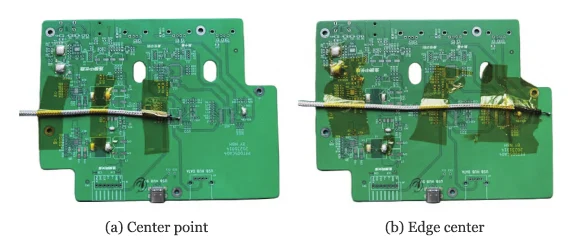
Engineers select measurement points at the center and the edge center of the bare PCB.
They record temperature readings once every 10 seconds, capturing a complete oven temperature profile across the preheating zone, reflow zone, and cooling zone.
(4) Optimization Scheme Test Data
Engineers establish thirteen sets of optimization schemes for different temperature zones (Table 1).
They record key parameters for each scheme, including soldering time, reflow zone duration, cooling rate, and final temperature.
(5) Actual Soldering Results Data
Engineers conduct actual soldering tests using scrap PCBA boards for each optimization scheme.
They inspect soldering quality visually and manually replicate capacitor detachment to intuitively verify the effectiveness of the new furnace temperature profile.
| Oven Profile | Zone 1 (°C) | Zone 2 (°C) | Zone 3 (°C) | Zone 4 (°C) | Zone 5 (°C) | Zone 6 (°C) | Zone 7 (°C) | Zone 8 (°C) |
|---|---|---|---|---|---|---|---|---|
| T13 | 140 | 180 | 200 | 260 | 120 | 160 | 200 | 130 |
| T12 | 140 | 180 | 200 | 260 | 130 | 160 | 200 | 140 |
| T11 | 140 | 180 | 200 | 252 | 140 | 160 | 200 | 150 |
| T10 | 140 | 170 | 190 | 252 | 125 | 160 | 190 | 135 |
| T9 | 140 | 180 | 200 | 250 | 135 | 160 | 190 | 145 |
| T8 | 140 | 190 | 210 | 257 | 130 | 160 | 220 | 145 |
| T7 | 140 | 190 | 210 | 260 | 135 | 160 | 220 | 150 |
| T6 | 145 | 190 | 210 | 250 | 120 | 150 | 200 | 135 |
| T5 | 145 | 190 | 210 | 257 | 130 | 150 | 210 | 140 |
| T4 | 145 | 190 | 210 | 255 | 140 | 150 | 210 | 150 |
| T3 | 140 | 180 | 210 | 255 | 150 | 150 | 210 | 150 |
| T2 | 160 | 190 | 210 | 250 | 160 | 170 | 230 | 160 |
| T1 | 145 | 175 | 220 | 250 | 170 | 165 | 220 | 170 |
| Curve 7 | 140 | 180 | 210 | 245 | 180 | 160 | 220 | 170 |
Table 1: Temperature Values for 13 Oven Temperature Profile Test Schemes
Data Analysis
This study employed various data analysis methods to systematically evaluate and optimize the furnace temperature profile:
(1) Comparative Analysis
Directly comparing the measured actual furnace temperature profile with the recommended profile to identify existing issues.
For example, it was found that the reflow zone duration was excessively long.
The duration at temperatures above 180 °C was approximately 170 s, far exceeding the recommended 40–60 s.
In addition, the cooling rate in the cooling zone was excessively slow. The cooling slope was only 2 °C/s, whereas the recommended range is 4–5 °C/s.
Engineers compare the results of different optimization schemes to identify the most suitable furnace temperature profile.
(2) Mathematical Analysis Method
Conduct a detailed zone-by-zone analysis of the measured temperature data to calculate key parameters such as heating time, peak temperature, and cooling rate.
This enables quantitative evaluation of the performance of each temperature zone.
(3) Model Development and Validation
Engineers establish a theoretical furnace temperature curve model based on the collected detailed measurement data and validate it against the actual measured data.
For example, the ideal curve requires the descent and ascent curves of the temperature peaks to be as symmetrical as possible.
By continuously adjusting the model parameters to better align with actual conditions, we ensure that the optimized furnace temperature curve enables a fast and stable welding process.
(4) Statistical Analysis and Inference
Engineers perform statistical analysis on the test results from 13 groups with different temperature settings.
They compare welding quality indicators under different schemes.
These included the duration of the reflow zone, cooling rate, and welding condition.
Statistical methods were used to determine which optimization measures significantly improved welding performance, ultimately identifying Scheme T7 as the optimal solution.
(5) Logical Reasoning and Comprehensive Evaluation
Based on a comparison of different optimization schemes, logical reasoning was applied together with the phenomenon of capacitor detachment observed in actual welding tests.
This confirmed the effectiveness of the final optimization scheme in improving welding quality.
By comprehensively considering multiple factors—including the extent of modifications, actual welding results, measured data, and production costs—the alternative schemes were evaluated.
The most suitable furnace temperature curve was ultimately selected.
In summary, through systematic experimental design and multi-faceted data analysis, this study successfully resolved the capacitor detachment issue.
It also provided an optimization solution that serves as a reference for similar equipment.
Oven Temperature Profile Measurement Results
Preliminary Measurement of the Oven Temperature Profile
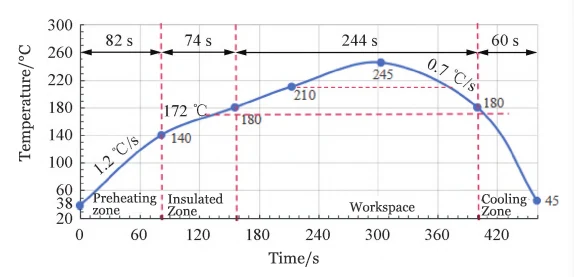
A preliminary measurement of the T-980 reflow soldering machine’s oven temperature profile 7 yielded actual data for the initial temperature profile, as shown in Figure 1.
Based on a conveyor belt speed of 170 mm/min and a total soldering time of 400 s, the actual preliminary profile was plotted using the original temperature values for each zone.
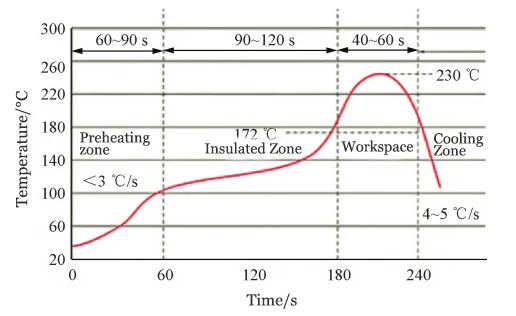
A comparison with the recommended oven temperature curve for QL-35/03 (Figure 2) and the industry-standard lead-free soldering oven temperature curve (Figure 3) reveals that the primary issues with Curve 7 include excessive dwell time in the reflow zone and an insufficient cooling rate in the cooling zone.
This indicates that the existing oven temperature curve does not fully meet optimal soldering requirements in practical applications.
Detailed Measurement Data Analysis
Curve 7 was measured in detail using a digital thermometer paired with a high-temperature Type K thermocouple probe.
The thermocouples were mounted at the center of the bare PCB and at the center of the edge, respectively, as shown in Figure 4.
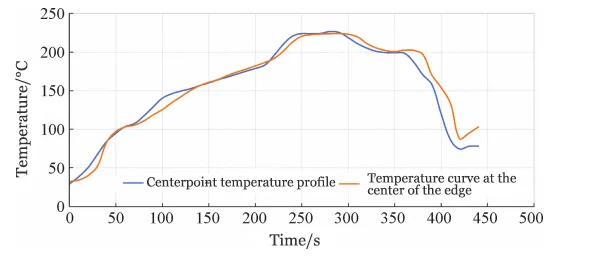
Temperature readings were taken every 10 seconds, yielding the actual oven temperature curve for Curve 7 at different locations, as shown in Figure 5.
Data analysis indicates that the duration of soldering at temperatures exceeding 180°C in the reflow zone was 170 seconds, far exceeding the 40–60 seconds recommended for the solder paste.
Prolonged exposure to high temperatures may cause component damage and excessive joint temperatures, making rapid cooling difficult.
Furthermore, the cooling rate in the cooling zone was only approximately 2 °C/s, lower than the recommended 4–5 °C/s.
The final temperature after cooling was 114 °C, significantly higher than the temperature required for solder joint solidification (around 70 °C).
These results also validate the earlier hypothesis regarding excessive time in the reflow zone and insufficient cooling in the cooling zone.
Model Development and Validation
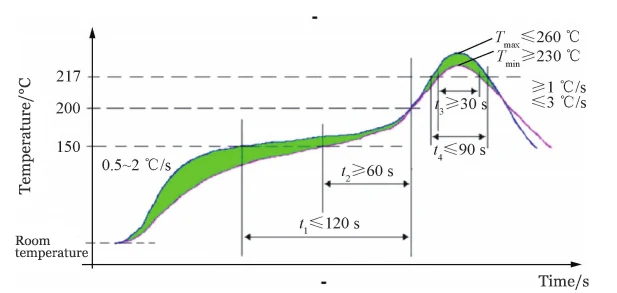
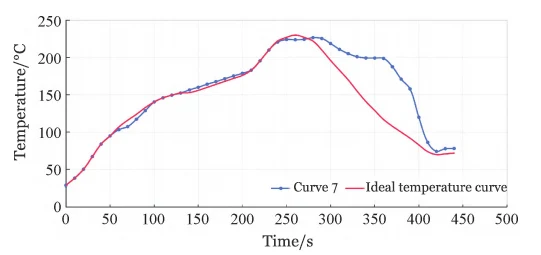
To optimize the furnace temperature profile, an ideal furnace temperature profile model was developed based on experimental data (Figure 6).
The model was validated by adjusting the belt speed and temperature values in each zone.
Increasing the belt speed shortens the runtime in the reflow zone and enhances the cooling rate in the cooling zone; lowering the temperature in the fifth zone helps improve cooling efficiency.
To ensure that the peak descent curve is as symmetrical as possible relative to the ascent curve, the temperature value for the 8th temperature zone was adjusted accordingly.
A zone-by-zone analysis of the simulated ideal furnace temperature curve model revealed that appropriately increasing the temperature setpoint for the fourth zone while simultaneously lowering the temperatures in the fifth and eighth zones yields an ideal furnace temperature curve.
This curve is relatively symmetrical, has a shorter duration, and exhibits an appropriate cooling slope.
These measures significantly improved upon the original issues.
Multiple Rounds of Testing and Optimization
To verify the effectiveness of different optimization schemes, 13 sets of distinct oven temperature profile test plans were formulated and implemented (Table 1).
The parameter settings for each set were gradually adjusted based on the results of preliminary analyses.
A comparative analysis of the reflow times and cooling conditions for each oven temperature profile revealed that the T5 and T7 temperature profile optimization schemes more closely approximate the ideal oven temperature profile (Figure 7).
Specifically, both T5 and T7 significantly reduced the time in the reflow zone and increased the cooling rate in the cooling zone.
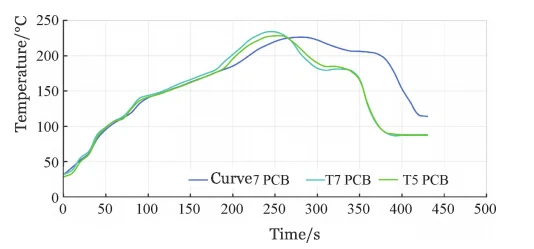
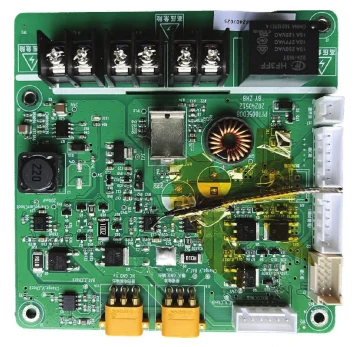
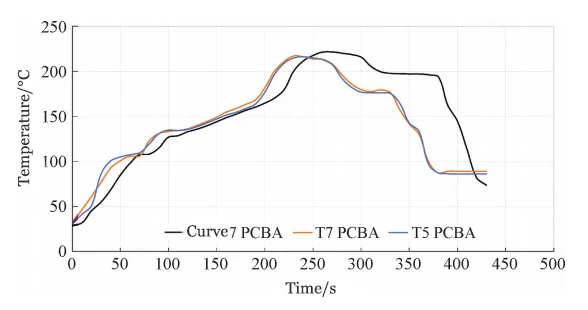
Further practical soldering tests were conducted using scrap PCBA (Figure 8), and the PCBA oven temperature profiles for Curve 7, T5, and T7 were measured under identical conditions (Figure 9).
The comparison results indicate that T5 and T7 perform similarly in actual soldering.
However, considering the extent of temperature modifications made to the original Curve 7 (Table 2), T7 was ultimately determined to be the optimal oven temperature curve modification scheme.
| Oven Profile | Zone 1 (°C) | Zone 2 (°C) | Zone 3 (°C) | Zone 4 (°C) | Zone 5 (°C) | Zone 6 (°C) | Zone 7 (°C) | Zone 8 (°C) |
|---|---|---|---|---|---|---|---|---|
| T7 | 140 | 190 | 210 | 260 | 135 | 160 | 220 | 150 |
| T5 | 145 | 190 | 210 | 257 | 130 | 150 | 210 | 140 |
| Profile 7 | 140 | 180 | 210 | 245 | 180 | 160 | 220 | 170 |
Table 2: Temperature Values of Each Zone for Profiles 7, T5, and T7
Verification of Actual Soldering Results
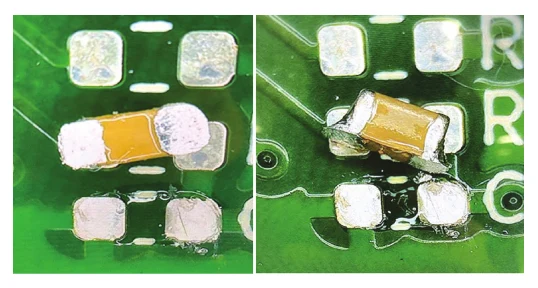
Through visual inspection and comparative tests involving manual reproduction of capacitor detachment using both T7 and Curve 7, the soldering results were satisfactory under the T7 temperature profile, with no instances of capacitor detachment observed.
However, capacitor detachment was successfully reproduced under Curve 7 (Figure 10).
These results clearly support the hypothesis that fine-tuning the temperature setpoints of the eight temperature zones can effectively resolve the capacitor detachment issue.
Through detailed testing and data analysis, T7 was ultimately confirmed as the optimal furnace temperature curve modification scheme.
Conclusions and Outlook
By systematically optimizing the oven temperature profile of the T-980 reflow soldering machine, this study successfully resolved the issue of capacitor detachment during the soldering of small-sized panel assemblies.
The experiment employed both coarse and fine measurement methods to obtain actual data for the existing oven temperature profile (Curve 7).
This was then compared with the recommended oven temperature profile and industry standards.
The comparison revealed two key issues: excessive dwell time in the reflow zone and an insufficient cooling rate in the cooling zone.
To address these issues, 13 sets of different oven temperature curve test plans were formulated by adjusting the conveyor belt speed and temperature values in each zone.
After multiple comparative tests and practical soldering validations, T7 was ultimately determined to be the optimal improved oven temperature curve.
Looking ahead, this study suggests further exploration and development in the following areas:
(1) Expanding the Scope of Application
Although the optimized temperature profile has proven effective in resolving capacitor detachment issues on the current PCBA model, different types of circuit boards and components may have varying requirements.
Therefore, further testing is needed to verify the applicability of this solution to other scenarios.
(2) Enhancing Stability and Adaptability
Although the current optimized solution has yielded good results in a laboratory environment, its long-term stability on industrial production lines still requires evaluation.
It is recommended to strengthen durability testing, particularly performance assessments under extreme conditions such as high-temperature and high-humidity environments.
This ensures that the optimized solution meets the high standards of industrial production.
In summary, through systematic data collection, analysis, and experimental validation, this study has successfully addressed the critical issue of capacitor detachment during the soldering of small-sized panelized boards.
This not only significantly improves soldering quality but also provides enterprises with a practical and feasible technical solution.
Additionally, the study offers forward-looking recommendations for future research directions, demonstrating the scientific rigor and practical utility of this research.