PCB warping is a critical issue in modern electronics manufacturing, particularly on automated surface mount lines, where even slight deformation can cause misalignment, poor component placement, or damage to insertion machinery.
With surface mount technology advancing toward higher precision, faster speeds, and stricter flatness requirements, controlling PCB warpage has become increasingly important.
The causes of warpage are complex, arising from material properties, multilayer structures, copper pattern distributions, thermal and mechanical stresses during manufacturing, and improper handling.
Understanding these factors and implementing preventive measures is essential to ensure board flatness, assembly accuracy, and overall production efficiency.
Hazards of PCB Warping
On automated surface mount lines, warped circuit boards cause positioning inaccuracies, preventing components from being properly inserted or placed into board holes and surface mount pads.
This can even damage automatic insertion machines.
After soldering, boards with mounted components may warp, making it difficult to trim component leads flush. Such boards also fail to fit into chassis or internal sockets, making board warping a significant headache for assembly plants.
Current surface mount technology is advancing toward higher precision, faster speeds, and greater intelligence.
This places stricter flatness requirements on PCB boards, which serve as the foundation for various electronic components.
The IPC standard specifically states that PCB boards with surface-mounted devices are permitted a deformation rate of 0.75%, while PCB boards without surface-mounted devices are permitted a deformation rate of 1.5%.
In practice, to meet the demands of high-precision and high-speed placement, some electronics assembly manufacturers impose stricter warpage tolerances—such as 0.5% or even 0.3% in certain cases.
PCBs are composed of materials like copper foil, resin, and glass cloth, each with distinct physical and chemical properties.
When laminated together, residual thermal stresses inevitably form, leading to warpage.
Additionally, during PCB manufacturing processes—including high-temperature exposure, mechanical cutting, and wet processing—significant deformation can occur.
In summary, the causes of PCB warpage are complex and varied.
Minimizing or eliminating deformation resulting from material properties or manufacturing processes has become one of the intricate challenges facing PCB manufacturers.
Analysis of Causes for PCB Board Warpage
PCB board warpage requires investigation from multiple perspectives including materials, structure, pattern distribution, and manufacturing processes.
This article analyzes and elaborates on various potential causes of warpage and corresponding improvement methods.
Uneven copper coverage on a circuit board can worsen board warping and bending.
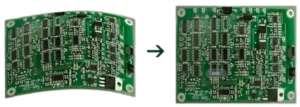
Generally, circuit boards are designed with large areas of copper foil serving as ground planes.
Sometimes, the Vcc layer also incorporates large copper foil areas.
When these extensive copper foils cannot be evenly distributed across a single board, it leads to uneven heat absorption and dissipation rates.
PCBs naturally undergo thermal expansion and contraction. If expansion and contraction occur asynchronously, differing stresses can cause deformation.
If the board’s temperature reaches the upper limit of its glass transition temperature (Tg), the board begins to soften, leading to deformation.
The connection points (vias) between layers on a PCB restrict its expansion and contraction.
Most modern circuit boards are multilayers, featuring rivet-like connection points (vias) between layers.
These connection points are categorized as through-holes, blind vias, and buried vias.
Areas with connection points restrict the board’s thermal expansion and contraction, indirectly contributing to board warping and bowing.
Causes of PCB Warping
(1) The weight of the circuit board itself can cause it to sag and warp.
Reflow ovens typically use chains to transport circuit boards through the process, supporting the entire board by its edges.
If components on the board are excessively heavy or the board dimensions are too large, its own weight can cause the center to sag, resulting in board warping.
(2) V-Cut depth and connecting strips affect panel warpage
V-Cuts are fundamentally the primary cause of structural compromise.
Since V-Cuts involve cutting grooves into large sheets of material, these areas become prone to deformation.
Effects of Laminating Materials, Structure, and Patterns on Board Deformation
PCBs are formed by laminating a core board, prepreg, and outer copper foil layers.
During lamination, the core board and copper foil undergo thermal deformation, with the deformation amount determined by the thermal expansion coefficients (CTE) of both materials.
The thermal expansion coefficient (CTE) of copper foil is approximately 17 × 10⁻⁶; for standard FR-4 substrate, the Z-axis CTE below the glass transition temperature (Tg) is (50–70) × 10⁻⁶, and above Tg it is (250–350) × 10⁻⁶.
The X-axis CTE, due to the presence of glass cloth, is generally similar to that of copper foil.
Deformation Caused During PCB Manufacturing
Deformation during PCB manufacturing arises from complex causes, primarily attributed to thermal stress and mechanical stress.
Thermal stress predominantly occurs during lamination, while mechanical stress mainly stems from stacking, handling, and baking processes.
Below is a brief discussion following the manufacturing sequence.
1. Copper-clad laminate arrival:
All copper-clad laminates are double-sided boards with symmetrical structures and no patterns.
The CTE of copper foil and glass cloth is nearly identical, so deformation due to CTE differences is virtually nonexistent during lamination.
However, the large size of laminate presses and temperature variations across different zones of the hot plate can cause slight differences in resin curing speed and degree during lamination.
Additionally, significant variations in dynamic viscosity occur at different heating rates, leading to localized stresses due to curing process differences.
Typically, these stresses reach equilibrium after lamination but gradually release during subsequent processing, causing deformation.
2. Laminating:
The PCB lamination process is the primary source of thermal stress. Similar to laminating copper-clad laminates, it also generates localized stresses due to curing variations.
PCBs, being thicker, featuring diverse pattern distributions, and containing more prepregs, experience greater thermal stresses that are more difficult to eliminate.
Stresses present in PCBs are released during subsequent processes like drilling, contour trimming, or baking, causing board deformation.
3. Solder Mask and Character Baking Processes:
Since solder mask inks cannot stack during curing, PCBs are vertically mounted in racks for baking.
The solder mask curing temperature of approximately 150°C slightly exceeds the Tg point of medium-low Tg materials.
Above the Tg point, the resin enters a highly elastic state, making the board susceptible to deformation under its own weight or due to strong oven airflow.
4. Hot Air Reflow Soldering:
For standard boards, reflow soldering occurs at a solder bath temperature of 225°C to 265°C for 3 to 6 seconds.
The hot air temperature ranges from 280°C to 300°C.
During solder leveling, boards enter the solder bath at room temperature and undergo post-treatment water washing at room temperature within two minutes after exiting.
This entire hot-air solder leveling process involves rapid heating and cooling.
Due to variations in PCB materials and structural homogeneity, thermal stress inevitably occurs during heating and cooling, leading to microscopic strain and overall warping deformation.
5. Storage:
During the semi-finished stage, PCBs are typically stored vertically in racks.
Improper rack tension adjustment or stacking during storage can cause mechanical deformation.
This effect is particularly severe for boards thinner than 2.0mm.
Beyond these factors, numerous other elements influence PCB deformation.
Preventing Warping and Deformation of PCB Boards
Circuit board warping significantly impacts the manufacturing of printed circuit boards and is one of the critical issues in the production process.
Boards with components mounted tend to bend after soldering, making it difficult to align component leads neatly.
The board cannot be installed into the chassis or internal sockets, so PCB warpage will disrupt the entire subsequent manufacturing process.
At present, printed circuit boards have entered the era of surface-mount and chip-level assembly, where manufacturing processes demand increasingly stringent warpage tolerances.
Therefore, we must identify the root causes of PCB warpage.
1. Engineering Design:
Considerations for Printed Circuit Board Design:
(1) The arrangement of prepreg layers between layers should be symmetrical.
For example, in a six-layer board, the thickness and number of prepreg layers between layers 1–2 and 5–6 should be consistent; otherwise, warping may occur after lamination.
(2) Core boards and prepregs for multilayer boards should be sourced from the same supplier.
(3) The patterned area on outer layers A and B should be as balanced as possible.
If layer A has a large copper plane while layer B carries only a few traces, the PCB will warp easily after etching.
If the patterned areas differ significantly, add isolated grids to the sparsely populated side for balance.
2. Pre-cutting Baking:
Baking laminates before cutting (150°C, duration 8±2 hours) removes moisture and fully cures the resin within the laminate, further eliminating residual stresses. This helps prevent board warping.
Currently, many double-sided and multilayer boards still adhere to this pre- or post-cutting baking step.
However, some board manufacturers make exceptions.
PCB factories currently have inconsistent baking time requirements, ranging from 4 to 10 hours.
It is recommended to determine the baking time based on the grade of the printed circuit board being produced and the customer’s warpage tolerance requirements.
Both methods—baking after cutting into panel sheets or baking the entire large sheet before cutting—are feasible.
Post-cutting baking is recommended. Inner layers should also undergo baking.
3. Orientation of Prepreg Layers:
Prepregs exhibit different shrinkage rates in the longitudinal and transverse directions after lamination.
Distinguishing these directions is essential during cutting and stacking.
Failure to do so often causes warpage in finished boards after lamination, which is difficult to correct even with pressure curing.
Much of the warping in multilayer boards stems from improper orientation of prepregs during lamination—specifically, random stacking without distinguishing between warp and weft directions.
How to distinguish between warp and weft directions?
For prepreg rolls, the direction of winding is the warp direction, while the width direction is the weft direction.
For copper-clad laminates, the long edge is the weft direction and the short edge is the warp direction.
If uncertain, consult the manufacturer or supplier.
4. Post-lamination Stress Relief:
After completing hot and cold pressing, remove the multilayer board, trim or mill off burrs, then lay it flat in an oven at 150°C for 4 hours.
This allows internal stresses to gradually release and ensures complete resin curing. This step must not be omitted.
5. Straightening for Thin Boards During Plating:
For ultra-thin multilayer boards (0.4–0.6mm) undergoing surface or pattern plating, special clamping rollers must be fabricated.
After securing the thin boards onto the flying bar in the automatic plating line, a circular rod connects all clamping rollers along the bar to straighten every board.
This prevents warping after plating.
Without this measure, plating a 20–30 micron copper layer will cause the thin boards to warp, making correction difficult.
6. Board Cooling After Hot Air Leveling:
After hot air leveling, PCBs undergo high-temperature shock from the solder bath (approx. 250°C).
Upon removal, they should be placed on flat marble or steel plates for natural cooling before proceeding to the post-processing machine for cleaning. This significantly reduces warping.
Some factories immerse boards in cold water immediately after hot air leveling to enhance lead-tin surface brightness, removing them after seconds before post-processing.
This thermal shock can cause warping, delamination, or bubbling in certain board types.
Additionally, an air-float bed can be installed on the equipment for cooling purposes.
7. Handling Warped Boards:
In well-managed factories, printed circuit boards undergo 100% flatness inspection during final quality control.
Any non-compliant boards are sorted out and placed in an oven.
They are baked at 150°C under heavy pressure for 3 to 6 hours, then allowed to cool naturally under the same pressure.
After pressure release, the boards are removed and re-inspected for flatness.
This process can salvage some boards, though certain boards may require two to three cycles of baking and pressing to achieve full flatness.
If the aforementioned anti-warping process measures are not properly implemented, some boards will remain warped even after baking and pressing and must be scrapped.
PCB Warpage Standard
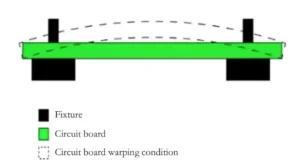
PCB warpage essentially refers to the bending of a circuit board.
It describes the phenomenon where a originally flat circuit board exhibits slight upward curvature at either end or in the middle when placed on a surface.
This phenomenon is termed PCB warpage within the industry.
PCB warpage calculation formula: Place the PCB flat on a table with all four corners touching the surface.
Measure the height of the arched section at the center. The calculation is: Warpage = (Arched height / PCB long side length) × 100%.
Industry standard for PCB warpage: According to IPC-6012 (1996 Edition) “Specification for Qualification and Performance of Rigid Printed Circuit Boards,” the maximum allowable warpage and twist for manufactured PCBs ranges from 0.75% to 1.5%.
Due to variations in manufacturing capabilities across facilities, control requirements for PCB warpage differ.
For standard double-sided multilayer PCBs with a thickness of 1.6 mils, most PCB manufacturers control warpage between 0.70-0.75%.
Many SMT and BGA boards require warpage within 0.5%, while some factories with superior process capabilities can achieve standards as low as 0.3%.
How to Prevent PCB Warping During Manufacturing
① Layers should be arranged symmetrically with consistent prepreg thickness and quantity.
For a six-layer board, layers 1-2 and 5-6 must have identical prepreg thickness and sheet count.
② Core boards and prepregs for multilayer PCBs should be sourced from the same supplier.
③ The patterned area on outer layers A and B should be as close as possible.
When layer A has a large copper plane and layer B has only a few traces, warping is likely to occur after etching.
Preventing PCB Warpage
1. Engineering Design:
– Align prepreg layers symmetrically;
– Use prepregs from the same supplier for core and laminate layers;
– Minimize differences in C/S pattern area on outer layers; independent grids may be employed.
2. Pre-cutting Curing:
Typically 150°C for 6–10 hours to remove moisture, fully cure resin, and eliminate internal stresses.
Curing is mandatory before cutting—for both inner layers and double-sided boards!
3. Prior to Multilayer Lamination, Note the Orientation of Prepreg Weft and Warp Directions:
Different shrinkage ratios exist for weft and warp. Distinguish these directions before cutting and stacking prepregs.
Core board cutting should also consider weft/warp orientation. Typically: Prepreg roll direction is weft;
Copper cladding length direction is warp; 10-layer 4OZ power board with thick copper
4. Post-lamination stress relief:
Cold press after lamination, trim burrs.
5. Pre-drilling oven baking:
150°C for 4 hours.
6. Avoid mechanical brushing for thin boards; chemical cleaning is recommended.
Use specialized fixtures during plating to prevent board bending or folding.
7. After hot-dip tinning, allow boards to cool naturally to room temperature on flat marble or steel plates, or cool in an air-float bed before cleaning.
Conclusion
Preventing PCB warpage requires a holistic approach encompassing engineering design, material selection, manufacturing processes, and handling procedures.
Symmetrical layer arrangements, pre-cutting and post-lamination stress relief, careful orientation of prepreg layers, controlled baking and cooling, and proper fixture use during plating are all critical to minimizing deformation.
Adhering to industry standards and implementing precise process controls can significantly reduce warpage, ensuring that PCBs meet the flatness requirements necessary for high-speed, high-precision surface mount assembly, ultimately improving product quality and manufacturing reliability.