With the rapid advancement of microelectronics technology, electronic products continue to evolve toward lighter, thinner, shorter, and smaller designs.
The high-density interconnections and fine-line PCB designs required for compact portable systems compel designers to continually reduce routing space and via sizes while increasing the number of board layers to achieve all necessary connections.
Correspondingly, printed circuit boards face challenges of high precision, fine-line capabilities, and high density.
To enable printed circuit boards to perform more functions, microvia technology has gained widespread adoption.
Microvias are typically defined as blind vias with apertures smaller than 100 microns or even below 50 microns.
Compared to holes drilled using traditional mechanical methods, microvias allow designers to increase board interconnection density.
In certain applications, they can even reduce the number of signal layers and traces on the board, enhancing functionality while lowering costs.
Blind vias have long been regarded as the most reliable interconnection method.
However, with their extensive adoption in high-density interconnect PCBs, reliability issues associated with blind via interconnections have increasingly surfaced.
Failures in interconnections caused by blind vias occur both post-assembly and during product operation.
This article analyzes multiple historical cases of PCB functional failures, focusing particularly on those caused by blind vias.
It examines root causes and provides summaries, aiming to offer reference suggestions for PCB process control to reduce the occurrence of similar defects.
Main Types of Blind Holes in HDI Boards
Based on the board’s laminate structure, blind holes are primarily categorized as follows:
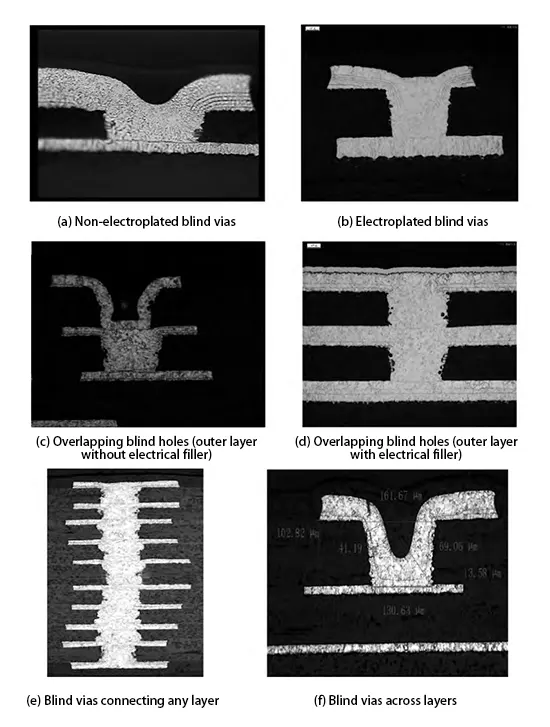
(1) Standard single-layer blind vias. Outer layer blind vias can be categorized as plated-through or non-plated-through based on customer requirements, as shown in Figure 1(a) and (b).
(2) Blind vias in double-layer and multi-layer boards. Inner-layer blind vias at stacked hole locations require plating-through, as shown in Figures 1(c) and (d).
(3) Blind vias for interconnections on any layer, see Figure 1(e).
(4) Cross-layer blind vias (e.g., 1-3 layer blind vias), see Figure 1(f).
Regardless of the layer location, severe defects in blind vias may cause functional failure of the PCB.
Types of Soldering Failures Caused by Blind Via Defects in HDI Boards and Analysis of Failure Causes
Blind via defects primarily lead to the following types of PCB functional failures: open circuits, short circuits, and solder blowouts.
Specific case studies will be used below to provide a detailed analysis.
Open Circuit
1. Open Circuit Caused by Inner Layer Interconnect Separation
Figure 2 shows an open circuit occurring after PCB assembly.
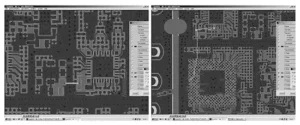
Using a multimeter, an open circuit was confirmed between R600 and U700 Pin 7, as well as between U800 Pin 5 and U500 A10. The detailed network relationship diagram is shown in Figure 2.
Based on the blind hole locations indicated by the anomaly network, a cross-section analysis was performed as shown in Figure 3.
Close examination of the blind hole cross-section image reveals interconnect separation between the blind hole bottom and the inner layer connection plate, as circled in Figure 3.
Investigation revealed that the board structure was BUM1+6+1, with RCC used for lamination.
Due to its high Z-axis CTE, significant deformation occurred along the Z-axis during lead-free soldering under high temperatures.
This deformation caused the blind via to be pulled apart from the inner layer connection pad, resulting in an open circuit.
In contrast, boards fabricated with LDP (laser-drillable prepreg containing glass cloth) exhibit significantly lower Z-axis deformation during assembly.
The failure rate of blind vias is markedly lower than that of RCC boards.
Consequently, LDP is increasingly replacing RCC for board lamination and has gained widespread adoption in the industry.

2. Open Circuits Caused by Insufficient Copper Deposition in Blind Holes
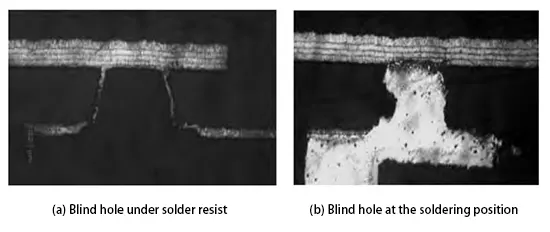
Figures 4 and 5 show cross-section images of open circuits after PCB assembly.
The cross-section analysis reveals insufficient copper plating on the blind vias of the single-sided board.
The examination shows that the copper plating under the solder mask in the blind vias is clearly deficient.
This deficiency stems from localized stacking during the electroplating process, where inadequate chemical exchange directly resulted in excessively thin copper plating.
During assembly, solder etching further compromised the copper plating, eroding the plated copper down to the point of complete copper depletion and causing an open circuit.
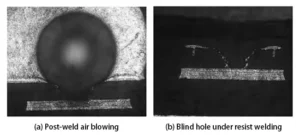
When blind via copper plating is insufficient, it can also cause solder blow after PCB assembly.
Figure 5(a) shows a cross-sectional image of a BGA solder joint exhibiting porosity after PCB assembly.
Cross-section analysis indicates that solder blow resulted from excessive plating thickness.
3. Open Circuit Caused by Insufficient Copper Thickness at Blind Hole Bottom Corners
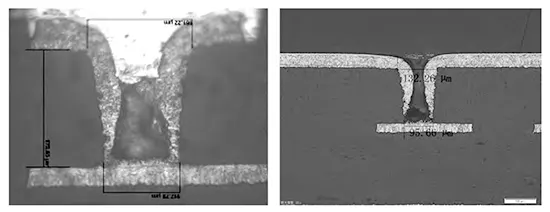
Insufficient copper thickness at blind hole bottom corners, particularly when copper is bridged at these corners (see Figure 6), can cause the bridged copper to fracture during assembly due to severe thermal shock.
This results in an open circuit after soldering.
Such bridged defects at blind hole bottoms are virtually undetectable under standard electrical testing conditions and can only be identified using specialized four-wire micro-resistance testing.
4. Multiple B-sheets Cause Blind Via Open Circuits After Soldering
The direct consequence of stacking multiple B-sheets is excessively thick dielectric layers used for lamination.
During laser ablation, even if blind vias can be penetrated, issues such as abnormal blind via dimensions and insufficient plating depth capability arise.
Consequently, insufficient copper thickness at the bottom of blind vias occurs, leading to open circuit problems in blind vias similar to those described in point 3 above.
This reliability issue stems from human operational errors and must be prevented through effective management measures and foolproofing.
Short Circuit Caused by Welding Gas
Figure 8 shows a PCB assembly where a BGA void formed after assembly, resulting in a short circuit.
Cross-section analysis indicates all blind via parameters meet relevant standards.
This type of solder blowout is often caused by unfilled blind vias on outer layers, where moisture in the vias after surface treatments like OSP fails to dry completely during baking, or by PCB board moisture absorption.
To resolve this issue, subject the board to low-temperature baking for 1–2 hours before assembly.
Post-Soldering Air Blowing
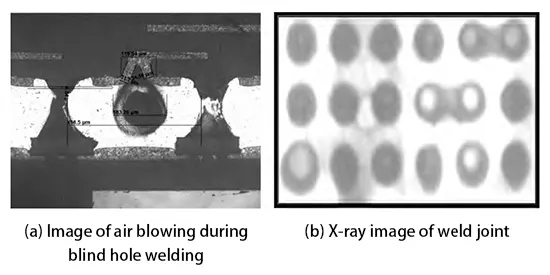
Air blowing after blind hole soldering can cause significant voids within the solder joint, a defect that reduces joint strength.
Consequently, most customers control this defect. Customers typically use X-ray equipment to inspect void area, with X-ray imaging clearly revealing the distribution of voids within solder balls.
Regarding acceptance criteria for voids, the industry lacks uniform standards.
IPC-A-610D provides preliminary definitions: Acceptable grades 1, 2, and 3 allow voids covering less than 25% of the X-ray image area of the solder ball.
However, many major international manufacturers reject this standard, imposing stricter and more demanding requirements.
For instance, IBM stipulates that BGA void area must not exceed 15%. If it surpasses 20%, it compromises joint reliability and service life.
Currently, numerous QFN devices are deployed in fiber optic communications, demanding exceptionally high void tolerance.
Consequently, controlling solder blow issues is imperative.
This discussion primarily examines cases where solder blow causes voids in BGA joints, identifies root causes, and proposes relevant solutions.
1. Blown Solder Joints Caused by Blind Hole Misalignment
Misalignment of blind holes in HDI laminate components, particularly when displaced from the bottom connection pad, frequently results in blown solder joints post-soldering.
This occurs primarily because moisture within the board evaporates through the open bottom of the blind hole during high-temperature soldering, infiltrating the solder joint and causing it to blow.
Cross-section images of misaligned blind hole pads and post-soldering blown joints are shown in Figure 9.
High-magnification observation of the blind via cross-section clearly reveals partial copper loss at the bottom, with only approximately 60% of the bottom connection pad remaining.
Misalignment is primarily attributed to positioning system issues, including layer misalignment, laser window deviation, and laser drilling inaccuracies.
2. Poor Blind Hole Filling During Electroplating Causing Solder Blow
Excessive concavity in the secondary outer layer of electroplated blind holes can cause irregular laser reflection during laser drilling, resulting in poor hole shape.
This type of blind hole defect also readily leads to solder blow, as shown in Figure 10, representing a relatively severe assembly defect.
Therefore, strict control of concavity after electroplating must be maintained for secondary outer-layer blind holes.

3. Gas Blowing in Solder Joints Caused by Secondary Outer Layer Blind Hole Leakage Filling
The direct consequence of secondary outer-layer blind hole leakage filling is poor plating on outer-layer blind holes positioned in stacked hole designs.
Without electrical filling in inner layer blind holes, the bottom connection plate for the outer layer blind holes cannot be formed.
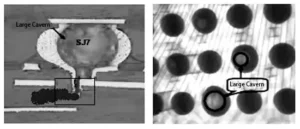
This results in a direct connection between the inner and outer layer blind holes, creating a larger cavity.
Consequently, gas blows out of the solder joint after soldering. Figure 11 demonstrates that the void in the solder joint of an abnormal blind via is nearly five times larger than that of a normal blind via.
4. Solder Ball Blowout Caused by Corner Cracks at the Bottom of Blind Holes
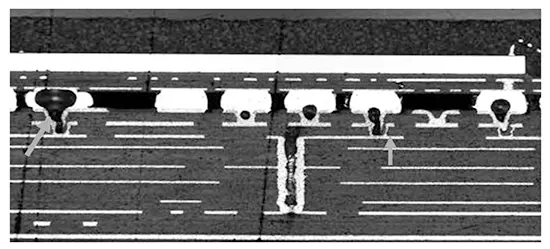
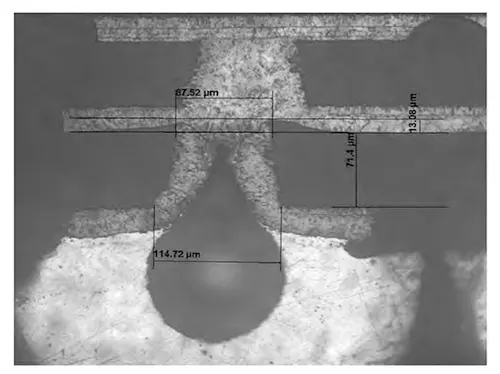
Figure 12 shows solder ball voids discovered on the BGA after PCB assembly.
Cross-section analysis revealed severe corner cracks in the outer layer blind vias.
This defect arises from relatively complex causes, primarily inadequate electroplating filling, improper horizontal plating parameters, or insufficient chemical activity.
These factors lead to poor copper deposition, ultimately causing corner cracks at the bottom of blind vias.
Such issues can be addressed by communicating with the customer to add electroplating filling for outer layer blind vias, thereby preventing recurrence.
Introduction to Visual Characteristics of Blind Via Defects
When a PCB experiences functional failure and blind vias are suspected as the cause, are there any straightforward methods for preliminary failure diagnosis?
The answer is yes. Based on insights from numerous failure cases, abnormalities in blind vias often reveal telltale signs under high-magnification inspection.
Below is a brief overview of typical blind via defects and their corresponding visual anomalies.
Misalignment Between Blind Holes and Bottom Connection Plates
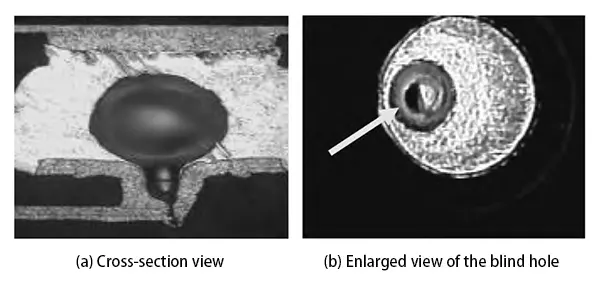
Misalignment between blind holes and bottom connection plates can cause welding blow.
For outer-layer blind holes, examination under a magnifying glass reveals defects at the bottom of the blind hole, as shown in Figure 13(b).
Blind Hole Drilling Failure
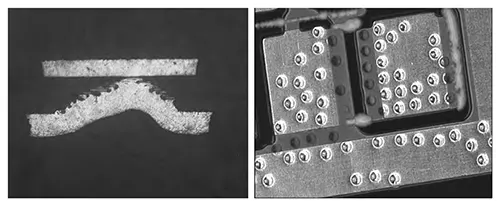
Figure 14 shows an image of a failed blind hole drill.
Visually, the blind hole profile exhibits significant abnormalities, with pronounced drill deviation.
Secondary Outer Layer Electroplating Blind Hole Fill Deviation
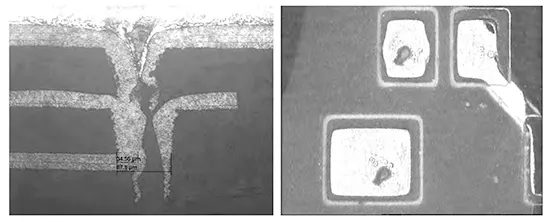
Figure 15 illustrates severe copper deviation in the secondary outer layer blind hole fill of a laminated board component, resulting in incomplete electroplating and excessive concavity.
Consequently, the outer layer blind hole PTH exhibits abnormal copper thickness.
Visually, the outer layer blind holes show pronounced tailing, as seen in the right image of Figure 15.
Resin-filled Via Surface Copper Plating with Stacked Blind Vias
Resin-filled via surface copper plating with stacked blind vias represents a novel process flow for HDI boards.
Typically, buried vias receive a relatively thin copper plating layer (approximately 10 μm).
Consequently, when laser-stacking blind vias over these buried vias, the laser energy tends to penetrate the copper plating on the resin surface.
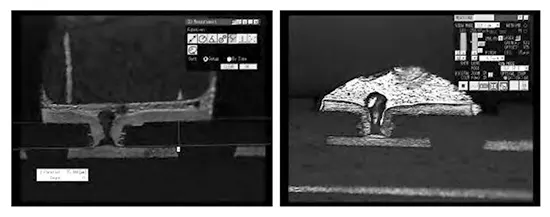
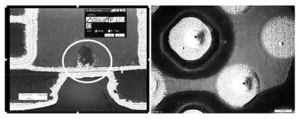
This creates a cavity at the center of the resin-filled via (where the laser pulse energy is most concentrated). as shown in Figure 16 (due to the small size of the void, the left and right cross-sections did not precisely capture the void’s center, so the blind hole bottom appears normal, but the resin-filled hole location shows distinct laser ablation marks).
Visually, a distinct void appears at the exact center of the blind hole, as shown in the right image.
For this type of resin-filled hole with surface copper plating and stacked blind holes, two improvement approaches exist: increasing the thickness of the copper plating on the resin surface, or controlling the laser drilling energy effectively.
Conclusion
The reliability of blind vias plays a pivotal role in the electronic packaging of HDI boards, warranting full attention in both PCB manufacturing and assembly processes.
By analyzing the causes of blind via failures in HDI board PCBA, we can identify the underlying mechanisms leading to such failures.
This understanding enables us to enhance PCB process control, optimize soldering techniques, and ultimately improve the reliability of BGA solder joints.
However, BGA solder joint failure analysis is a complex technical endeavor.
Only through persistent exploration and accumulated experience can the true root causes of solder joint failures be identified.