Via holes serve to interconnect circuit traces. The advancement of the electronics industry has driven the development of PCBs while imposing higher demands on printed circuit board manufacturing processes and surface mount technology.
The via hole filling process emerged to meet these requirements, which include:
(1) Copper filling within the via hole is sufficient; solder mask filling is optional.
(2) The via hole must contain tin-lead solder with a specified thickness (4 microns).
No solder mask ink should enter the hole, preventing trapped solder balls;
(3) The process must fill the via hole with opaque solder mask ink, ensuring it contains no solder rings or solder balls and meets flatness requirements.
As electronic products evolve toward “lightweight, thin, compact, and miniaturized” designs, PCBs are advancing toward higher density and greater complexity.
Consequently, numerous PCBs incorporating SMT and BGA components have emerged.
Customers require via filling during component placement primarily for five purposes:
(1) Prevent solder from penetrating through the via to the component side during wave soldering, causing short circuits.
This becomes especially critical when manufacturers place vias over BGA pads, requiring them to plug the vias and then apply gold plating to facilitate BGA soldering.
(2) Preventing flux residue from accumulating inside the vias;
(3) Enabling vacuum suction to create negative pressure during PCB testing after surface mount assembly and component placement;
(4) Preventing solder paste from flowing into the holes, which could cause cold solder joints and affect placement accuracy;
(5) Preventing solder balls from bouncing out during wave soldering, which could cause short circuits.
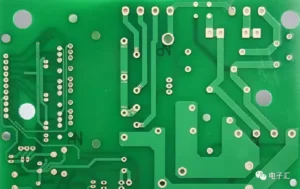
Resin plugging and electroplating plugging are the two main types of hole plugging.
Resin plugging: This method uses solvent-free ink to fill holes.
It not only addresses the common issue of conventional ink failing to fully fill holes but also reduces the risk of thermal cracking in the ink.
It is typically used for holes with larger dimensions in both width and depth.
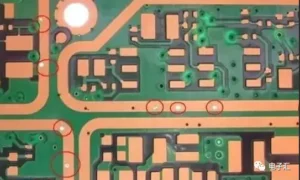
Benefits of Resin Via Plugging
1 For via plugging on multilayer BGA boards, resin plugging reduces via spacing, resolving routing and wiring issues;
2. For buried vias in inner-layer HDIs, it balances the conflict between laminating thickness control and inner-layer HDI via filling design;
3. For through-holes in thicker boards, it enhances product reliability;
4. Manufacturers often use resin via filling for PCBs with BGAs.
Traditional BGAs may route traces to the reverse side using vias between pads.
However, when high BGA density prevents viable via routing, manufacturers drill holes directly from the pads to other layers for routing.
They then fill these holes with resin and plate them with copper to form pads, a process commonly known as VIP (Via-in-Pad).
If vias are created on pads without resin filling, solder leakage can easily cause back-side short circuits and front-side solder voids.
The PCB resin via-in-pad process includes drilling, plating, filling, baking, and grinding.
After manufacturers drill the holes, they plate them through, then fill them with resin and bake them.
Next, they grind the surface flat. Since the ground resin lacks copper, they apply an additional copper plating layer to form the pad.
They complete these processes before the standard PCB drilling stage—preparing holes that require filling first, and then drilling the remaining holes according to the normal production sequence.
If the via filling is imperfect and air bubbles remain inside the hole, these bubbles readily absorb moisture.
When the board passes through the solder wave, it may cause the board to fail.
However, if bubbles form during the filling process, baking forces them out, causing one side of the board to sink while the other bulges.
Manufacturers can identify defective boards at this stage.
Boards with bubbles may not necessarily fail, as moisture is the primary cause of failure.
Therefore, boards fresh from production or those baked during assembly typically do not experience failure.
Electroplating via filling: This process utilizes additive properties to control copper growth rates in different areas for via filling.
Manufacturers primarily apply it in continuous multi-layer stacked via fabrication (blind via process) or in high-current designs.
Advantages of Electroplating Via Filling
1. Facilitates the design of stacked vias and panel vias;
2. Improves electrical performance, aiding high-frequency design;
3. Enhances heat dissipation;
3. Completes via filling and electrical interconnection in a single step;
4. Blind vias filled with electroplated copper offer higher reliability and superior conductivity compared to conductive paste.
PCB Through-Hole Plugging Process
Hot Air Leveling Post-Pluggation Process
This process sequence is: Surface Solder Mask Application → HAL → Pluggation → Curing. Production employs a non-pluggable process flow.
After hot air leveling, all conductive vias requiring plugging are filled using an aluminum stencil or ink-blocking screen.
Plugging ink may utilize photosensitive ink or thermosetting ink. This process flow ensures conductive vias retain ink after hot air leveling.
However, it may cause plugging ink contamination on the board surface, unevenness, and potential cold solder joints during component placement.
Hot Air Leveling Pre-Pluggation Process
1. Plug holes with aluminum foil, cure, grind the board, then perform pattern transfer.
This process uses a CNC drilling machine to drill aluminum sheets requiring plugging, creating a stencil for plugging.
Thermosetting ink can also be used for plugging ink due to its high hardness and excellent adhesion to hole walls.
Process flow: Pre-treatment → Via plugging → Board grinding → Pattern transfer → Etching → Surface solder mask application
This method ensures flush via plugging for hot air leveling, preventing quality issues like ink splattering or edge ink loss.
However, it requires thick copper plating in a single pass, demanding high-quality copper plating across the entire board.
2. Direct screen printing of surface solder mask after aluminum plugging
This process uses CNC drilling machines to create aluminum plugs for holes.
These plugs are fabricated into screens and mounted on screen printing machines for plugging.
After plugging, the boards are left to rest for no more than 30 minutes before applying surface solder mask directly via 36T mesh screen printing.
Process flow: Pre-treatment → Via plugging → Screen printing → Pre-baking → Exposure → Development → Curing.
This method ensures good via cover oil adhesion and flat plugged vias.
After hot air leveling, it prevents solder wetting on vias and solder ball retention inside holes.
However, it may cause ink migration onto pads after curing, leading to poor solderability.
3. Aluminum Foil Via Plugging, Development, Pre-Curing, and Board Grinding Followed by Surface Solder Mask Application
Use a CNC drilling machine to drill required via holes in aluminum foil, fabricate a stencil, and mount it on a shift screen printer for via plugging.
Plugs must be fully filled with excess material on both sides. Follow with curing and board grinding for surface treatment.
Process flow: Pre-treatment → Via Plugging → Pre-baking → Development —Pre-curing—Surface solder resist application.
This process employs plug hole curing to prevent ink loss or ink splattering in vias after HAL.
However, it remains challenging to completely eliminate solder balling in vias and solder coverage issues on through-holes after HAL.
4. Simultaneous Surface Solder Mask and Via Plugging
This method employs a 36T (43T) mesh screen mounted on a screen printer.
Using a spacer plate or pin bed, it plugs all vias while applying the surface solder mask.
The process flow is: Pre-treatment → Screen Printing → Pre-baking → Exposure → Development → Curing.
This process offers short cycle times and high equipment utilization, ensuring no solder mask loss in vias and no solder wetting in through-holes after hot air leveling.
However, air trapped within vias during screen printing expands during curing, rupturing the solder mask and causing voids and unevenness.
Conclusion
Effective via hole filling is essential for maintaining PCB reliability, manufacturability, and performance in high-density, multilayer designs.
Proper process selection—whether resin plugging or electroplating—along with optimized pre- and post-pluggation methods, ensures flatness, prevents solder defects, and supports advanced surface mount assembly.
By carefully managing material properties, plugging techniques, and curing sequences, manufacturers can minimize defects such as solder balls, voids, and ink migration, thereby improving both yield and long-term electrical performance of PCBs.