
The high-power requirements of high-power light-emitting diode (LED) lighting and automotive inverters have driven a continuous increase in the power density per unit area or volume of printed circuit boards (PCBs).
Thermal Challenges in High-Power PCB Applications
This increase has resulted in the generation of significant amounts of heat.
At the same time, high-density integration limits the space available for heat dissipation, potentially leading to congestion or blockage in heat dissipation pathways.
Prolonged exposure to high temperatures or frequent thermal cycling can accelerate physical performance issues.
These issues include product aging, structural deformation, and component damage caused by overheating.
Additionally, the product’s thermal reliability and signal transmission fidelity are severely compromised.
Advantages of Aluminum Nitride Ceramic Substrates
Aluminum nitride ceramic substrates play a unique role in supporting electronic components due to their excellent thermal conductivity, high dielectric constant, high melting point, low coefficient of thermal expansion, and insulating properties.
Therefore, incorporating locally embedded aluminum nitride ceramics into PCB thermal management designs can effectively reduce the operating temperatures of both components and the PCB, thereby extending the product’s service life.
In recent years, embedded ceramic PCB designs have garnered increasing attention and have been widely adopted by end-users in applications such as high-power LED lighting and automotive electronics.
Adhesive Overflow Issues in Mass Production
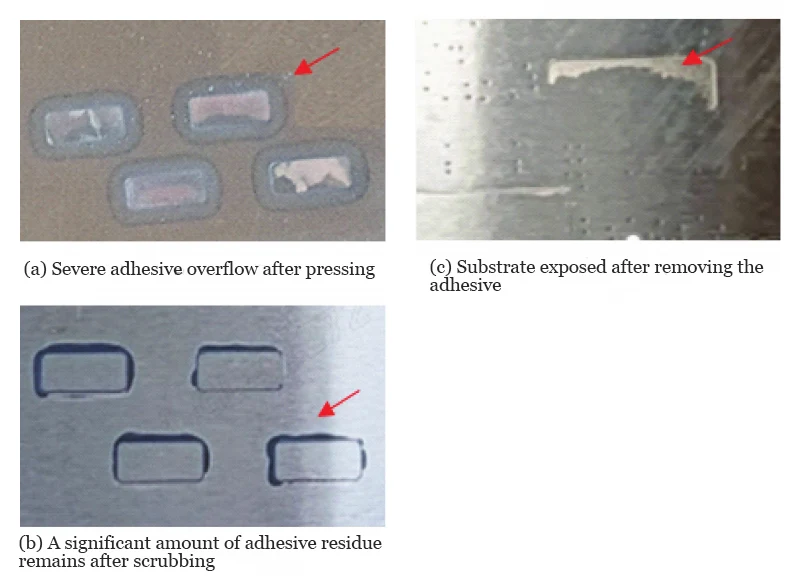
During mass production of a high-layer-count PCB with embedded AlN ceramic developed for Client A, excessive adhesive overflow was observed on the surface after the first lamination, with the issue being particularly severe, as shown in Figure 1(a).
Even after sanding both sides once with a belt sander, significant adhesive residue remained, as shown in Figure 1(b).
During the sample production phase, the excess adhesive issue can be addressed through manual sanding; however, during mass production, this method significantly impacts production schedules and product quality.
If the excess adhesive is not properly handled, it may cause the copper layer on the ceramic-clad substrate to thin, or even expose the substrate, as shown in Figure 1(c).
Therefore, precise control of the amount of excess adhesive is particularly critical.
Analysis of Adhesive Leakage Causes
Product Features
This article discusses the analysis and improvement of adhesive leakage issues in embedded aluminum nitride ceramic PCBs.
The PCB is a 14-layer board with a stack-up shown in Figure 2; the embedded aluminum nitride ceramic structure is achieved through two lamination processes.
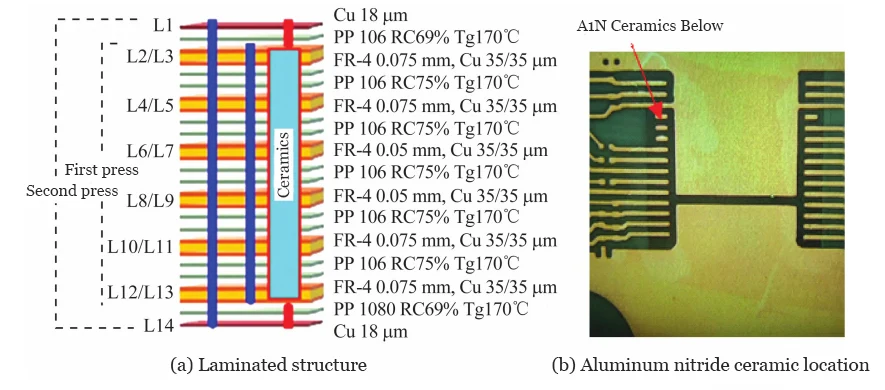
The surface metallization of the AlN ceramic substrate is completed in advance, and it is embedded during the first lamination process between layers 2 and 13 to ensure its surface aligns with layers 2 and 13.
During this process, minor adhesive overflow must meet trace flatness requirements after two rounds of mechanical grinding.
Upon completion of the second lamination, the embedded structure of the AlN ceramic substrate is realized.
In this configuration, the copper foil is interconnected with the outer copper foil via laser-drilled holes, which ensures electrical continuity.
It also rapidly facilitates chip heat dissipation by utilizing the AlN ceramic substrate as a heat dissipation path, as shown in Figure 3.
Analysis of the Causes of Adhesive Leakage
Through repeated testing using an increased number of test boards, we have ruled out the influence of operational, material, and environmental factors on adhesive leakage in this product.
Based on existing experience and relevant literature, we will conduct a further analysis from the following perspectives.
1. Effects of Thickness Differences Between PCB Substrates and Aluminum Nitride Ceramics
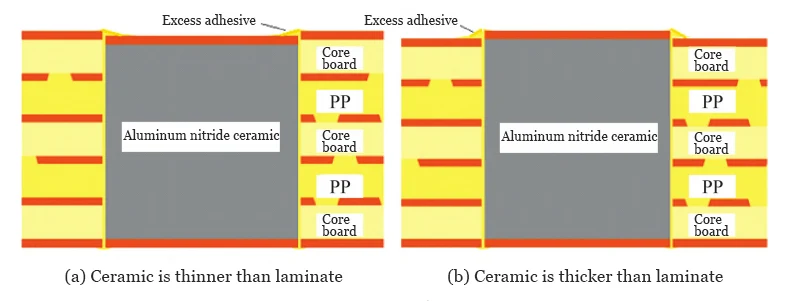
If the PCB laminate is thicker than the AlN ceramic, excess adhesive will fill the copper-clad surface of the AlN ceramic, and the thickness of the excess adhesive on both sides will be uneven, making it difficult to clean, as shown in Figure 3(a).
If the PCB laminate is thicker than the AlN ceramic, the excess adhesive will flow toward the PCB substrate, as shown in Figure 3(b).
If the thickness difference is too great, it may even cause localized pressure loss in the layers, posing significant risks to slot gap filling and reliability.
Therefore, the ideal scenario is for the PCB and the ceramic substrate to be of equal thickness.
However, the actual thickness of the PCB is influenced by factors such as copper residue rate, prepreg (PP) thickness tolerance, and laminate thickness tolerance.
2. The Effect of PCB Slot Dimensions
When aluminum nitride ceramic is placed into the slot, a gap forms between it and the substrate.
Resin is used to fill this gap, effectively bonding the ceramic to the substrate.
During the lamination process, PP flows to fill the gaps along the edges of the slot; once the slot is filled, excess resin may overflow.
Therefore, the duration and volume of PP filling along the slot edges affect the amount of PP overflow, which in turn influences the amount of resin overflow at the ceramic’s position.
3. Effect of Heating Rate on Resin Bleed
The heating rate during the lamination process determines the flow rate of the resin and affects both the filling of the cavity and the control of resin bleed at that location.
The speed of the heating rate is directly related to the volume of resin flow.
4. The Effect of Panel Layout on Solder Paste Overflow
The embedded aluminum nitride ceramic substrate consists of a core board + PP + core board laminate, bonded by solder paste flowing into the slot gaps.
Typically, a three-in-one barrier or aluminum foil is used to prevent solder paste leakage.
Additionally, to prevent PP solder paste from flowing onto the steel plate, copper foil is applied to the outer layer of the core board in the laminate.
Different panel layouts result in variations in solder paste overflow due to differences in flatness and thermal conductivity.
In summary, the primary factors affecting lamination resin overflow include the thickness matching between the PCB substrate and the AlN ceramic, the size of the PCB slots, the heating rate during the lamination process, and the panel layout.
Parameters can be optimized using an orthogonal experimental design to improve the process.
Orthogonal Design and Results
Orthogonal Design
To address the issue of adhesive overflow in PCBs with embedded aluminum nitride ceramics, an L9(34) orthogonal table was selected for the orthogonal experiment.
Factor A: Thickness difference = PCB laminate design thickness – ceramic thickness;
Factor B: Gap width = PCB internal slot length (width) – aluminum nitride ceramic length (width);
Factor C: Different lamination processes, varying the heating rate;
Factor D: Board layout methods, tested using three methods: copper foil back cover, three-in-one + copper foil back cover, and aluminum sheet + copper foil back cover.
The design of the orthogonal test factors and levels is shown in Table 1.
| Factor Level | A: Thickness Difference (mm) | B: Gap Width (mm) | C: Heating Rate (°C·min⁻¹) | D: Panel Arrangement Method |
|---|---|---|---|---|
| Level 1 (K1) | 0.05 | 0.1 | 3.0 | Three-in-one + copper foil cover |
| Level 2 (K2) | 0 | 0.2 | 2.5 | Aluminum sheet + copper foil cover |
| Level 3 (K3) | -0.05 | 0.3 | 2.0 | Copper foil cover |
Table 1: Factor–Level Table
Test results were evaluated based on the amount of excess adhesive.
A sanding machine was used to sand both sides of the board once, and the number of excess adhesive spots at the ceramic locations on the board surface was counted.
Provided that the adhesive filling was complete, fewer excess adhesive spots indicated better control.
Orthogonal Experiments and Results
Nine sets of experiments were designed based on the L9(34) orthogonal array (see Table 2).
| Test No. | Lamination Design & Copper Thickness Difference (mm) | Gap Width (mm) | Heating Rate (°C·min⁻¹) | Panel Arrangement Method | Resin Overflow (points) |
|---|---|---|---|---|---|
| 1 | 0.05 | 0.1 | 3.0 | Three-in-one + copper foil cover | 43 |
| 2 | 0.05 | 0.2 | 2.5 | Aluminum sheet + copper foil cover | 39 |
| 3 | 0.05 | 0.3 | 2.0 | Copper foil cover | 30 |
| 4 | 0 | 0.1 | 2.5 | Copper foil cover | 17 |
| 5 | 0 | 0.2 | 2.0 | Three-in-one + copper foil cover | 13 |
| 6 | 0 | 0.3 | 3.0 | Aluminum sheet + copper foil cover | 10 |
| 7 | -0.05 | 0.1 | 2.0 | Aluminum sheet + copper foil cover | 36 |
| 8 | -0.05 | 0.2 | 3.0 | Copper foil cover | 30 |
| 9 | -0.05 | 0.3 | 2.5 | Three-in-one + copper foil cover | 29 |
| K1 | 112 | 96 | 83 | 85 | — |
| K2 | 40 | 82 | 85 | 85 | — |
| K3 | 95 | 69 | 79 | 77 | — |
| R | 72 | 27 | 6 | 8 | — |
Table 2: Orthogonal Experimental Design L₉ (3⁴) for Embedded Ceramic Plate and Test Results
Orthogonal Array and Parameter Definitions
Here, L denotes the orthogonal array code, the subscript 9 indicates the number of experiments, the number 3 in parentheses represents the number of factor levels, and the superscript 4 denotes the number of columns.
In the data analysis, K1, K2, and K3 represent the mean values of the experimental results for the laminate design, ceramic thickness difference, gap width, and heating rate levels, respectively.
R is the difference between the maximum and minimum values of the K values in each column.
Materials and Process Control Variables
The materials used were 0.1 mm FR-4 substrates measuring 470 mm × 415 mm and 1.5 mm thick aluminum nitride ceramic substrates (see Figure 1) .
Corresponding to the test numbers in Table 2, the thickness match between the PCB and the ceramic was controlled by adjusting the core board thickness and the resin content of the PP between L7 and L8.
The gap width was controlled via the dimensions of the inner-layer milled grooves, the heating rate was varied by selecting different lamination programs, and the panel layout was differentiated by including auxiliary materials such as three-in-one laminates, aluminum sheets, and copper foil.
Post-Lamination Processing and Inspection
After lamination, the test boards were processed twice in a wire-brushing machine to remove residual adhesive.
The boards were inspected for adhesive overflow; those with no overflow were deemed “OK,” while those with residual overflow were recorded as defective.
A line width gauge was used to measure the width of the overflow, and production data for the corresponding board numbers was collected and analyzed.
Panel Layout Methods and Main Effects Analysis
The “three-in-one + copper foil reverse cover” was set as the first layout method; the “aluminum sheet + copper foil reverse cover” was set as the second layout method; and the “copper foil reverse cover” was set as the third layout method.
This yielded a main effects plot for the amount of excess adhesive, as shown in Figure 4.
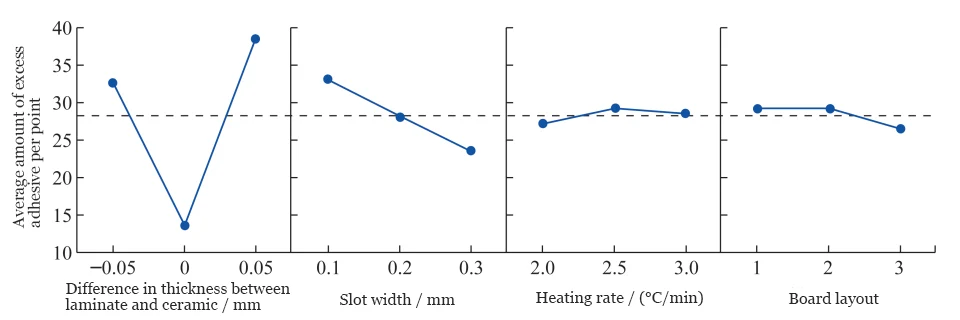
The test results indicate that the order of influence of the factors is A > B > D > C.
K-Value Analysis and Optimal Combination
Based on the K-value analysis (where a smaller K-value is better), the interaction effects of factors A2B3C3D3 were not observed in the nine experiments.
However, since the R-values for factors C and D were significantly lower, Experiment 6 (combination A2B3) can be considered the optimal result among the nine experiments.
Based on the evaluation criterion of excess adhesive volume in Test 6, its value of 10 is also the smallest.
Further analysis of variance (ANOVA) was performed on the results of this test, with factor C treated as an error term; the ANOVA results are shown in Table 3.
| Factor | Sum of Squares (S) | Degrees of Freedom (f) | Mean Square (M) | F Value | Contribution (%) | Significance |
|---|---|---|---|---|---|---|
| A | 944.22 | 2 | 472.11 | 151.75 | 86.93 | ** |
| B | 121.55 | 2 | 60.78 | 19.54 | 11.19 | * |
| C (Error Term) | 6.22 | 2 | 3.11 | 1.00 | 0.57 | — |
| D | 14.22 | 2 | 7.11 | 2.29 | 1.31 | — |
Table 3: Variance Analysis Results of Buried Ceramic Via L₉ (3⁴) Orthogonal Experiment
ANOVA Interpretation
In Table 3, the sum of squares (S) quantifies the total magnitude of data variation by summing the squares of the differences in the experimental results.
The degrees of freedom (f) reflect the number of independent data points used to calculate the sum of squares, and the mean square (M) is the ratio of the sum of squares to its corresponding degrees of freedom.
This represents the average amount of variation, eliminates the influence of differences in degrees of freedom, and facilitates direct comparison of variation from different sources.
The F-value is the ratio of the mean square of the factor to the mean square of the error, used to test the significance of the factor’s effect.
According to the F-test table, F0.05 (2, 2) = 19.0 and F0.01(2, 2) = 99.0.
Key Factor Influence and Engineering Insights
Examination of the ANOVA table reveals that factor A has a highly significant effect on the adhesive overflow results, while factor B exhibits a significant effect.
Specifically, during the lamination process of embedding aluminum nitride ceramics, the most significant factor affecting the amount of excess adhesive is the compatibility of PCB thickness.
That is, the better the match between PCB thickness and ceramic thickness, the smaller the amount of excess adhesive.
Secondly, the width of the slot gap also has a significant impact on the amount of excess adhesive.
The experiments show that as the slot gap width gradually increases, the amount of excess adhesive decreases.
Process Optimization Recommendations
However, in actual production, an excessively wide slot gap can lead to insufficient adhesive.
Therefore, the selection of the slot gap width should comprehensively consider factors such as the number of PP layers in the stackup, the residual copper rate of the inner layers, copper thickness, and board thickness to determine the actual optimal value.
Experiments revealed that the optimal slot gap width is 0.3 mm.
It should also be noted that the lamination heating rate and stacking method have a relatively minor impact on the excess adhesive results.
Typically, the heating rate during the stacking process is controlled at approximately 2 °C/min.
For ease of operation, mass production employs the copper foil reverse-covering method, which is easy to implement.
Verification of Improvement Results
Based on the results of the orthogonal experiment, embedded aluminum nitride ceramic plates were fabricated.
The intermediate PP layer in the PCB stack-up design was adjusted according to the measured ceramic thickness to ensure that the difference between the stack-up design thickness and the ceramic thickness was controlled within 0.01 mm.
At the same time, the PCB was manufactured with a difference of 0.3 mm between the length of the internal slots and the ceramic length, in accordance with design requirements.
Lamination Outcome and Surface Quality
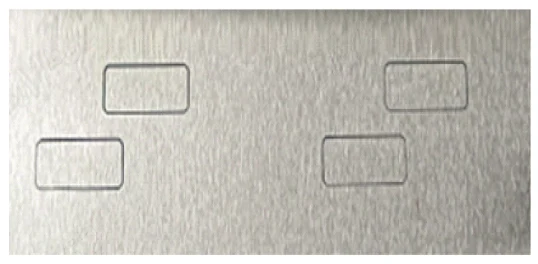
After lamination, the board surface was flat.
The excess adhesive at the ceramic locations was completely removed after two rounds of wire-polishing, achieving the expected results, as shown in Figure 5.
Reliability Verification
After the aluminum nitride ceramic plates were embedded, reliability tests were conducted as required, and all results met the specifications.
The relevant test results are shown in Table 4.
| No. | Test Item | Test Method & Standard | Test Result |
|---|---|---|---|
| 1 | Thermal Shock Test | -40 ~ 125 °C; transition time: 30 min / 10 s / 30 min; 1000 cycles; resistance change rate ≤ 10%; cross-section inspection after test for cracks and delamination | Pass; resistance change rate: 3.55%–6.71%; cross-section shows no cracks or delamination between substrate and copper |
| 2 | Conductive Anodic Filament (CAF) Test | Temperature: 85 °C; Humidity: 85% RH; Bias voltage: 100 V; Duration: 500 h; Requirement: insulation resistance > 100 MΩ | Pass; insulation resistance: 4,360–8,670 MΩ |
| 3 | High Temperature Storage Test | Test condition: 125 ± 2 °C for 1000 h; cross-section inspection; no resin voids, delamination, or copper cracks | Pass; no resin voids, no delamination, no copper cracks |
| 4 | Delamination Time Test | Initial temperature: 30 °C; heating rate: 10 °C/min; ramp to 260 °C and hold until failure; standard: delamination time > 10 min | Pass; no delamination observed after 70 min |
| 5 | Dielectric Withstand Voltage Test | Ramp from 0 V to 1000 V DC at 100 V/s; hold for 30 s; standard: no surface flashover, air breakdown, interlayer breakdown, or arcing | Pass; no surface leakage, air breakdown, interlayer breakdown, or arcing observed |
Table 4: Reliability Test of Buried Aluminum Nitride Ceramic PCB
Conclusion
As the demand for high power and high current continues to grow, PCBs with embedded or integrated ceramic materials—which offer superior thermal conductivity—are expected to see increasingly widespread application.
This paper provides an in-depth analysis of how factors such as thickness matching, slot dimensions, heating rates, and panel layout affect the amount of adhesive overflow.
Furthermore, using an orthogonal experimental design method, systematic parametric experiments were conducted on factors affecting resin overflow during lamination.
By implementing an L9(34) orthogonal experimental design and performing analysis of variance on the test results, the primary factors influencing resin overflow were identified.
The optimized parameters were then validated, effectively controlling the resin overflow issue.
Reliability test results indicate compliance, enabling the successful mass production of PCBs with embedded aluminum nitride ceramics.