Electronic devices are rapidly evolving toward miniaturization, increased complexity, and flexibility, placing unprecedented demands on surface mount technology (SMT).
As a core component of SMT, the quality of solder paste printing directly determines the reliability of mounted components.
Limitations of Conventional Solder Paste Printing Methods
Screen printing and inkjet printing are currently the most common methods for preparing solder paste.
Although screen printing is a mature technology that offers high efficiency and low cost, it suffers from low process resolution, poor flexibility, and insufficient solder paste uniformity.
Furthermore, as a contact-based process, screen printing is difficult to adapt to non-planar substrates.
It is also difficult to apply to substrates with pre-mounted or pre-packaged components.
This limits its application in the preparation of solder paste for complex integrated structures.
Although inkjet printing offers the advantages of mask-free and digital control, enabling non-contact deposition, it has limitations such as the need for low-viscosity solder paste, susceptibility to nozzle clogging, and low efficiency.
Therefore, there is an urgent need to develop a flexible, efficient, and high-resolution non-contact solder paste preparation process.
Introduction of LIFT Technology in Solder Paste Printing
Laser-induced forward transfer (LIFT) technology, with its high efficiency, high resolution, and non-contact advantages, holds broad prospects for application in solder paste printing.
In 2015, Mathews et al. utilized LIFT technology to successfully achieve solder paste printing with a 50-micrometer diameter.
Engineers first sequentially coat a silver sacrificial layer and a target solder paste layer on a donor substrate, then apply laser irradiation.
Makrygianni et al. further systematically investigated the influence of sacrificial layer properties, laser energy density, solder paste thickness, transfer gap, and substrate material properties on jetting velocity and transfer morphology.
They found that a smaller transfer gap effectively suppresses solder paste splatter.
They also found that increasing the film thickness requires a corresponding increase in laser energy density.
Shan et al. conducted an in-depth investigation into the physical mechanisms of laser-induced solder paste transfer.
They point out that a threshold transfer gap exists, and that this threshold is influenced by both the laser spot size and the solder paste film thickness.
Research has confirmed that LIFT technology can achieve precise single-point solder paste transfer under a 130-micrometer transfer gap.
Challenges and Proposed Solution
Consequently, achieving solder paste transfer printing at larger gaps remains a current challenge.
This study proposes a voxel-based laser-induced solder paste transfer method to enable laser-driven solder paste transfer under large gaps.
Engineers systematically investigate the effects of parameters such as nanosecond pulsed laser energy and spot size on solder paste jetting behavior and establish a process window for solder paste jetting.
Engineers perform large-area solder paste array laser jetting to evaluate the positional accuracy of solder paste printing at different gaps, thereby fabricating solder paste arrays on PCB pads.
Method
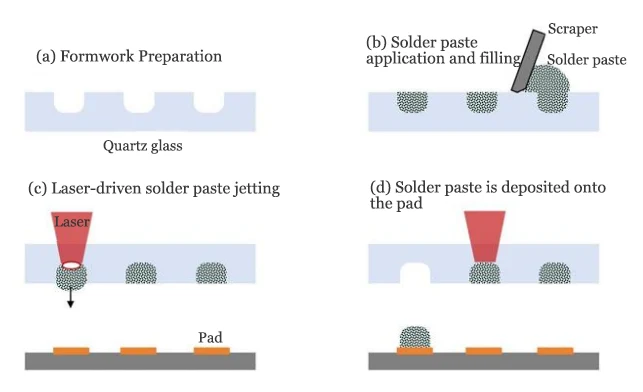
The principle of the voxel-based laser-induced solder paste transfer printing method is shown in Figure 1.
Engineers first etch a template with U-shaped recesses onto the surface of a quartz glass substrate.
Next, they fill the micro-pits with solder paste using a squeegee technique to ensure uniform filling of the template cavities.
They then invert the template and focus a pulsed laser beam through the quartz glass onto the solder paste within the grooves.
This causes the flux in the solder paste to volatilize, forming high-pressure vapor that expands and propels the solder paste downward. At the same time, engineers align the PCB pads with the laser beam so the ejected solder paste is deposited onto the pad surfaces.
By controlling pulsed-beam scanning via a galvanometer, they achieve efficient array printing of the solder paste.
The voxel-based laser-induced solder paste transfer printing method offers the following three advantages.
1) Large-Gap Solder Paste Transfer via Voxel-Based Deposition
Engineers achieve large transfer gaps by performing voxel-based solder paste transfer, in which the solder paste is peeled off the stencil as a viscous material under laser irradiation.
They then deposit it via free fall, eliminating the need for liquid bridge transfer and removing the limitation on maximum transfer distance.
2) High material utilization:
During the voxel-based solder transfer process, laser irradiation causes the solder paste to separate almost completely from the stencil.
It forms a viscous substance with virtually no residue. This results in nearly 100% material utilization.
3) High consistency:
The voxel-based solder transfer process achieves nearly complete transfer of solder paste from the stencil to the recipient substrate under laser irradiation.
It also achieves consistent volume deposition across the entire array.
Experimental System
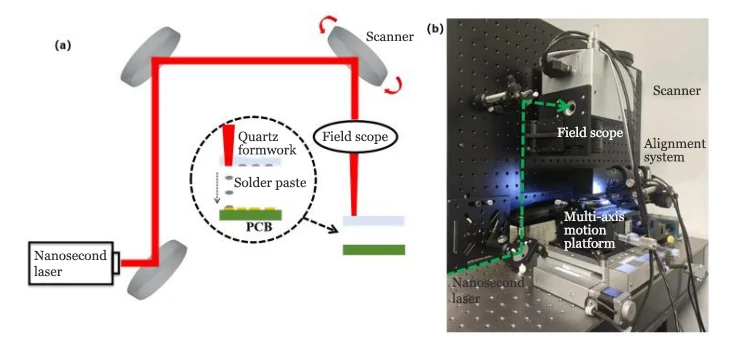
The experimental setup for solder paste transfer is shown in Figure 2. The system comprises a nanosecond laser source, an f-theta lens, an alignment system, and a multi-axis translation stage.
The nanosecond laser (FORMULA-D) generates a pulsed laser beam with a pulse width of 75 ns, a wavelength of 532 nm, a maximum pulse energy of 3 mJ, and a repetition rate of 4 to 10 kHz.
Engineers focus the laser beam using an f-theta lens, producing a spot size of 60 µm at the focal plane and achieving a scanning speed of up to 5 m/s.
They use two clamping devices equipped with multi-axis translation stages to independently secure the donor quartz template and the receiving PCB substrate.
Combined with the alignment system, this setup enables precise alignment between the laser beam, the dimples on the donor template, and the pads on the receiving substrate, as well as control of the transfer gap.
Materials and Stencil Preparation
Engineers conduct laser-driven solder paste jet printing experiments in an air environment and select fused silica glass as the stencil material.
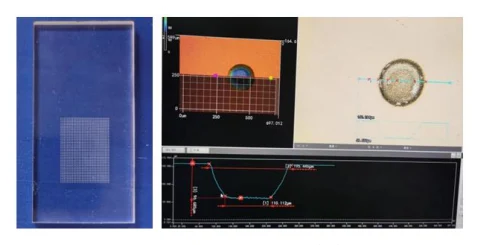
They laser-etch a 3-mm-thick glass plate to create three types of pit stencils: 200 μm in diameter and 90 μm in depth; 250 μm in diameter and 110 μm in depth; and 300 μm in diameter and 140 μm in depth.
They use Type 7 solder paste as the printing material, with a particle size range of 2 to 11 µm.
The laser spot size was identical to the pit diameter.
Engineers clean the stencil and then use a blade to repeatedly apply Type 7 solder paste in a single direction across the surface until the pits are fully filled and no solder balls remain on the glass surface.
Results and Discussion
The laser power density determines the magnitude of the driving force exerted on the solder paste and is a key factor in determining the solder paste transfer efficiency.
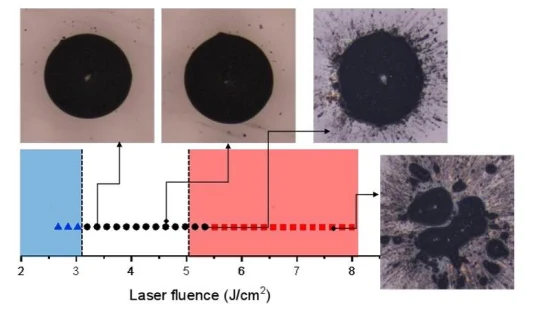
The deposition and donor patterns of the solder paste at different laser power densities are shown in Figure 4.
Engineers use a stencil with a 200 µm diameter and a 90 µm depth in the experiments.
They vary the laser energy flux density between 2.0 and 8.5 J/cm² while maintaining a constant transfer gap of 300 µm.
At a laser energy flux density of 3 J/cm², laser irradiation caused the solder paste to partially peel away from the stencil, forming a raised morphology, but it was not successfully transferred to the substrate.
Increasing the energy to 3.5 J/cm² resulted in complete transfer, forming a clear circular solder paste deposit on the substrate with a larger diameter and lower height compared to the dimple dimensions.
Engineers achieve complete transfer at 5.0 J/cm², with no significant changes in deposition morphology, spatter, or droplet fragmentation.
However, when the energy reached 5.3 J/cm², excessive energy caused spatter, resulting in debris and satellite droplets.
Further increasing the laser energy to 7.7 J/cm² resulted in severe spatter, depositing only tiny satellite droplets and fragments.
Therefore, the energy range for laser-driven spatter-free solder paste deposition is 3.5 to 5.0 J/cm².
Deposition Quality and Reflow Performance
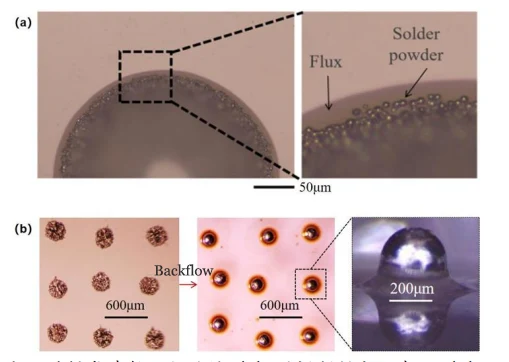
Observation of the solder paste deposition morphology on the receiving substrate is shown in Figure 5a.
Engineers observe that the tin balls remain intact, with no signs of fragmentation or melting, and that the flux is largely retained during the laser-driven transfer process without significant evaporation.
As a result, they maintain the solderability of the paste after laser-driven transfer printing.
They then conduct further reflow analysis to determine whether flux evaporation caused by laser transfer affects subsequent reflow performance.
After heating and reflow soldering the laser-printed solder paste at 200 °C for 5 minutes, they obtain the results shown in Figure 5b.
It can be seen that after thermal reflow, the solder paste successfully reflowed into balls.
Engineers therefore preliminarily conclude that the loss of flux content caused by laser printing does not affect the subsequent reflow soldering performance of the solder paste.
Influence of Stencil Geometry on Droplet Size
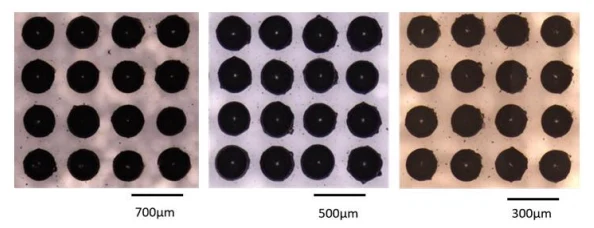
Engineers vary the dimensions of the etched grooves on the quartz glass surface, thereby changing the volume of filled tin paste and producing tin paste droplets of different sizes.
As shown in Figure 6, they use pit array templates with dimensions of 300 μm in diameter and 140 μm in depth, 200 μm in diameter and 90 μm in depth, and 120 μm in diameter and 60 μm in depth.
Engineers prepare solder paste arrays of 350 μm, 250 μm, and 150 μm in size, respectively, and observe that the required laser power density decreases gradually.
Consequently, the laser-driven solder paste jet printing process offers a wide range of applications and can accommodate the preparation of solder paste in a broad range of sizes.
Effect of Transfer Gap on Position Accuracy
The transfer printing distance is a critical parameter limiting the application of laser-driven solder paste jetting.
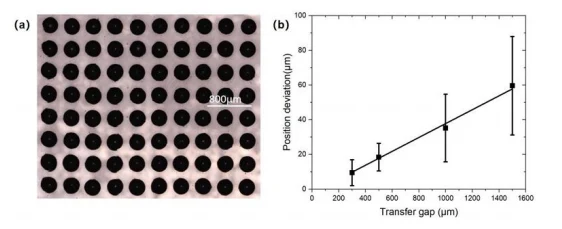
Figure 7 shows the evolution of the deviation in the landing position of the solder paste jet as the transfer gap increases from 300 µm to 1.5 mm.
Engineers perform image extraction and contour detection on photographs of the solder paste deposition array to obtain the position coordinates of each deposit in the array.
Engineers then match and process the data against the theoretical deposition position array to determine the deviation for each deposition.
As the transfer gap increased, the positional deviation increased proportionally.
When the transfer gap was 300 µm, the average positional deviation was less than 5 µm, and the maximum deviation for any single point in the array did not exceed 10 µm.
When engineers increase the transfer gap to 1.5 mm, the average positional deviation remains below 60 µm, and the maximum deviation at any single point in the array does not exceed 90 µm.
Even with a transfer gap of 1.5 mm, this process still enables complete solder paste transfer, achieving the target solder paste deposition array.
Engineers describe existing laser tin spraying methods using continuous-film solder paste, which rely on liquid-bridge transfer and limit the transfer distance to within 150 μm.
This method utilizes the constraining effect of the stencil pits on the solder paste.
It results in a relatively stable solder paste jetting process. The maximum transfer gap is more than ten times greater than that of the continuous-film solder paste process.
Large-Scale Printing Validation and Efficiency
Engineers use the aforementioned laser parameters for solder paste transfer to conduct a validation study of large-scale array solder paste jet printing with a transfer gap of 500 µm.
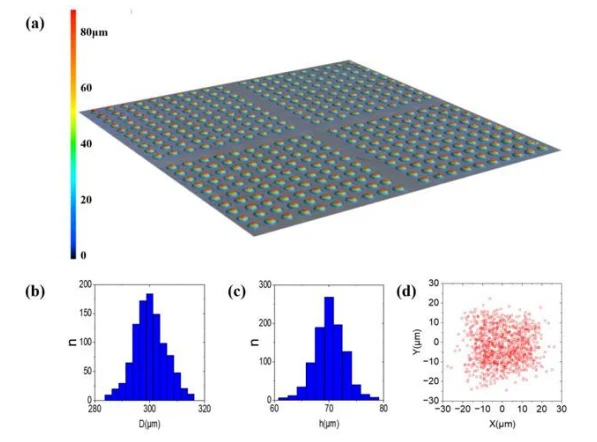
As shown in Figure 8a, they use confocal microscopy results of 400 solder paste deposits to statistically evaluate the stability and consistency of large-scale array solder paste transfer.
Figures 8b–d present statistical analyses of the dimensional and positional deviations in the large-scale array.
The experimental results indicate excellent dimensional consistency in the solder paste deposits, with a diameter distribution of 300 ± 20 µm and a height distribution of 70 ± 10 µm, both following a normal distribution.
Measurements of positional deviation also demonstrated similar high precision, with a maximum positional deviation of less than 30 µm; 95% of the deposits exhibited a deviation of 20 µm or less.
Based on the galvanometer scanning time for 400 solder paste deposits, engineers calculate the solder paste jetting deposition efficiency to be 1,600 dots per second.
This represents a significant improvement in transfer efficiency compared to traditional nozzle-based solder paste deposition methods.
Conclusion
This paper presents a voxel-based solder paste transfer method.
Engineers conduct systematic transfer experiments using stencils with different pit aspect ratios under varying laser spot sizes, laser flux, and transfer gaps.
The main experimental results are as follows:
(1) Engineers investigate the effect of laser energy on the morphology of solder paste jetting and establish a process window for solder paste deposition.
(2) Laser-driven solder paste deposition results in minimal flux loss, thereby having a negligible impact on subsequent reflow.
(3) The voxel-based solder paste transfer method achieved a maximum transfer distance of 1.5 mm and a transfer rate of 1,600 dots per second.