Driven by the need to “streamline processes, reduce costs, and minimize pollution,” an increasing number of electronic soldering operations are adopting “no-clean” post-soldering processes.
However, if “solder balls” appear on the board surface after soldering, the “no-clean” requirement cannot be met; therefore, preventing and controlling “solder balls” is particularly critical during the implementation of “no-clean” processes.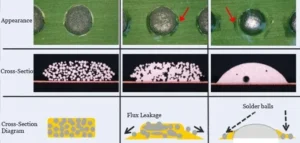
Impact of Solder Balls
“Solder balls” not only affect the appearance of board-level products, but more seriously, due to the high component density on printed circuit boards, they can cause short circuits during use, thereby compromising product reliability.
Considering the entire electronic soldering landscape, the processes where “solder balls” are likely to occur primarily include:
SMT surface mount soldering, wave soldering, and manual soldering.
This article will explore the causes of “solder balls” and their prevention and control methods from these three perspectives.
Since wave soldering and manual soldering have been in use for many years, with their processes well-established, this article will focus primarily on the causes of solder balls and the corresponding prevention and control measures in the SMT surface mount soldering process.
Driven by the need to “streamline processes, reduce costs, and minimize pollution,” an increasing number of electronic soldering operations are adopting “no-clean” post-soldering processes.
However, if “solder balls” appear on the board surface after soldering, the “no-clean” requirement cannot be met; therefore, preventing and controlling “solder balls” is particularly critical during the implementation of “no-clean” processes.
“Solder balls” not only affect the appearance of board-level products, but more seriously, due to the high component density on printed circuit boards, they can cause short circuits during use, thereby compromising product reliability.
Considering the entire electronic soldering landscape, the processes where “solder balls” are likely to occur primarily include:
SMT surface mount soldering, wave soldering, and manual soldering.
Focus of This Study
This article will explore the causes of “solder balls” and their prevention and control methods from these three perspectives.
Since wave soldering and manual soldering have been in use for many years, with their processes well-established, this article will focus primarily on the causes of solder balls and the corresponding prevention and control measures in the SMT surface mount soldering process.
Morphology of Solder Balls and Industry Standards
Different industry standards have specific requirements for “solder balls.” The key specifications are as follows:
MIL-STD-2000 Standard: Solder balls are not permitted.
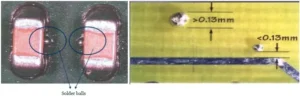
IPC-A-610C Standard: The number of solder balls must be less than 5 per square inch, and the minimum clearance must be 0.13 mm.
Solder balls with a diameter ≤ 0.13 mm are considered acceptable, while those with a diameter ≥ 0.13 mm are unacceptable and require corrective action.
IPC-A-610D Standard (Latest Version for Lead-Free Soldering):
The provision stating “fewer than 5 solder balls per square inch” has been removed, and no clearer definition of the solder ball phenomenon is provided.
Automotive and Military Product Standards: No solder balls are permitted; solder balls must be cleaned or manually removed after PCB soldering.
Photos of common solder ball shapes and sizes are shown below:
Causes of Solder Balls in the SMT Surface Mount Process and Methods for Prevention and Control
In the SMT surface mount soldering process, various factors—including reflow temperature, time, solder paste quality, print thickness, stencil fabrication, and placement pressure—can lead to the formation of solder balls.
Identifying the root causes and implementing targeted preventive measures is key to achieving a solder-ball-free board.
Solder Ball Issues Caused by Solder Paste Quality
The quality of the solder paste directly affects the likelihood of solder balls forming. The four key factors include:
1. Metal Content
The mass fraction of metal in solder paste is approximately 89%–91%, while the volume fraction is about 50%.
The higher the metal content, the more densely packed the tin powder particles are; this makes them less prone to vaporization and dispersion during melting, thereby reducing the likelihood of solder balls forming.
Conversely, a lower metal content significantly increases the probability of solder balls appearing.
2. Oxide Content
Higher oxide content increases the surface tension when the metal powder melts and fuses with the pad.
Furthermore, during the reflow soldering process, the oxide layer on the metal powder surface thickens, hindering complete wetting of the molten solder and ultimately leading to the formation of fine solder balls.
3. Metal Powder Particle Size
The metal powder in solder paste consists of extremely fine, nearly spherical particles, typically ranging from 25 to 45 μm in diameter.
Finer powders have lower oxide content, which can effectively mitigate the balling phenomenon.
4. Resistance to Thermal Collapse
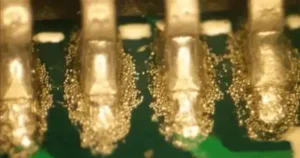
During the preheating phase of reflow soldering, if the solder paste has poor resistance to thermal collapse, the paste that has been printed and formed but not yet melted may collapse, causing some of the paste to flow outside the pad;
Upon entering the soldering zone, the solder melts, contracts into a solder joint, and wets and climbs.
If insufficient stress is present—due to factors such as a lack of flux—the paste outside the pad cannot contract, and upon complete melting, it forms solder balls.
Solder Ball Issues Caused by Improper Use
In addition to the quality of the solder paste itself, improper operation and process parameters are also major causes of solder balls.
Specifically, these can be divided into six points:
1. Unreasonable Reflow Soldering Process Parameters
The reflow soldering process consists of four stages: preheating, holding, soldering, and cooling.
During the preheating stage, the printed circuit board and surface-mount components must be slowly heated to 120–150°C to remove volatile solvents from the solder paste and minimize thermal shock.
If the preheating temperature is too high or the rate of heating is too fast, it will accelerate the vaporization of the flux, causing the solder paste to collapse or splatter, which in turn leads to solder balls.
It is recommended to use moderate preheating temperatures and rates to suppress the formation of solder balls.
1. Improper Solder Paste Printing Thickness or Quantity
Solder paste printing thickness is typically controlled between 0.15–0.20 mm.
Excessive thickness or quantity can easily cause the solder paste to collapse, resulting in solder balls.
When fabricating the stencil, apertures should be designed based on pad size; typically, controlling the aperture size to approximately 90% of the corresponding pad contact area can effectively reduce solder ball formation.
3. Excessive Placement Pressure
Excessive pressure during component placement forces the solder paste, causing some paste to be squeezed beneath the component or causing solder powder to scatter.
When soldering, this scattered solder powder melts, forming solder balls.
It is recommended to select an appropriate placement pressure to avoid excessive compression of the solder paste.
4. Insufficiently Warmed Solder Paste
Solder paste must be stored refrigerated and brought to room temperature before opening.
If opened while still too cold, moisture will condense on the paste’s surface.
During preheating, this moisture vaporizes, causing solder particles to fly out; during soldering, the molten solder splatters, forming solder balls.
Given the high humidity in China during summer, it is recommended to let the solder paste warm up at room temperature for 4–5 hours after removing it from refrigeration before opening.
5. Humid Production Environment
If printed circuit boards are stored in a damp warehouse for too long, small water droplets may form inside the packaging.
This moisture, similar to moisture absorbed by the solder paste, can affect soldering results and cause solder balls.
If conditions permit, the printed circuit boards and components should be dried before assembly, followed by printing and soldering.
6. Prolonged Exposure of Solder Paste to Air
When using solder paste, minimize its exposure to air as much as possible.
After removing a portion of the paste, immediately secure the lid tightly (pressing down the inner lid to expel air).
Failure to do so will accelerate the drying of the solder paste or cause it to absorb moisture during subsequent use, leading to solder balls.
The formation of solder balls results from the combined effect of multiple factors.
Preventive measures targeting a single step are far from sufficient; only by comprehensively avoiding adverse factors and potential hazards throughout the production process can optimal soldering results be achieved.
Measures to Prevent Solder Balling in the SMT Surface Mount Process
1. Selecting the Right Solder Paste
When selecting solder paste, it is essential to conduct trials based on your existing process conditions to verify the paste’s suitability for your products and processes and to understand its actual performance.
During evaluation, focus on key parameters such as the ratio of flux to powder and the particle size of the solder balls.
The optimal choice is a solder paste that suits your specific processes and products; it does not necessarily need to have the best values for every parameter.
Once the solder paste is selected, all parameters must be finalized and documented to serve as the basis for quality control acceptance upon delivery from the supplier.
This involves verifying written documentation and conducting trials on samples from different batches.
High-quality suppliers will provide process recommendations tailored to customer needs and will upgrade their solder paste products to address defects.
Selecting stable, reputable suppliers provides strong support for solder ball prevention.

2. Strengthening Process Control and Improvement
For the entire SMT surface mount process, strict operating procedures must be established, with a focus on the following six key points:
Storage: Store strictly in accordance with supplier requirements at a refrigerated temperature of 0–10°C;
Thawing: After removal, allow the solder paste to thaw thoroughly at room temperature; do not open the package until it has fully thawed.
SMixing: Mix the solder paste according to the methods and time specifications provided by the supplier;
Printing: Control printing pressure, keep the stencil surface clean, and promptly wipe away excess solder paste residue to prevent PCB surface contamination;
Reflow Profile: Strictly follow the established standard profile; do not adjust arbitrarily. Regularly verify profile deviations and make corrections.
Stencil Optimization: The stencil aperture design and aperture ratio affect solder paste printing and soldering characteristics, and can easily cause solder balls.
Experiments have shown that changing the 1:1 stencil aperture for surface-mount components prone to solder balls to a 1:0.75 wedge-shaped aperture can significantly reduce the probability of solder ball formation, or even virtually eliminate it.
Although solder ball prevention in the SMT surface-mount process is relatively complex, through long-term experience and process optimization, it is possible to achieve solder ball-free results or significantly reduce the probability of solder ball formation.
Causes and Prevention Methods for Solder Beads in the Wave Soldering Process
In the wave soldering process, solder beads primarily form under two conditions:
First, when the board comes into contact with the molten tin, excessive flux or moisture on the board, or insufficiently volatilized high-boiling-point solvents can suddenly vaporize upon contact with the high-temperature molten tin.
The extreme temperature difference causes the solder to spatter, forming tiny solder beads;
Second, as the PCB exits the tin bath, the pins may pull out columns of solder.
When the excess solder falls back into the tin bath, it splashes and lands on the board surface, forming solder beads.
Therefore, the prevention and control of solder beads in wave soldering primarily focuses on two key areas: flux selection and process control.
Preventive Measures Related to Flux
Flux quality issues significantly cause solder balls and mainly involve two scenarios. First, excess moisture in flux does not fully evaporate during preheating.
Second, high-boiling-point or non-volatile substances remain in flux after preheating and cannot fully remove.
In actual production, increasing the preheating temperature or slowing the board feed rate mitigates this issue.
Additionally, before selecting a flux, it is necessary to conduct process validation on supplier samples, document the standard process when solder balls do not occur, review supplier documentation, and strictly verify compliance during subsequent incoming inspection to ensure consistent flux quality.
Process-Related Prevention and Control Measures
Unreasonable process parameters can directly lead to solder ball formation, primarily resulting from four types of defects: insufficient preheating temperature, excessive conveyor belt speed, insufficient incline of the conveyor chain (or PCB surface), and excessive flux application.
Establish standardized operating procedures. Strictly calibrate all parameters.
Specific requirements are as follows:
1. Preheating Temperature
Generally set between 90°C and 110°C (Note: This refers to the actual temperature on the solder side of the PCB, not the temperature displayed on the equipment). Insufficient preheating temperature will result in solder balls after soldering;
2. Conveyor Speed
Maintain a speed of 1.1–1.4 meters per minute. Adjust the preheating temperature according to the speed. Increase the preheating temperature as conveyor speed increases to ensure sufficient flux evaporation and prevent solder balls.
3. Chain (or PCB surface) Angle
This refers to the angle between the chain and the surface of the molten solder.
Ensure that the component side of the PCB makes contact with the molten solder at a single point.
If there is no angle or the angle is too small, air bubbles will form between the molten solder and the soldering surface; when these bubbles burst, they create solder balls.
4. Air Tool Adjustment
Primarily blows away excess flux and ensures even flux distribution. The recommended angle is approximately 10 degrees.
An improper air tool angle can result in excessive or uneven flux application, which not only causes flux to drip onto the heating elements—shortening their lifespan—but also leads to “solder splattering” when the PCB enters the solder bath, resulting in solder balls.
In actual production, selecting appropriate materials based on the specific conditions of your wave soldering equipment, establishing strict “Wave Soldering Operating Procedures,” and strictly adhering to them can eliminate the solder ball issues caused by the wave soldering process.
Causes and Prevention of Solder Beads in Manual Soldering Processes
During manual soldering, the occurrence of solder beads is relatively rare.
Common issues include rosin splatter, while solder bead splatter or residual solder dross on pads may occasionally occur.
Among these, solder beads and dross pose a greater potential risk to product safety.
The first clause isn’t actually passive, but I’ll still tighten everything into active, object-minimized phrasing:
The primary causes of solder balls and residue are as follows: first, flux may completely evaporate before removing the heat source, reducing solder fluidity.
When solder adheres to the iron tip and withdraws, solder balls or residue form.
Alternatively, molten solder may accidentally splash from the iron tip and, upon cooling, adhere to the board surface or components;
Second, improper soldering techniques—such as skipping preheating and directly melting solder wire onto the joint—create excessive temperature differences and cause solder splatter and solder ball formation.
Strengthen technical training for operators and guide mastery of correct soldering time and position. Control solder quantity appropriately and clean the soldering iron tip promptly.
Establish “Manual Soldering Process Requirements” to achieve standardized and controllable manual soldering and effectively prevent the formation of solder balls.