Consumer electronics, medical equipment, and automotive electronics industries continue to pursue smaller form factors and higher levels of integration.
In response to these trends, FPCs (flexible printed circuit boards), which serve as critical interconnect platforms, now incorporate finer circuit patterns (line width/spacing ≤ 50 μm), denser routing layouts, and more intricate stepped configurations, including stacked multilayer via structures.
Process Requirements for Dry Film Filling
Such designs impose stringent requirements on the filling capabilities of dry film in the photolithography process.
First is step-over filling: the height difference between the via pads and the substrate must be fully covered by the dry film to prevent gaps or fractures after etching.
Second is line resolution: the integrity of the lines between via pads directly affects signal transmission accuracy ;
And finally, process compatibility: the dry film must be compatible with the parameters of processes such as exposure, development, and etching to ensure stability in mass production.
Material properties primarily influence dry film filling capability, including thickness and photosensitivity.
The geometry of the electroplated steps also affects performance, including step height difference and step morphology.
In addition, process parameters such as film application pressure, exposure parameters, and development speed further determine the filling capability.
However, current research on dry film filling in FPC photolithography processes remains insufficient.
Research Objectives and Methodology
This paper investigates two commonly used dry films (29 μm and 25 μm thick) and quantifies three core metrics through experiments:
(1) the resolution limit of circuits under different exposure energy and development process parameters to determine the resolution capabilities of the two dry films;
(2) The limits of the dry film’s filling capability regarding step height thresholds (using 25 μm as the boundary), revealing differences in the adaptability of dry film thicknesses to complex structures;
(3) The patterns of how process characteristics, such as lamination pressure, affect filling yield, and establishing a quantitative relationship model between process parameters and filling performance.
Dry film selection and process optimization in FPC production can directly apply the research findings.
These findings provide technical support for addressing common defects such as poor resolution and etching notches in fine-line processing, thereby improving product yield.
Experiment
Development Point Test
Development point tests determine the development line speeds corresponding to the high, medium, low, and development points of dry films A and B.
Both dry films are first applied to the surface of a pretreated substrate. After standing for 1 hour, the process passes them through the developing line at different linear speeds.
The method records the undeveloped length and calculates the development point using the formula: Development Point = Undeveloped Length / Total Length of Development Tank × 100%.
The test yielded linear speed data corresponding to three development points: 40%, 50%, and 60% (see Table 1).
| Dry Film Type | A (29 μm) | A (29 μm) | A (29 μm) | B (25 μm) | B (25 μm) | B (25 μm) |
|---|---|---|---|---|---|---|
| Development Point (%) | 40% | 50% | 60% | 40% | 50% | 60% |
| Line Speed (m/min) | 2.8 | 3.4 | 4.3 | 3.5 | 4.0 | 5.0 |
Table 1. Correspondence Between Dry Film A/B Development Points and Line Speeds
Resolution & Adhesion Testing
Conventional FCCL serves as the test substrate for resolution and adhesion testing of the two dry films.
The process sets different exposure energies (exposure scales) in combination with different development line speeds to determine the resolution and adhesion capabilities of each dry film.
The experiment adopts a two-factor, three-level DOE design (exposure scale × development line speed), with specific factor level information shown in Table 2.
The line widths in the resolution test patterns ranged from 20 to 50 μm, with line width-to-spacing ratios of 1:1, 1:10, and 10:1.
The 1:1 and 1:10 ratios corresponded to resolution testing, while the 10:1 ratio corresponded to adhesion testing.
| Influencing Factor | Level 1 | Level 2 | Level 3 |
|---|---|---|---|
| Exposure Energy | 12 | 15 | 18 |
| Development Point | 40% | 50% | 60% |
Table 2. DOE Test Matrix
Table 3 summarizes the exposure energy required for the high, medium, and low light sensitivity grades of the two dry films under current conditions.
This summary is derived from the material specifications of the two dry films and the exposure capabilities of the actual exposure unit.
| Dry Film Type | A | A | A | B | B | B |
|---|---|---|---|---|---|---|
| Exposure Scale | 12 | 15 | 18 | 12 | 15 | 18 |
| Exposure Energy (mJ) | 20 | 30 | 40 | 25 | 40 | 55 |
Table 3. Exposure Energy of Dry Films A and B at Different Exposure Scales
DOE-Based Fabrication and Measurement
Following the DOE plan described above, the process fabricates test plates to evaluate the resolution of two dry films, A and B.
A microscope collects and measures development and resolution data for different film widths.
The resolution and adhesion results for the two dry films are as follows:
(1) Resolution Results
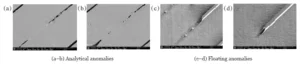
With the exposure scale set to 18 divisions and under three different development conditions, both dry films exhibited poor resolution (as shown in Figures 2a–b).
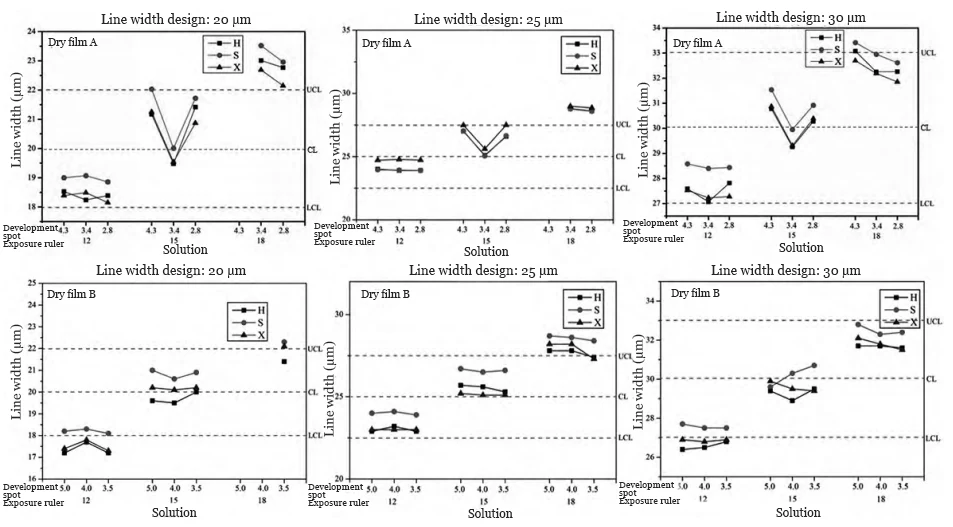
Furthermore, as the number of exposure scale divisions increased, the film width also increased (as shown in Figure 1);
(2) Optimal Process Window
With the exposure scale set to 15 divisions and under the three development conditions, both dry films exhibited optimal resolution, with deviations from the design values for each film width ≤ ±10%.
The minimum resolution capability (L/S) for both dry films was 20/20 μm. (Note: L: vertical lines, H: horizontal lines, S: diagonal lines)
(3) Adhesion Performance
Regarding dry film adhesion, both films exhibited peeling at the 12-grid exposure scale (see Figures 2c–d).
When paired with appropriate exposure energy, Film A exhibited adhesion of ≥20 μm, and Film B exhibited adhesion of ≥25 μm;
(4) Comprehensive Analysis and Key Findings
Table 4 presents a comprehensive analysis of the test results for resolution, adhesion, and appearance.
At an exposure scale of 15, both dry films achieve superior resolution, adhesion, and appearance under all three development conditions compared with other conditions.
This indicates that exposure energy has a significant impact on the resolution and adhesion of dry films, and underscores the necessity of regularly conducting exposure scale tests during actual production.
| Exposure Scale | Development Point | Minimum Resolution Y1 (μm) A | Minimum Resolution Y1 (μm) B | Minimum Adhesion Y2 (μm) A | Minimum Adhesion Y2 (μm) B | Appearance Y3 (A) | Appearance Y3 (B) |
|---|---|---|---|---|---|---|---|
| 12 | High (60%) | 20 | 20 | 25 | 25 | 20 μm (Poor adhesion) | 20 μm (Poor adhesion) |
| 12 | Medium (50%) | 20 | 20 | 25 | 30 | 20 μm (Poor adhesion) | 20–25 μm (Poor adhesion) |
| 12 | Low (40%) | 20 | 20 | 25 | 30 | 20 μm (Poor adhesion) | 20–25 μm (Poor adhesion) |
| 15 | High (60%) | 20 | 20 | 20 | 20 | OK | OK |
| 15 | Medium (50%) | 20 | 20 | 20 | 20 | OK | OK |
| 15 | Low (40%) | 20 | 20 | 20 | 20 | OK | OK |
| 18 | High (60%) | 30 | 25 | 20 | 20 | 20–25 μm (Poor resolution) | 20 μm (Poor resolution) |
| 18 | Medium (50%) | 20 | 25 | 20 | 20 | OK | 20 μm (Poor resolution) |
| 18 | Low (40%) | 20 | 20 | 20 | 20 | OK | OK |
Table 4. Results of Response Variable Y for Dry Films A and B Under Different Conditions
Dry Film Fillability Test
DOE-optimized processing conditions guide the execution of dry film fillability tests.
The study uses the morphology of the electroplated steps, step height difference, and film application pressure as factors.
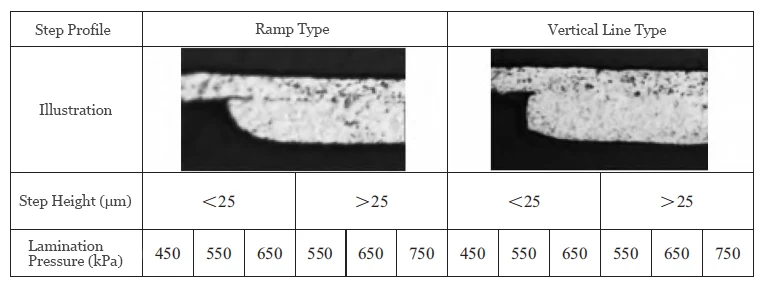
A design of experiments then analyzes the impact of each factor on the yield of circuits and pads (see Table 5).
Test Pattern Design and Functional Simulation
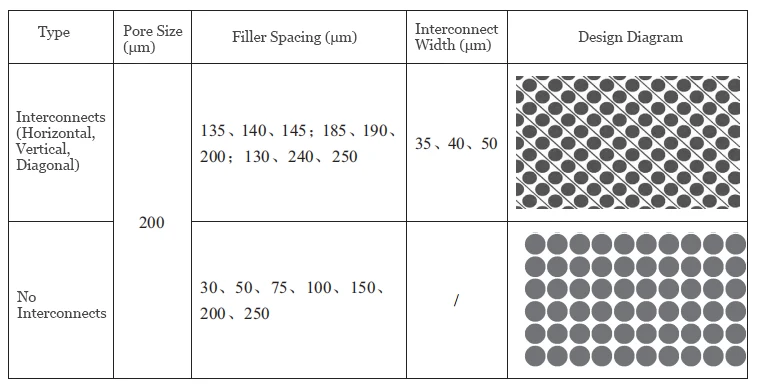
Fill test patterns are divided into two types—copper-surface step fills and PAD-enclosed lines—to simulate circuit design results for different products.
Copper-surface step fills test and verify the dry film’s direct filling and coverage performance.
PAD-enclosed lines test and verify the dry film’s circuit resolution capability under variations in fill thickness (see Table 6).
Cross-Section Characterization and Process Verification
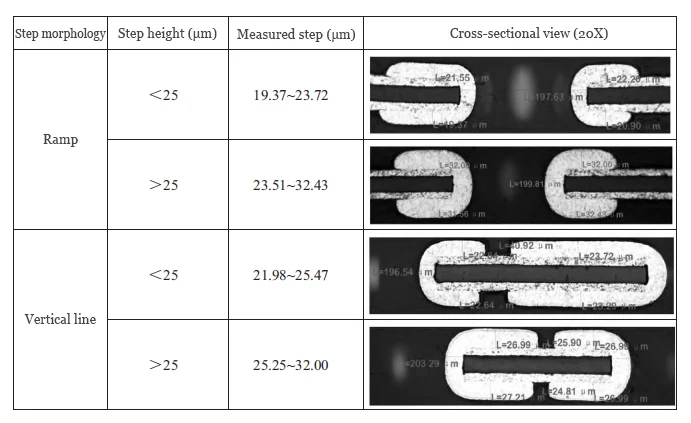
Cross-sections undergo examination after the completion of pattern plating.
This examination verifies and quantifies the step height and step morphology for different pattern plating lines (chemicals), as shown in Table 7.
Based on the results of the DOE optimization for resolution, the test boards underwent lamination → exposure → development → etching.
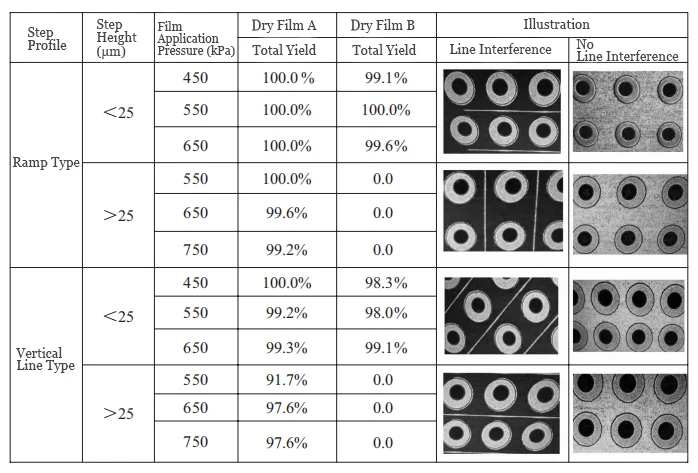
Inspection of the copper surface, circuit lines, and PAD surfaces occurs after etching to identify damage, pinholes, and notches, and the process then determines the overall yield (see Table 8).
Fill Yield Analysis Results
Further analysis of the above fill yield results led to the following conclusions:
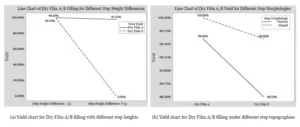
(1) When the step height is <25 μm: The average fill yield for Dry Film A is 99.8%, and for Dry Film B it is 99.0%.
The difference between the two is negligible, and both can cover step heights below 25 μm (Figure 3a);
(2) When the step height is >25 μm, the average fill yield for Dry Film A is 97.54%, while that for Dry Film B is 0.
Dry Film A serves as the preferred choice for manufacturing outer layer circuits in products with step heights between 25 and 32 μm.
(3) When the step height is <25 μm, under both step morphology conditions, Dry Film A achieved a yield of 100% for the ramp type and 99.6% for the vertical line type;
Dry Film B achieved yields of 99.6% for the ramp type and 98.5% for the vertical line type (Figure 3b).
Influence of Step Topography on Fillability
The difference in yield data between the two dry films under the two step topography conditions indicates that step topography also affects the fillability of the dry film.
Ramp-type steps are more conducive to dry film filling, whereas vertical-line-type steps impose stricter requirements on dry film thickness compared to ramp-type steps.
Experimental Analysis
Resolution and Adhesion of Dry Films
Resolution and adhesion tests identify the median exposure energy as the optimal condition for both dry films.
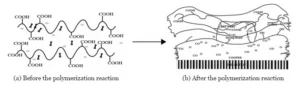
This is because, at this energy level, the degree of photopolymerization reaches equilibrium, allowing the dry film in the exposed areas to form a uniform and dense resist layer.
Dry Film A/B achieved a fine resolution of L/S = 20/20 μm, and the adhesion between the film layer and the copper surface remained stable (as shown in Figure 4).
However, when the photopolymerization reaction is excessive, a dense cross-linked structure forms within the film.
During development, the developer solution struggles to penetrate the unexposed areas, leaving behind unreacted resin that forms “residue.”
Simultaneously, the film becomes brittle and prone to cracking, resulting in poor resolution;
Dry Film A/B fails to achieve a resolution of L/S = 20/20 μm. In addition, insufficient photopolymerization reduces the cross-linking degree of the dry film molecular chains.
This weakened cross-linking decreases both physical adsorption and chemical bonding between the film layer and the copper surface.
As a result, the developer impact causes film peeling, leading to poor adhesion performance in both dry films A and B.
Filling Capability of Dry Film
1. Relationship Between Step Height and Dry Film Thickness
Dry film thickness fundamentally determines its ability to fill step differences.
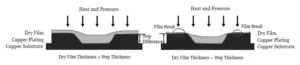
When heated, the dry film flows into the recessed areas of the board surface and, under applied pressure, fills these recesses (see Figure 5).
When the dry film thickness is greater than or equal to the step height, its filling and coverage capabilities are superior.
If the step height exceeds the dry film thickness, optimized lamination settings may improve material flow into recessed areas.
However, the insufficient film thickness cannot fully accommodate the raised step features.
As a result, the step protrusions can penetrate the dry film and create ring-shaped notches during the etching process.
Therefore, when fabricating circuit patterns containing step differences, it is essential to select a dry film of appropriate thickness.
2. Effect of Step Topography on Dry Film Filling
This test revealed that, in addition to the effect of step height on dry film fillability, the geometric structure or morphology of the step itself also influences the fill effect (as shown in Figure 6).
A smaller step inclination angle, such as a ramp-type structure, reduces the physical stress experienced by the dry film during coverage.
Its inherent flexibility allows it to closely conform to the step surface.
This conformity reduces voids and stress concentrations, resulting in a significantly higher fill yield compared to structures with steep vertical changes.
Conversely, a steeper step angle, such as a vertical step, increases the likelihood of dry film overhang formation.
It also concentrates tension at the step edges, which leads to defects such as incomplete coverage or film lifting.
Additionally, fully filling the base of the step requires greater pressure from the dry film process.
Particularly when the step height exceeds the dry film thickness, the filling yield drops sharply.
When the step spacing on PCB pads becomes too small, the dry film encounters spatial constraints during flow and curing.
These constraints increase the likelihood of insufficient filling, residual bubbles, and dry film rupture.

3. The Interaction Between Application Pressure and Step Topography
Appropriate application pressure facilitates the flow and filling of the dry film.
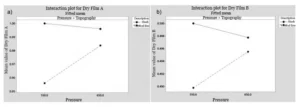
For sloped steps, even low application pressure can achieve perfect filling of the dry film;
Vertical steps require higher application pressure, as shown in Figure 7.
Application pressure adjusts the flow and deformation capabilities of the dry film through mechanical force to adapt to the geometric constraints of different steps.
Sloped steps require “light pressure to maintain shape,” utilizing the dry film’s inherent extensibility to achieve smooth coverage;
Vertical steps require “heavy pressure to fill gaps,” using external force to force the dry film to fill vertical gaps.
Of course, the result of forced filling is a tendency for “adhesive deficiency” at the top of the pads, leading to pad notches.
Conclusion
This study focuses on a systematic investigation of the filling capability of dry films in the FPC photolithography process.
Three major test modules were designed, including development spot tests, resolution tests, and filling capability tests.
These modules were combined with a DOE analysis to evaluate the performance of dry films A and B under different process conditions.
The results indicate that there is no significant difference in the resolution capability between the two dry films;
However, Dry Film A meets step height requirements of up to 32 μm. It outperforms Dry Film B, which is limited to 25 μm. As a result, Dry Film A provides better coverage for electroforming products.
Furthermore, the experiments revealed that, under identical step height conditions, step morphology has a greater impact on dry film filling performance.
In actual production, selection of the appropriate dry film type must be carried out according to specific requirements.
Film application pressure parameters also require optimization based on process conditions.
Key considerations include the product’s plating type, whether hole filling is required, and the circuit line grade.
These factors determine whether stable filling performance and high-quality circuit fabrication results can be achieved.