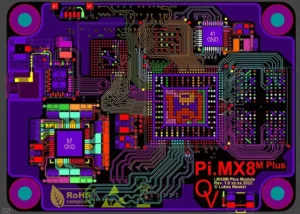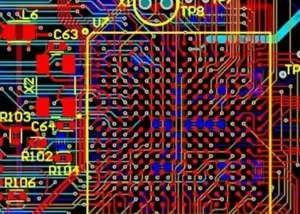
Some printed circuit boards (PCBs) require the large copper surfaces to be coated with gold, a process known as “gold plating.”
During subsequent processing and handling, these gold-plated surfaces are highly susceptible to scratching.
Scratches not only affect the product’s appearance but can also lead to degraded electrical performance and increased scrap rates.
While there are numerous methods to address scratching on gold-plated surfaces—such as optimizing manufacturing processes and enhancing handling protections—their effectiveness varies.
Polyethylene (PE) film possesses excellent flexibility, abrasion resistance, and adhesion, and is commonly used for surface protection in other fields.
Applying it to protect large gold-plated surfaces on PCBs is therefore a viable solution.
Properties and Selection of PE Film
Properties of PE Film
PE film possesses excellent chemical stability and can withstand the corrosive effects of most acids and alkalis.
It maintains stable chemical properties in PCB manufacturing environments and does not react chemically with metals or other materials on the PCB surface.
PE film also offers excellent flexibility, allowing it to conform well to the various shapes of the PCB’s copper surface.
During the application process, it will not crack or peel off due to stress concentration.
Its abrasion resistance is also notable, enabling it to withstand friction from external objects against the copper surface to a certain extent.
PE film adheres primarily through its own surface tension, allowing it to bond firmly to the PCB surface to provide effective protection without causing damage or leaving residue when removed.
Criteria for Selecting PE Film
Engineers consider several factors when selecting PE film to protect the gold-plated surfaces of PCBs.
Film thickness has a significant impact on both protective effectiveness and ease of use.
While thicker films offer better protection, they are more difficult to apply and remove and are more expensive;
Thinner films, on the other hand, may provide insufficient protection.
Experimental tests and production practice confirm the most suitable PE film thickness. Engineers choose a PE film thickness of 50 μm.
This thickness delivers sufficient protection. It also ensures easy handling during operation.
Tack performance of the film is critical. High tack can damage the gold-plated surface during removal.
Low tack fails to ensure secure adhesion and also causes easy peeling of the film.
Therefore, engineers select a PE film with moderate tack. They specify an initial adhesion of 1.5 N/25 mm (±0.25 N).
After a certain period, the adhesion should remain around 1.7 N/25 mm (±0.25 N), ensuring both film stability during processing and smooth removal.
Additionally, engineers consider the transparency and tensile strength of the PE film.
The PE film has a transparency of 83%, which decreases with prolonged storage. It provides an elongation at break of 150%–400%.
This transparency allows clear observation and inspection of the Daikin surface. This elongation range prevents rupture during stretching in processing.
PE Film Application Process
Preparation Before Application
Before applying the PE film, the gold-plated surface of the PCB must undergo thorough cleaning.
First, technicians use ultrasonic cleaning technology. They place the PCB on a horizontal cleaning line moving at (3.0±0.2) m/min.
The system operates at an ultrasonic frequency of ≥28 Hz and a water temperature of (55±2) °C.
This process removes surface oil, dust, and impurities.
Subsequently, operators perform hot-air drying. This step ensures the copper side becomes completely dry. Complete drying prevents residual moisture from reducing PE film adhesion.
Step-by-Step Application Process Control
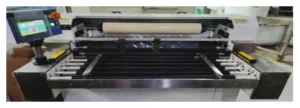
Install the prepared PE film onto the laminating machine, as shown in Figure 1, and adjust the machine parameters.
Operators set the application feed speed to a linear speed of (4±2) m/min. They adjust the plate spacing to 8–15 mm.
These settings ensure the film applies evenly and smoothly onto the Daikin surface.
During the application process, ensure that the film adheres tightly to the surface to prevent air bubbles.
Use a rubber roller to gently press the film after application, working sequentially from one end to the other to remove air bubbles and ensure full contact between the film and the surface.
Post-Application Inspection
After application, inspectors examine the PCB covered with PE film for tears, wrinkles, trapped air bubbles, or areas with poor adhesion.
When defects appear, technicians promptly repair or reapply the film.
For products that pass inspection, store them in an environment with a temperature of (22±2) °C and a humidity of 30%–70% to ensure more stable adhesion between the PE film and the PCB surface, thereby further enhancing protection.
Experimental Design and Analysis of Results
Experimental Design
A comparative experiment tested the effectiveness of applying PE film in reducing surface scratches on PCBs.
Researchers selected 1,600 PCBs from the same batch with identical specifications.
They randomly divided the PCBs into two groups.
The experimental group received PE film application on the large gold surface. The control group did not receive PE film application. Each group contained 800 PCBs.
Both groups of PCBs underwent subsequent processing under identical production conditions, including handling and machining, to simulate various scenarios encountered in actual production.
After processing, operators inspected and statistically analyzed surface scratches on the gold-plated surfaces of both groups of PCBs.
Scratch Inspection Method
Examine the gold-plated surface using an optical magnifying glass with a magnification of 40x.
The appearance of the scratches serves as the criterion for assessing the severity of scratching.
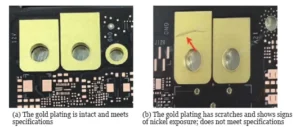
A gold-plated surface qualifies as acceptable when it has no scratches or exposed nickel. A gold-plated surface becomes unacceptable when exposed nickel appears.
Figure 2 illustrates these conditions.
Count the number of PCBs that exhibit valid etching defects. Then calculate the etching defect rate using the ratio of defective PCBs to the total number of PCBs.
Express the etching defect rate as a percentage using the formula: Etching Defect Rate = (Number of PCBs with etching defects ÷ Total number of PCBs) × 100%.
Analysis of Results
Table 1 presents the experimental results. As shown in Table 1, the rate of surface scratches on the large gold surface of the PCB decreased significantly after applying the PE film.
Analysis shows that applying the film protects the large gold surface and reduces scrap costs caused by scratches.
| Dry Film Type | A (29 μm) | A (29 μm) | A (29 μm) | B (25 μm) | B (25 μm) | B (25 μm) |
|---|---|---|---|---|---|---|
| Development Point (%) | 40% | 50% | 60% | 40% | 50% | 60% |
| Line Speed (m/min) | 2.8 | 3.4 | 4.3 | 3.5 | 4.0 | 5.0 |
Table 1. Experimental Results
Conclusion
Researchers investigate methods to improve the scratch resistance of large gold-plated PCB surfaces using PE film.
PE film effectively protects gold-plated PCB surfaces. External forces can cause scratches on these surfaces.
Applying PE film prevents scratches caused by external forces.
Selecting PE film with appropriate properties and optimizing the application process can significantly reduce the scratch rate on large gold-plated PCB surfaces and improve product quality.
In actual production, operators can adjust and refine the PE film application process according to specific circumstances to better meet production requirements.