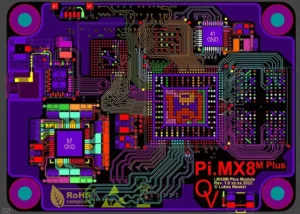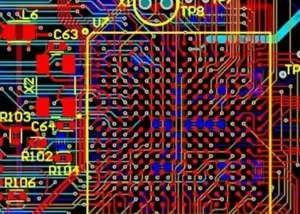
Printed circuit board (PCB) ink is an indispensable key material in the PCB manufacturing process.
It not only protects circuit patterns and provides insulation but also serves multiple functions, including marking, electrical conductivity, and facilitating processing.
In recent years, PCB ink technology has evolved beyond traditional solder mask protection materials.
It is now developing toward high-precision pattern transfer systems, high-reliability solder mask bonding, and low dielectric constant (low-Dk) / low dissipation factor (low-Df) materials designed for high-frequency and high-speed electronic applications.
This transformation reflects the increasing demands of advanced electronics such as 5G communication systems, automotive electronics, high-performance computing, and HDI (High-Density Interconnect) packaging substrates.
Main Categories of PCB Inks (by Function and Application)
1. Solder Mask Ink
Solder mask ink is the most widely used PCB functional coating and is applied to nearly all rigid and rigid-flex printed circuit boards.
Its primary function is to selectively expose solder pads while covering copper traces that do not require soldering.
This ensures process stability during SMT assembly and prevents electrical and mechanical failures.
From an engineering perspective, the solder mask serves four critical roles: preventing solder shorts, resisting copper oxidation, providing electrical insulation, and protecting the environment against humidity and chemicals.
The dominant industrial process is Liquid Photoimageable Solder Mask (LPSM).
This system is typically applied by screen printing or spray coating, followed by a photolithography process consisting of pre-baking, UV or LDI laser exposure, alkaline development, and final thermal curing.
Typical process control parameters:
| Parameter | Industrial Range | Function Impact |
|---|---|---|
| Curing temperature | 150–180°C | Polymer crosslinking stability |
| Dielectric strength | >100 kV/mm | Electrical insulation safety |
| Adhesion to copper | >0.8 MPa | Peel resistance during thermal cycling |
| Pattern resolution | 50–75 μm | Fine-pitch component compatibility |
Solder mask ink is universally applied as the top protective layer of all PCBs, including single-layer, multilayer, HDI, and flexible boards.
2. Legend/Marking Ink
Legend ink (also called silkscreen ink) is used for functional and identification markings on PCB surfaces.
These markings include component reference designators (e.g., R1, C1), polarity indicators, logos, production codes, and traceability data such as barcodes.
The primary functional requirement of legend ink is high contrast visibility and long-term legibility under thermal and chemical exposure during assembly and operation.
Traditionally, screen printing has been the dominant process.
However, inkjet printing technology has experienced rapid expansion in recent years, particularly in high-mix, low-volume production environments, where stencil-free operation enhances efficiency.
Process capability comparison:
| Process | Resolution | Setup Cost | Application Suitability |
|---|---|---|---|
| Screen printing | ~100–150 μm | High initial tooling | Mass production |
| Inkjet printing | ≤80 μm | Low setup cost | Prototyping, NPI, flexible production |
Color usage is typically white or black, selected based on solder mask contrast requirements.
3. Circuit/Etch Resist Ink
Circuit or etch resist ink is used during subtractive PCB fabrication processes to protect copper foil that must remain after chemical etching.
This material is also commonly referred to in industry as “wet film,” distinguishing it from dry film photoresists.
Its main function is to define circuit patterns on inner and outer layers by resisting acidic or alkaline etchants during the copper removal process.
From a materials engineering perspective, this ink must achieve a balance between high chemical resistance, fine resolution capability, and clean removability after processing.
Key performance requirements:
| Property | Requirement | Importance |
|---|---|---|
| Chemical resistance | High (acid/alkali stable) | Prevent pattern loss |
| Resolution capability | ≤50 μm | Fine circuit formation |
| Strippability | Complete removal | Prevent residue contamination |
This ink is critical in multilayer PCB fabrication where precise impedance control and trace geometry directly influence signal integrity.
4. Via Filling/Plugging Ink
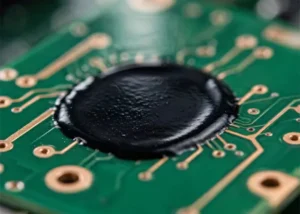
Via filling ink is used to fill or partially fill plated through-holes and microvias, especially in HDI structures and advanced packaging substrates.
Its primary purpose is to prevent solder wicking during wave soldering and to eliminate voids that may trap flux residues.
In advanced PCB applications, it also provides surface planarization for high-density component mounting.
This material is highly engineered, requiring controlled rheology and low shrinkage behavior during curing.
Typical performance requirements:
| Parameter | Target Value | Functional Role |
|---|---|---|
| Volumetric shrinkage | <5% | Prevent via void formation |
| Glass transition temperature (Tg) | ≥150°C | Thermal reliability |
| Surface planarity | High | Enables fine-pitch SMT mounting |
Via fill inks are essential in smartphones, AI servers, automotive ECUs, and IC carrier substrates.
5. Conductive Ink
Conductive inks introduce electrical functionality into PCB-related and printed electronics systems. The two most common types are carbon-based inks and silver-based conductive pastes.
Carbon ink is widely used for low-cost, wear-resistant applications such as keypad contacts, jumper circuits, and EMI shielding layers.
Silver paste, in contrast, is used in high-conductivity applications such as RFID antennas, flexible circuits, and membrane switches.
Electrical performance comparison:
| Ink Type | Conductivity | Cost Level | Typical Applications |
|---|---|---|---|
| Carbon ink | Moderate | Low | Keypads, switches, EMI shielding |
| Silver paste | High | High | FPCs, RFID, sensors |
Conductive inks are especially important in flexible electronics and printed circuit systems where traditional copper etching is not feasible.
6. Peelable Mask / Blue Mask
Peelable mask ink is a temporary protective coating used during selective soldering, surface finishing, and plating processes.
It is applied to protect sensitive PCB areas such as gold fingers, test points, and threaded holes from contamination or solder exposure.
After processing, it can be removed mechanically or manually without leaving residue or damaging the substrate.
From a process engineering standpoint, peelable masks must maintain thermal stability during reflow processes (up to approximately 260°C) while retaining controlled adhesion strength for clean removal.
How to Select PCB Inks Based on Application
The selection of PCB inks is fundamentally driven by application requirements rather than material availability.
Engineers typically evaluate electrical performance, thermal endurance, mechanical stress, and manufacturing process compatibility.
Application-based selection matrix:
| Application Area | Recommended Ink System | Key Engineering Requirement |
|---|---|---|
| Consumer electronics | Standard LPSM solder mask + legend ink | Cost efficiency and throughput |
| Automotive electronics | High-Tg solder mask + robust etch resist | Thermal cycling reliability |
| HDI / smartphone boards | Via fill + high-resolution solder mask | Miniaturization and planarity |
| High-frequency RF boards | Low-Dk / low-Df ink systems | Signal integrity stability |
| Flexible electronics (FPC) | Silver/carbon conductive ink | Mechanical flexibility |
| Industrial control systems | Standard solder mask + etch resist | Long-term durability |
In high-reliability sectors such as automotive and aerospace, material qualification often follows IPC standards such as IPC-SM-840 for solder mask performance and IPC-6012 for rigid PCB qualification.
Conclusion
PCB inks have evolved from simple protective coatings into highly functional engineering materials that directly influence the electrical, mechanical, and thermal performance of modern electronic systems.
Driven by continued advances in electronics, operating frequencies keep increasing while geometries become progressively smaller and integration density rises further.
In this environment, PCB inks no longer remain limited to protective roles; instead, they actively enable lithography precision, support electrical functionality, and enhance overall system reliability.
Future development trends are clearly moving toward:
High-frequency low-Dk / low-Df formulations
Ultra-fine pattern resolution materials
Environmentally compliant, low-VOC systems
Multifunctional inks integrating electrical and mechanical properties
In this context, PCB ink technology has become a critical enabler in the evolution of advanced electronics manufacturing.
References
- IPC-SM-840 – Qualification and Performance of Permanent Solder Mask
- IPC-6012 – Rigid Printed Board Qualification and Performance Specification
- IPC-4562 – Metal Foil for Printed Boards
- Coombs, C. F. Jr. – Printed Circuits Handbook, McGraw-Hill
- Tummala, R. – Microelectronics Packaging Handbook
- Technical datasheets: Taiyo Ink, Sun Chemical, Henkel Electronics Materials