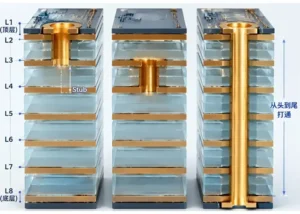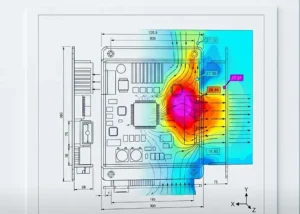
In the surface treatment and processing of printed circuit boards (PCBs), nickel-gold plating has become a critical process. Currently, it is used for surface treatment on both sides of PCBs, including printed connectors (commonly known as “gold fingers”), BGA packages, and substrate boards.
The combination of nickel and gold plating provides the following functions:
(1) It serves as a base for aluminum and gold wire bonding.
(2) The plating layer offers wear resistance and low contact resistance, making it suitable for mechanical contacts and switch mechanisms.
(3) The plating layer is solderable.
Vertical continuous electroplating lines can be used not only for copper and copper-tin plating on printed circuit boards but also for nickel-gold plating, offering excellent uniformity and significant savings in precious metals.
Overview of Vertical Continuous Nickel-Gold Plating Equipment for PCBs
Vertical Nickel-Gold Plating Process
To meet quality and reliability requirements, all aspects of the plating—including color, hardness, uniformity, coverage, plating thickness, and solderability—must be thoroughly evaluated.
Furthermore, to effectively manage the plating bath and ensure its stability, analysis, and replenishment, strict control must be maintained in both operations and management.
The nickel-gold plating process is not overly complex and generally involves several steps, including cleaning.
Depending on the specific workpiece, different treatment methods can be selected for the copper surface to achieve optimal plating results.
The following outlines the vertical nickel-gold plating process:
Automatic loading → Degreasing (acid cleaning) → Water-blocking roller → Two water rinses → Water-blocking roller → Micro-etching → Water-blocking roller → Two water rinses → Activation → Water-blocking roller → Water rinse → Water-blocking roller → Nickel plating → Water-blocking roller → Water rinse → Water-blocking roller → Gold plating → Air drying → Water-blocking roller → Gold recovery → Water-blocking roller → Two water rinses → Hot water rinse → Blow-drying → Automatic unloading
Overview of Vertical Continuous Nickel-Gold Plating Equipment
Vertical continuous nickel-gold plating equipment uses a steel belt conveyor with upper clamps on the conductive edges to ensure that printed circuit boards pass smoothly through the plating tanks during the plating process.
The tank inlets and outlets utilize enclosed roller drives synchronized with the steel belt to prevent boards from getting jammed.
The liquid level in the main tank is maintained 2 mm to 4 mm below the clamping point to prevent gold plating above the clamping point, which would result in a waste of gold salt.
The vertical continuous nickel-gold plating equipment uses a robotic arm in conjunction with a new type of suction cup (the suction pressure of which can be controlled to prevent the dry film from being punctured during selective plating, which could cause gold plating in areas where it is not required).
Printed circuit boards thicker than 0.3 mm are loaded and unloaded automatically.
Boards thinner than 0.3 mm require the application of a thin board frame (currently, automatic framing machines are available for this process, enabling automated bonding), resulting in minimal or unmanned operation.
Challenges and Solutions for Vertical Continuous Nickel-Gold Plating Equipment
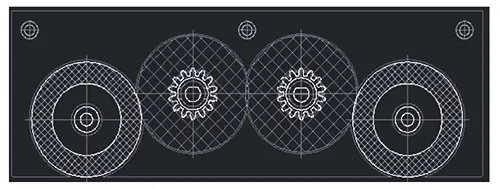
1. Sealed Design for the Main Tank’s Electrolyte Inlets and Outlets
The sealed design of the main tank’s electrolyte inlets and outlets prevents significant carryover of the bath solution.
Solution: Four sets of roller drives are used in synchronization with the main drive.
Specially designed rollers were developed to ensure a compression-style passage;
While this cannot guarantee complete passage, it prevents the electrolyte from splashing out directly (see Figure 1).
2. How to Achieve Automatic Board Loading and Unloading with a Robotic Arm
Solution:
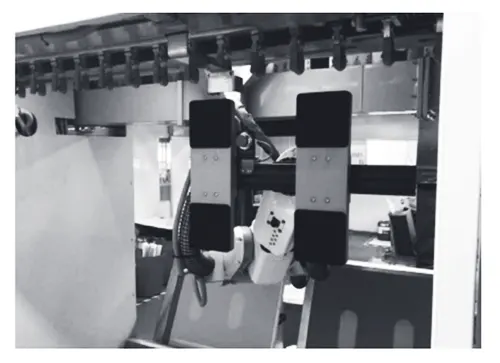
(1) Use the world-leading “Nachi-Fujikoshi” six-axis robotic arm.
(2) Use adjustable flat suction cups (adjustable according to product dimensions).
(3) Incorporate an in-line drying design to enable automatic stacking after the robotic arm unloads the boards.
(4) A CCD camera automatically corrects for board misalignment or overlap, preventing product displacement.
(5) Add conductive copper edge sensors to prevent issues with unopened conductive edges in the pre-manufacturing stage, as well as issues with conductive edges being oriented incorrectly during product placement (as shown in Figure 2).
3. How to Achieve Energy Efficiency and Environmental Protection by Reducing Carryover
Solutions:
(1) Install water-blocking rollers before and after the water-washing tanks along the entire production line to prevent solution carryover between tanks, thereby reducing carryover and lowering water consumption during the washing process.
(2) Install water-blocking rollers before and after the chemical baths along the entire production line.
Use special polyurethane (PU) rollers for the gold-nickel bath and rollers with a hardness of 20 for the micro-etching bath.
This primarily addresses cross-contamination between main baths and excessive carryover.
(3) Install an air-blow function after the gold bath to effectively prevent carryover from the gold bath.
Technical Requirements for Vertical Continuous Nickel-Gold Plating Equipment
(1) Capable of plating entire panels in a single pass; minimum product size: 250 × 250 mm; maximum product size: 750 mm × 750 mm.
(2) Production speed: 0.5–2 meters per minute, adjustable.
(3) Gold plating uniformity: For a plating thickness of 0.25 μm, the R-value must be within 0.05 μm.
(4) For a plating thickness of 0.5 μm, the R-value must be within 0.1 μm.
(5) For a plating thickness of 0.75 μm, the R-value must be within 0.15 μm.
Significance of the Successful R&D of Vertical Continuous Nickel-Gold Plating Equipment
The Overall Significance of the Project’s Implementation
This project aims to develop intelligent, environmentally friendly electroplating production equipment to fully replace manual labor and improve the uniformity of product plating layers.
Upon completion, the project will not only reduce labor costs and increase production efficiency but also bring automated electroplating production lines up to world-class standards.
This will promote the advancement of China’s automated electroplating production equipment industry toward high-end technology and significantly enhance the international competitiveness and influence of the electroplated printed circuit board industry, as well as related sectors and enterprises.
Advantages of Project Implementation
1. Comparison of Gold Plating Uniformity
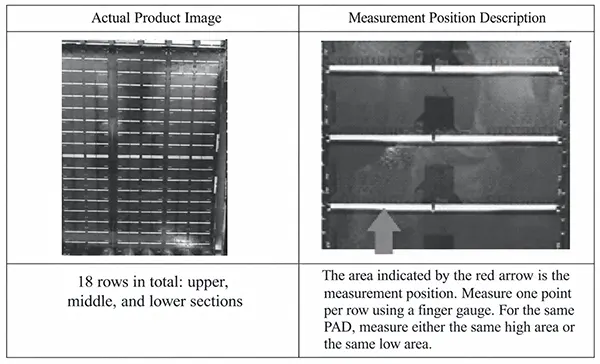
Comparison of gold plating uniformity (see Table 1 and Figure 3).
Based on a comparison of the uniformity range (R) values, the uniformity range (R) improved by 0.0812 μm (3.24 μ”).
| No. | Conventional Line – Side A | Conventional Line – Side B | Vertical Line – Side A | Vertical Line – Side B |
|---|---|---|---|---|
| 1 | 0.98 | 0.99 | 0.83 | 0.83 |
| 2 | 0.87 | 0.87 | 0.86 | 0.85 |
| 3 | 0.85 | 0.94 | 0.85 | 0.84 |
| 4 | 0.93 | 0.92 | 0.89 | 0.83 |
| 5 | 0.94 | 0.96 | 0.84 | 0.83 |
| 6 | 0.97 | 0.90 | 0.84 | 0.82 |
| 7 | 0.81 | 0.83 | 0.83 | 0.79 |
| 8 | 1.00 | 0.92 | 0.83 | 0.80 |
| 9 | 0.94 | 0.99 | 0.81 | 0.84 |
| … | … | … | … | … |
| 16 | 0.96 | 0.90 | 0.78 | 0.86 |
| 17 | 0.86 | 0.89 | 0.83 | 0.83 |
| 18 | 0.90 | 0.91 | 0.83 | 0.86 |
Table 1. Uniformity Comparison Between Conventional Lines and Vertical Lines (Unit: μm)
2. Cost-Saving Calculations for Gold Plating
Method for calculating gold plating thickness: Area × Thickness × Density of gold plating = Pure gold content
Method for calculating cost: Area × (Average value of traditional finger lines – Average value of vertical continuous lines) × Density of gold = Pure gold content (Converted gold salt × Unit price)
Unit Conversions
1 sf = 929.03 cm²
39.37 μ” = 1 μm = 0.0001 cm
1 g of gold salt = 0.683 g of pure gold
The density of gold-cobalt alloy ranges from 16.5 to 17.5; we use the midpoint value of 17 to calculate the customer’s actual data.
Plated area per piece:
0.12 sf × 929.03 (conversion factor) × 2 (both sides) = 222.96 cm²
Differences Between Traditional Gold Fingers and Vertical Continuous Plating Lines
7.55 – 4.31 = 3.24 μ” / 39.37 (conversion factor) = 0.0822 μm / 1000 (conversion factor) = 0.00000823 cm
Difference in Pure Gold Plating per Board (Gold Salt Content)
222.96 × 0.00000823 × 17 = 0.0311 g pure gold / 0.683 = 0.045 g gold salt
2,500 boards are produced daily, calculated based on 22 days per month.
0.045 × 2,500 = 112.5 g/day × 22 = 2,475 g/month × unit price of gold salt (190 yuan/g) = 470,250 yuan
Based on a gold plating thickness of 0.75 μm, the monthly cost savings amount to 470,250 yuan.
3. Vertical Continuous Nickel-Plated Gold Wire (Nickel Plating Uniformity)
Vertical continuous nickel-plated gold wire (see Table 2 and Figure 4).
Product dimensions: 500 mm × 600 mm, 24 dots per side, 48 dots on both sides.
The customer specified a thickness of 3–5 μm, with a range (R) of 0.85 μm.
The basic uniformity capability has reached its limit, fully surpassing that of traditional nickel plating equipment.
| No. | Measurement 1 (μm) | Measurement 2 (μm) | Measurement 3 (μm) | No. | Measurement 1 (μm) | Measurement 2 (μm) | Measurement 3 (μm) |
|---|---|---|---|---|---|---|---|
| 1 | 3.3 | 3.4 | 3.2 | 9 | 3.0 | 3.4 | 3.3 |
| 2 | 3.4 | 3.4 | 3.2 | 10 | 3.4 | 3.1 | 3.5 |
| 3 | 3.2 | 3.4 | — | 11 | 3.5 | 3.4 | 3.5 |
| 4 | 3.5 | 3.9 | 3.4 | 12 | 3.7 | 3.6 | 3.6 |
| 5 | 3.7 | 3.4 | 3.1 | 13 | 3.6 | 3.5 | 3.5 |
| 6 | 3.1 | 3.4 | 3.7 | 14 | 3.5 | 3.7 | 3.6 |
| 7 | 3.6 | 3.8 | 3.2 | 15 | 3.2 | 3.3 | 3.3 |
| 8 | 3.2 | 3.2 | 3.7 | 16 | 3.1 | 3.2 | 3.3 |
Table 2. Nickel Plating Uniformity

4. Control of Potassium Cyanide Gold
Potassium cyanide gold is a highly toxic substance subject to national control and requires strict management.
The vertical continuous nickel-gold plating line is equipped with the following safety measures:
(1) The main gold tank of the equipment is equipped with a locking mechanism and a lid-opening alarm.
(2) The gold tank filter vessels are designed with locking mechanisms and alarm functions.
(3) All piping outside the production line is designed with flanged connections to prevent leaks.
(4) The equipment includes designated mounting locations for monitoring devices, allowing for independent installation.
Patents Granted for Vertical Continuous Nickel-Gold Plating Equipment
Patents Granted for Vertical Continuous Nickel-Gold Plating Equipment (see Table 3).
| Patent Grant Date | Patent Title | Category | Patent No. | Approval Authority | Inventor | Authorization Status |
|---|---|---|---|---|---|---|
| 2017-02-22 | A Water-Blocking Device and Vertical Electroplating System for Circuit Boards in an Electroplating Tank | Invention Patent | 201610767597.1 | China National Intellectual Property Administration | Jiang Zejun | Granted |
| 2016-06-15 | A Loading and Unloading Suction Device | Utility Model Patent | 201620065341.1 | China National Intellectual Property Administration | Jiang Zejun | Granted |
Table 3. Details of Granted Technical Patents
Conclusion
The vertical continuous nickel-gold plating line uses a steel belt drive system.
Products with a maximum size of 750 mm × 750 mm can pass through the system in a single pass, thereby increasing production capacity and reducing the cost of printed circuit board production.
The main tanks in the equipment all employ a spray-nozzle circulation system, which ensures more uniform mixing and significantly improves plating efficiency.
Traditional lines used copper wire brushes for conductivity and employed a constant-voltage plating method.
In contrast, the vertical continuous nickel-gold plating line uses fixed carbon brushes for conductivity in the gold tank and operates on a constant-current basis, resulting in more stable rectifier input and output;
The main tank employs a master-slave rectifier configuration (e.g., rectifier specifications: 5 A slave unit / 100 A master unit = 5 V;
Since the rectifier’s starting current accuracy is 3%, the slave unit operates at low currents and automatically switches to the master unit when the current exceeds the slave’s rated capacity).
Current can be adjusted with an accuracy of 0.01 A, ensuring precise current start and stop and preventing current fluctuations.
The vertical continuous nickel-gold plating line, which performs full-board plating directly from the upper clamp, truly enables minimal or unmanned operation throughout the entire line.
It ensures the smooth movement of printed circuit boards within the plating tank, improves product quality and production efficiency, and sets a new benchmark for automated equipment in the printed circuit board surface treatment process.