
In the field of high-end printed circuit board (PCB) manufacturing, milled vias (such as dogbone vias and small square vias) serve as core microstructures for interlayer interconnection and precise signal transmission.
High-End PCB Milled Vias and Machining Accuracy Requirements
Their machining accuracy directly determines the product’s electrical performance, structural reliability, and production yield.
These vias typically feature extremely small dimensions, requiring small-diameter milling cutters (≤1.0 mm) for precision machining.
However, due to structural design limitations, small-diameter milling cutters have a relatively high length-to-diameter ratio, resulting in significantly insufficient rigidity.
When machining high-hardness, high-copper-thickness multilayer laminates, they are prone to bending deformation under cutting resistance—a phenomenon known as “tool deflection”—which in turn leads to issues such as groove contour distortion and dimensional deviations.
This has become a key technical bottleneck constraining the production of high-end PCBs.
Existing Research on PCB Slot Machining and Deformation Control
To address the deformation issues in PCB slot machining, targeted research has been conducted:
Li Shengwen et al. addressed machining defects in mechanically drilled square slots by optimizing drill geometry and cutting parameters, effectively reducing burrs on slot edges and dimensional deviations.
Their research confirmed that the compatibility between tool structure and machining parameters is central to improving slot machining quality;
Xie Siwen proposed a segmented drilling process to improve the quality of short slots in printed circuit boards.
By controlling the cutting depth in segments to distribute the cutting force, this method significantly reduced machining deformation, providing practical evidence for the effectiveness of intermittent cutting in suppressing deformation;
In their study on the milling of PCBs using micro-milling cutters, Liu Yang et al. systematically analyzed the correlation between tool wear and dimensional accuracy.
They found that structural parameters such as cutter core thickness and edge length directly affect cutting stability, while insufficient rigidity exacerbates machining errors.
These findings provide important references for precision slot machining in PCBs and lay the foundation for the process optimization direction of this study.
Research Gap and Study Focus on Tool Yielding Mechanism
Although previous research in the field of PCB slot and hole machining has made some progress, there remains a lack of systematic studies on the optimization of milling cutter structures and process parameters.
Therefore, building upon existing research, this study focuses on the deformation mechanism of “tool yielding.”
Through a multi-factor experimental design, it clarifies the influence mechanisms of milling cutter type, structural parameters, and machining parameters on deformation, thereby providing data support and engineering guidance for enhancing the technical level of precision PCB machining.
Analysis of “Tool Clearance” Deformation
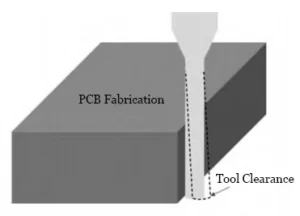
During the precision machining of small-sized milled-plated grooves, “tool clearance” deformation (see Figure 1) is a typical issue that limits machining accuracy.
Specifically, when using small-diameter milling cutters (≤1.0 mm) to machine solid copper layers or thick PCB boards, irregular protrusions or indentations often appear along the groove edges, exceeding straightness tolerances, which ultimately leads to distorted slot profiles and dimensional deviations, failing to meet the precision requirements of high-end PCB products.
This phenomenon directly affects the interlayer connectivity and signal transmission performance of milled slots and is one of the key factors contributing to a decline in product yield rates.
Mechanism of Tool Deflection: Dynamic Imbalance Between Rigidity and Cutting Forces
An in-depth analysis of the causes of “tool deflection” reveals that it is essentially the result of an imbalance in the dynamic equilibrium between the rigidity characteristics of the milling cutter’s cutting system and the cutting forces.
This can primarily be attributed to the synergistic interaction of three core factors:
Insufficient Cutter Rigidity as the Fundamental Cause
First, insufficient cutter rigidity is the fundamental cause. Small-diameter milling cutters generally have a high length-to-diameter ratio, and their tail-end support stiffness is significantly lower than that of larger-sized cutters, making them typical flexible cutting systems.
When cutting resistance exceeds their stiffness limit, the cutter undergoes elastic deflection in the non-cutting direction.
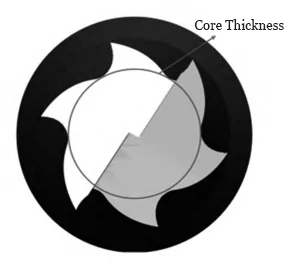
The core thickness (see Figure 3) and cutting edge length are key parameters determining structural rigidity; the smaller the core thickness and the longer the cutting edge, the weaker the resistance to bending and vibration, and the higher the risk of tool deflection.
This principle is supported by research conducted by Liu Yang et al., who found in their study of micro-milling of PCBs that tool structural parameters and wear conditions are directly linked to machining dimensional accuracy, and that insufficient rigidity exacerbates dimensional deviations.
Influence of Milling Cutter Type on Cutting Stability
Second, differences in the suitability of milling cutter types are a significant influencing factor.
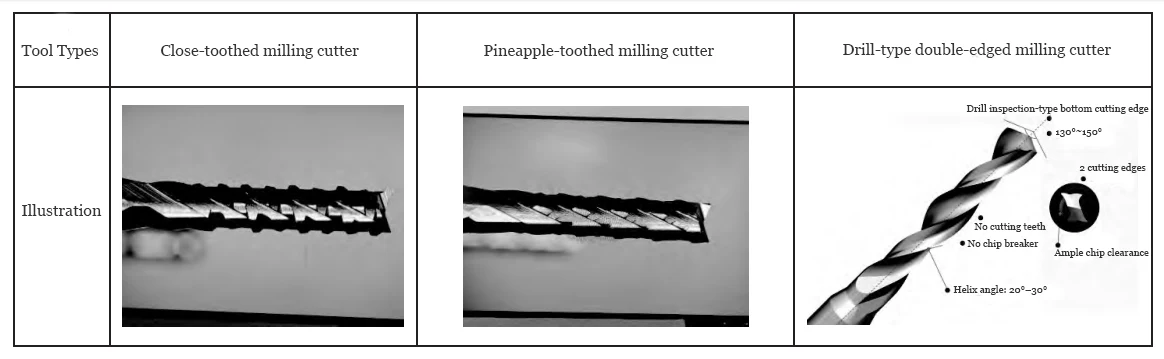
Different types of milling cutters have distinct cutting tooth structures and chip flute designs, which directly alter the distribution of cutting forces and machining stability.
Effect of Machining Parameters on Tool Yielding Deformation
Third, improper machining parameters will further exacerbate deformation.
Feed rate and spindle speed indirectly influence “tool yielding” deformation by regulating the generation of cutting heat and the intensity of cutting force impacts.
Excessively high feed rates increase the material removal rate per unit time, causing cutting resistance to exceed the cutter’s load capacity;
Conversely, excessively high spindle speeds intensify frictional heat generation and high-frequency vibrations, triggering thermal deformation of the cutter and amplifying trajectory deviation errors—both of which lead to an exacerbation of the “tool yielding” phenomenon.
Test Materials and Methods
Test Materials
(1) Test PCB: A 22-layer PCB with a total copper thickness of 1.25 mm and a board thickness of 3.16 mm was produced via lamination.
(2) Test Tools: A fine-tooth end mill with a diameter of 0.8 mm and a cutting length of 7.0 mm, a pineapple-tooth end mill, and a drill-type double-edge end mill were selected.
Experimental Design and Performance Testing
(1) Fixed process parameters: spindle speed 40 krpm, feed rate 3 mm/s.
The optimal cutter geometry was selected by comparing the machining deformation of three different types of milling cutters.
(2) After determining the optimal cutter geometry, a full factorial experimental design was employed for 0.8 mm diameter milling cutters to systematically investigate the effects of four key factors—core thickness, cutting edge length, feed rate, and spindle speed—on deformation.
The experimental factor levels are shown in Table 2, constituting 2³ = 16 experimental combinations. The specific experimental plan is shown in Table 3.
(3) Performance Testing. Deformation was used as the core evaluation metric, and high-precision optical microscopy was employed for inspection. The target standard was deformation ≤ 25 μm.
| Factor | Level 1 | Level 2 |
|---|---|---|
| Core Thickness | 68% | 75% |
| Tool Length (mm) | 7.0 | 5.0 |
| Feed Rate (mm/s) | 3 | 5 |
| Spindle Speed (krpm) | 40 | 44 |
Table 2. Experimental Factor Level Design
| No. | Core Thickness | Tool Length (mm) | Feed Rate (mm/s) | Spindle Speed (krpm) |
|---|---|---|---|---|
| 1 | 68% | 7.0 | 3 | 40 |
| 2 | 68% | 7.0 | 3 | 44 |
| 3 | 68% | 7.0 | 5 | 40 |
| 4 | 68% | 7.0 | 5 | 44 |
| 5 | 68% | 5.0 | 3 | 40 |
| 6 | 68% | 5.0 | 3 | 44 |
| 7 | 68% | 5.0 | 5 | 40 |
| 8 | 68% | 5.0 | 5 | 44 |
| 9 | 75% | 7.0 | 3 | 40 |
| 10 | 75% | 7.0 | 3 | 44 |
| 11 | 75% | 7.0 | 5 | 40 |
| 12 | 75% | 7.0 | 5 | 44 |
| 13 | 75% | 5.0 | 3 | 40 |
| 14 | 75% | 5.0 | 3 | 44 |
| 15 | 75% | 5.0 | 5 | 40 |
| 16 | 75% | 5.0 | 5 | 44 |
Table 3. Experimental Plan
Results and Discussion
Effect of Milling Cutter Type on Slot Deformation
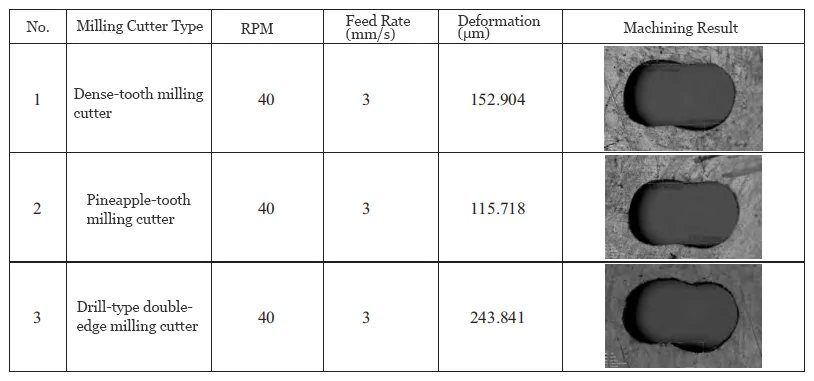
Table 4 shows a comparison of slot deformation caused by different types of milling cutters under identical cutting parameters.
The results show that the pineapple-tooth milling cutter produced the least deformation, significantly outperforming the fine-tooth milling cutter and the drill-type double-edge milling cutter.
This result is directly related to the mechanical properties of the milling cutter’s tooth profile: the fine-tooth milling cutter’s multi-tooth intermittent cutting leads to large fluctuations in cutting forces and increased vibration;
The pressure concentration on a single cutting edge of the drill-type double-edge milling cutter leads to rapid wear and a decline in rigidity;
Whereas the narrow tooth width design of the pineapple-tooth milling cutter effectively distributes the cutting force, reduces the cutting stress per unit area, and minimizes milling cutter vibration and tool deflection, thereby achieving superior deformation control.
The Effect of Milling Parameters on Slot Deformation
A pineapple-tooth milling cutter serves as the tool for the experiments. The study examines the effects of different milling parameters on slot deformation and machining results.
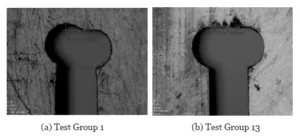
Table 5 and Figure 3 present the corresponding experimental results.
Analysis of the 16 experimental datasets identifies Group 13 as the optimal configuration.
Group 13 uses a core thickness of 75%, a cutting edge length of 5.0 mm, a feed rate of 3 mm/s, and a spindle speed of 40 krpm.
This configuration produces the best machining performance. It limits deformation to 9.06 μm, which is well below the target threshold of ≤25 μm.
Based on the experimental data, the influence of each parameter on deformation is analyzed as follows:
(1) Effect of Core Thickness on Milling Cutter Bending Resistance
Effect of core thickness:
Increasing core thickness from 68% to 75% reduces deformation under identical edge length and cutting conditions.
This improvement results from enhanced cross-sectional stiffness, which strengthens resistance to bending.
This is because core thickness directly determines the milling cutter’s cross-sectional resistance to bending;
A larger core thickness results in greater tool rigidity, reducing elastic deformation under cutting forces and thereby effectively suppressing tool deflection.
(2) Effect of Cutting Edge Length on Milling Cutter Rigidity and Deformation
Effect of edge length:
Comparing data under the same core thickness and cutting parameters (e.g., No. 1 vs. 5, No. 9 vs. 13), deformation decreases sharply when the edge length is reduced from 7.0 mm to 5.0 mm.
For small-diameter milling cutters, the length-to-diameter ratio is inversely proportional to rigidity.
The shorter the cutting edge length, the smaller the length-to-diameter ratio, the higher the tailstock support stiffness, and the lower the risk of vibration and deformation.
The cantilever beam model predicts that deformation scales with the cube of the cutting edge length.
This relationship confirms a strong sensitivity of stiffness to geometric length. Shortening the cutting edge length increases tool rigidity.
It also effectively suppresses vibration during machining.
(3) Effect of Feed Rate on Milling Deformation Control
Effect of feed rate: Across all parameter combinations, lower feed rates consistently resulted in smaller deformations compared to higher feed rates (e.g., No. 13 vs. No. 15).
Reducing the feed rate lowers the material removal rate per unit time. Cutting forces remain within a stable range.
Tool deformation decreases under reduced mechanical load. This reduction in deformation consequently suppresses tool deflection.
(4) Effect of Spindle Speed on Thermal Deformation and Vibration Stability
Effect of spindle speed: The influence of spindle speed on deformation is relatively complex, but near the optimal parameters (e.g., No. 13 vs. No. 14), a lower spindle speed (40 krpm) performs better.
Excessively high spindle speeds (e.g., 44 krpm) increase the friction frequency between the milling cutter and the workpiece.
This condition causes continuous accumulation of cutting heat. The accumulated heat induces thermal deformation of the tool.
At the same time, high-frequency vibrations amplify trajectory deviations, ultimately increasing the amount of deformation;
Whereas an appropriate spindle speed (40 krpm) balances cutting efficiency and stability, reducing the effects of thermal deformation and vibration.
| No. | Core Thickness | Tool Length (mm) | Feed Rate (mm/s) | Spindle Speed (krpm) | Deformation (μm) |
|---|---|---|---|---|---|
| 1 | 68% | 7.0 | 3 | 40 | 145.30 |
| 2 | 68% | 7.0 | 3 | 44 | 157.59 |
| 3 | 68% | 7.0 | 5 | 40 | 171.50 |
| 4 | 68% | 7.0 | 5 | 44 | 173.43 |
| 5 | 68% | 5.0 | 3 | 40 | 42.13 |
| 6 | 68% | 5.0 | 3 | 44 | 47.45 |
| 7 | 68% | 5.0 | 5 | 40 | 88.90 |
| 8 | 68% | 5.0 | 5 | 44 | 86.71 |
| 9 | 75% | 7.0 | 3 | 40 | 53.14 |
| 10 | 75% | 7.0 | 3 | 44 | 83.25 |
| 11 | 75% | 7.0 | 5 | 40 | 108.59 |
| 12 | 75% | 7.0 | 5 | 44 | 125.30 |
| 13 | 75% | 5.0 | 3 | 40 | 9.06 |
| 14 | 75% | 5.0 | 3 | 44 | 13.87 |
| 15 | 75% | 5.0 | 5 | 40 | 24.28 |
| 16 | 75% | 5.0 | 5 | 44 | 34.69 |
Table 5. Results of Groove Deformation Tests Under Different Milling Parameters
Analysis of Parameter Interdependencies
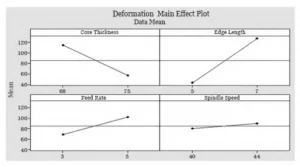
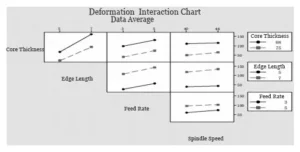
Main effect analysis (Figure 4) evaluates the relative importance of each parameter. Interaction analysis (Figure 5) examines the coupling relationships between parameters.
Response optimization analysis (Figure 6) determines the optimal parameter combinations. These analyses further clarify parameter significance and optimal configurations.
The main effect analysis plot shows that edge length is the most critical factor affecting deformation; reducing the edge length from 7.0 mm to 5.0 mm significantly reduces deformation.
Followed by feed rate and core thickness, a lower feed rate (3 mm/s) and higher core thickness (75%) both help control deformation; the influence of spindle speed is relatively minor.
The interaction analysis plot indicates that there is a certain degree of interaction between blade length and core thickness, as well as between blade length and feed rate:
The combination of a short edge length (5.0 mm) and a high core thickness (75%) intensifies the influence of feed rate on deformation.
A reduced feed rate further enhances deformation suppression by leveraging the increased structural rigidity.
Response optimization analysis validates the optimal process parameter combination.
The experimental data of Group 13 matches this optimized configuration. This combination achieves machining with minimal deformation.

Conclusion
Selection of milling cutter types supports the study framework. Full-factorial experiments on machining parameters provide systematic data for analysis.
An in-depth investigation of deformation mechanisms clarifies the underlying causes of machining deformation in small-sized milled grooves.
This integrated approach successfully addresses the deformation problem.
The key conclusions are as follows:
(1) The pineapple-tooth milling cutter is the optimal tool type for machining small-diameter plated grooves.
The narrow tooth width design disperses cutting forces effectively. It reduces cutter vibration and lowers the risk of tool deflection.
It also delivers significantly better deformation control than fine-tooth milling cutters and drill-tooth double-edge milling cutters.
(2) A 0.8 mm diameter pineapple-tooth milling cutter achieves optimal performance under a specific process parameter combination.
The optimal settings include a core thickness of 75%, a cutting edge length of 5.0 mm, a feed rate of 3 mm/s, and a spindle speed of 40 krpm.
This configuration controls machining deformation within 25 μm. Under optimal conditions, deformation reaches as low as 9.06 μm.
This result effectively resolves deformation issues in milling plated grooves.
(3) Insufficient cutter rigidity is the fundamental cause of machining deformation in small-sized milled grooves, where the resulting “tool yielding” effect governs the overall accuracy loss.
Increasing core thickness and shortening cutting edge length improve cutter structural rigidity, while selecting a lower feed rate and an appropriate spindle speed reduces cutting force fluctuation and thermal load.
These optimized cutter structures and machining parameters suppress the tool yielding phenomenon at its root, leading to improved machining accuracy.