Various issues may arise during the PCBA manufacturing process, including problems related to soldering, components, design, and manufacturing processes.
Below are some common issues encountered in PCBA manufacturing and their specific solutions.
Soldering Issues
Cold Solder Joints
Problem Description: The solder joint has not fully melted, resulting in an unreliable electrical connection.
Solution: Optimize the reflow soldering temperature profile to ensure the solder paste melts completely.
Check the quality of the solder paste printing to ensure the correct amount of solder paste is applied. Use high-quality solder paste and components.
Bridging (Short Circuits)
Problem Description: A short circuit occurs between adjacent solder joints. Bridging accounts for more than half of all wave soldering defects.
Solution: Optimize solder paste printing parameters to avoid excess solder paste.
Adjust the placement accuracy of the placement machine to ensure precise component positioning. Check the PCB pad design to ensure reasonable spacing.
Solder Voids
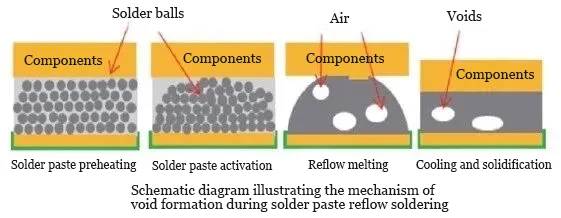
Problem Description: Air bubbles are present inside the solder joint, affecting solder strength and electrical conductivity.
The root cause of solder voids is that air or volatile gases trapped within the solder paste after melting are not completely expelled.
Contributing factors include solder paste material, paste print shape, paste volume, reflow temperature, reflow time, joint dimensions, and structure.
Solution: Optimize the reflow soldering temperature profile to reduce bubble formation.
Use low-volatility solder paste. Check the solderability of the PCB pads and components.
Solder Balls
Problem Description:
Solder beads form during the soldering process.
When solder paste printing defects occur, the solder paste collapses, or it is forced out of the pad by the mounted component, solder beads form on the side of the component or remain beneath it after reflow soldering.
They resemble solder balls but are much larger in size and typically appear between the two leads of large-sized surface-mount components or between fine-pitch pins.
Solution:
As a common defect in the soldering process, the causes of solder beads are complex and varied.
By optimizing the characteristics of the solder mask, precisely controlling the composition of the solder paste, improving wettability, rationally designing the soldering process and stencil aperture, and considering the impact of component shape and height, the formation of solder beads can be effectively reduced.
At the same time, timely detection and removal of formed solder beads can ensure the performance and reliability of electronic products.
Implementing appropriate countermeasures to minimize their occurrence will improve the soldering quality and reliability of electronic products.
Solder Balling
Problem Description:
Solder balling refers to abnormal conical or pin-like solder joints.
The primary cause of solder balling is that the solder does not have sufficient time to contract during cooling.
Such solder joints may violate minimum electrical clearance requirements or cause short circuits when the distance to adjacent boards is too close during system assembly.
Solution:
Solder balling is directly related to temperature.
Low preheat temperatures and low solder melting temperatures can result in insufficient temperature after passing the wave, preventing the molten solder from contracting effectively.
Low solder melting temperatures also increase the viscosity of the molten solder, exacerbating the formation of solder balls.
It is recommended to reconfigure the temperature measurement profile. Flux also plays a significant role in tip formation.
Insufficient flux activity or reduced concentration weakens its ability to remove oxidation and lower surface tension.
As a result, the flux cannot effectively support solder contraction when the molten solder exits the solder pot.
Increasing the flux concentration, activity, and application volume, as well as raising the spray pressure to improve penetration, can help eliminate solder balls.
When the conveyor speed is too fast, excess solder may not have time to be drawn back into the solder pot, resulting in solder balls.
In cases where solder balls are caused by excessively long lead lengths, the leads should be trimmed. It is recommended that the lead length (L) not exceed 2 mm.
PCB soldering processes commonly produce several defects.
These defects include tombstoning, solder buildup, excessive or insufficient solder, rosin-core solder formation, overheating, poor wetting, asymmetrical joints, looseness, pinholes, copper foil lifting, delamination, and solder mask discoloration.
To address these defects, we must focus on optimizing soldering parameters, enhancing pre-soldering preparation, controlling the soldering environment, strengthening quality control, and improving operator skills.
By implementing these measures, we can ensure the effectiveness and reliability of PCB soldering, thereby improving the overall performance and service life of electronic products.
Component Issues
Incorrect Components
Problem Description: Components are placed incorrectly.
Solution: Strengthen material management to ensure clear component identification.
Conduct a material verification check before placement. Use a barcode scanning system to verify part numbers.
Damaged Components
Problem Description: Components are damaged during placement or soldering.
Solution: Optimize the nozzle pressure and speed of the placement machine.
Inspect component packaging and shipping methods to prevent mechanical damage.
Carefully control the temperature and humidity during storage and handling of electronic components to avoid adverse effects.
Implement anti-static measures during operations, such as wearing anti-static gloves and using anti-static tools.
PCB Design Issues
Improper Pad Design
Problem Description: Improper pad dimensions or spacing, leading to poor soldering.
Solution: Optimize pad design based on component specifications. Design pads in accordance with IPC standards.
Conduct design reviews and DFM (Design for Manufacturability) analyses before mass production.
Poor Thermal Design
Problem Description: Inappropriate PCB thermal design leads to component overheating.
Solution: Optimize the PCB layout by adding vias and heat sinks. Use PCB materials with high thermal conductivity.
Incorporate thermal simulation analysis into the design process.
Solder Mask Defects
Problem Description: The solder mask protects the copper traces on the PCB from oxidation and corrosion while preventing solder from flowing to unwanted areas during soldering.
Solder mask defects may cause short circuits or open circuits.
Solution: Strengthen process control during solder mask application to ensure it is uniform, bubble-free, and free of peeling; simultaneously, conduct rigorous inspection of the solder mask to promptly identify and repair defects.
Reverse Polarity
Problem Description: In PCB design, if component polarity is not clearly marked, or if polarized components are not installed correctly during assembly, reverse polarity issues may occur.
This can damage components and the PCB, and may even lead to safety incidents.
Solution: Clearly mark component polarity during the design phase, and strengthen inspection and verification during assembly.
Short Circuits and Open Circuits
Problem Description: Short circuits and open circuits are among the most common failures in PCBs.
Short circuits can cause excessive current, damaging components and circuits; open circuits prevent signal transmission, affecting device functionality.
Solution: Strengthen quality control during the design and manufacturing processes to ensure correct circuit connections and eliminate short circuits and open circuits; simultaneously, add electrical testing items to the testing phase to promptly detect and repair faults.
Process Issues
Poor Solder Paste Printing
Problem Description: Solder paste is printed unevenly or there are missed areas.
Solution: Clean the stencil regularly to prevent clogging. Adjust the pressure and speed settings of the printer. Use high-quality stencils and solder paste.
Insufficient Placement Accuracy
Problem Description: Due to factors such as temperature and vibration, components may shift during placement on the PCB, resulting in reduced placement accuracy.
Solution: Calibrate the placement machine’s vision system and nozzles.
Optimize the placement program and use precise positioning tools to ensure components are accurately placed on the PCB. Control temperature and time during the soldering process to reduce the risk of component displacement.
Check the PCB’s reference point design to ensure accurate identification.
Use adhesives or glue to secure components and prevent them from shifting during soldering.
Inspection and Testing Issues
Insufficient Inspection Coverage
Issue Description: Some defects are not detected.
Solution: Combine multiple inspection methods (e.g., AOI, X-ray, functional testing).
Optimize inspection procedures to improve coverage. Calibrate inspection equipment regularly to ensure accuracy.
High Test Failure Rate
Problem Description: PCBA functional test failure rates are high.
Solution: Analyze the causes of test failures and optimize design and processes accordingly.
Optimize test procedures to reduce false positives. Strengthen quality control during the production process.
Environmental and Operational Issues
Electrostatic Discharge (ESD) Damage
Problem Description: ESD causes damage to components.
Solution: Use anti-static workbenches and tools. Operators should wear anti-static wrist straps.
Control workshop humidity and temperature to reduce ESD generation.
Operators play a critical role in the production process; by ensuring they master correct operating methods and skills, their ability to identify and address quality issues can be enhanced.
Contamination Issues
Problem Description: PCBs or components are contaminated, affecting soldering quality.
Solution: Maintain a clean production environment and regularly clean equipment and tools.
Use high-quality cleaning agents for PCBA cleaning. Inspect the cleanliness of PCBs and components before soldering.
Supply Chain Issues
Component Shortages
Issue Description: Insufficient supply of critical components is affecting production schedules.
Solution: Establish a diversified supplier network to mitigate supply chain risks.
Forecast demand in advance and implement effective inventory management.
Build long-term partnerships with suppliers to ensure a stable supply.
Component Quality Issues
Problem Description: Procured components fail to meet quality standards or are counterfeit or substandard.
These components may exhibit issues such as cold solder joints or false soldering during the soldering process, or demonstrate unstable performance or even failure during use.
Solution: Strengthen supplier quality management and conduct regular quality audits.
Perform strict inspections on incoming materials. Establish a quality issue traceability mechanism to ensure timely feedback and improvements.
Component Size Mismatch
Problem Description: Mismatched component sizes relative to PCB pads may result in poor soldering or components failing to seat properly.
Solution: Strengthen verification of incoming BOM files against actual PCB packaging.
Use DFM software to analyze the alignment between PCB layout files and BOM files to identify and correct errors in advance.
Component Lead Oxidation
Problem Description: Oxidation of component leads affects soldering quality, resulting in loose solder joints or poor electrical connections.
Storage environments that are humid, hot, or exposed to direct sunlight may cause component performance degradation or damage.
Solution: Keep components in their original vacuum-sealed packaging until placement or use to prevent oxidation or contamination during storage or transportation.
Summary
A wide variety of issues may arise during the PCBA manufacturing process, spanning areas such as soldering, components, design, manufacturing processes, inspection, the manufacturing environment, and the supply chain.
By optimizing design and manufacturing processes, and strengthening quality control and supply chain management, these issues can be effectively resolved, thereby improving the quality and efficiency of PCBA production.