SMT is currently one of the most widely used technologies and processes in the electronic assembly industry.
Since its introduction to the market in the early 1970s, it has gradually become the mainstream in the modern electronic assembly industry.
The application of SMT in China began in the early 1980s.
Today, high-reliability electronic products in the military equipment sector are also evolving toward miniaturization and multifunctionality.
With the widespread use of surface-mount components, the demand for SMT in this field has grown significantly.
To ensure the surface mount quality and production efficiency of a certain military product and meet the demands of mass production, this paper focuses on the solder paste printing process.
By integrating the characteristics of the printer, stencil design parameters, and PCB parameters, and through experimentation and analysis, appropriate process parameters are derived.
SMT Solder Paste Printing Process
Solder paste printing is the first step in the SMT production line.
According to statistics, 70% of defects and failures in electronic products are related to solder paste; therefore, the solder paste printing process is of critical importance to SMT.
During the solder paste printing process, when the solder paste is subjected to constant rates of shear stress and strain, its viscosity decreases over time and further decreases as the shear stress applied to the solder paste increases.
When solder paste is applied to the openings of the stencil, the squeegee moving forward at a certain speed and angle exerts a certain amount of stress on the solder paste, causing its viscosity to decrease.
As the squeegee rolls, it forces the solder paste through the mesh openings, forming a three-dimensional pattern on the pad.
Removing the squeegee causes the solder paste to return to its original high-viscosity state, ensuring smooth release from the stencil and completion of the printing process.
In conventional processes, solder paste printing technology must meet the following standards:
1) Appropriate solder paste thickness, with uniform distribution of metal particles and good consistency;
2) Good solder paste formation after printing, with neat and clear edges;
3) High alignment of the printed solder paste with the pads, with coverage of 75% or more;
4) No sagging or cracking of the printed solder paste, and no adhesion between adjacent patterns;
5) The thickness of the printed solder paste is inspected according to standards based on the component pitch.
Selection of Technical Parameters for the Solder Paste Printing Process
This military product comprises four different types of PCBs. For PCB 1, all surface-mount components are resistive devices, with the exception of two D2PAK-packaged regulated power supplies;
PCBA #2 contains one type of PLCC component, multiple SOP components, and resistor components, with a minimum lead spacing of 0.5 mm; the surface-mount components on PCBA #3 and #4 are all resistor components.
After assembly, the products must undergo rigorous testing, including resistance to high overloads and storage and operation under extreme environmental conditions.
Therefore, the surface mount assembly process is subject to strict requirements, and all technical parameters of the printing process must be strictly controlled.
Selection of Solder Paste
Solder paste is a new type of soldering material that has emerged alongside the development of SMT.
It is a paste-like substance formed by mixing ultra-fine (10–75 μm) solder alloy powder mixed with flux.
In SMT production, it serves to secure components, form a strong metallurgical bond, and promote wetting.
Based on the characteristics of the components and pads for this product type, and to meet the requirements of both GJB 3243 and GB 3131, two types of ALPHA solder paste (Sn63Pb37) were selected and designated as X and Y, respectively. Solder paste X uses No. 4 powder, while Y uses No. 3 powder.
Comparative tests were conducted on them, and the results of printing, placement, and soldering are shown in Figure 1.
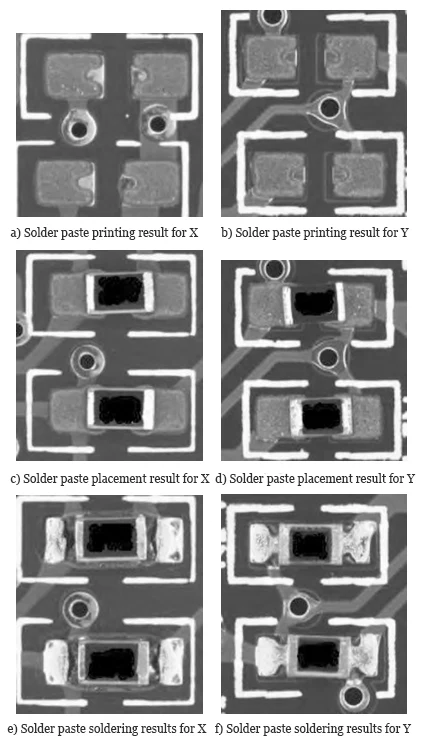
Observation via AOI revealed that the edges of the Y solder paste pattern were sharper than those of the X solder paste, and the pads were fully covered.
After component placement, the shape of the X paste changed significantly, while the Y paste remained unchanged.
Following vacuum vapor-phase reflow soldering, the Y paste demonstrated superior ramp height and wettability compared to the X paste, resulting in better performance.
Analyzing the soldering mechanism, the particle size of No. 4 solder paste is smaller than that of No. 3.
Therefore, for the same amount of solder paste, No. 4 has a larger surface area, making it more prone to oxidation and less favorable for soldering.
Consequently, Y solder paste should be selected.
Requirements for Stencil Fabrication
A stencil, also known as a template, is one of the key tools used in solder paste printing, serving to dispense a precise amount of solder paste.
The amount of solder paste dispensed depends primarily on the length, width, and thickness of the stencil apertures, as well as the printing gap between the stencil and the PCB, the latter of which is often related to squeegee pressure.
Specific design and manufacturing requirements follow the IPC-7525B leaded soldering standard.
The parameters for this type of stencil are as follows:
1) Laser cutting method is used;
2) For fine-pitch components with a lead pitch of less than 0.64 mm, stainless steel sheets with high elasticity and a low coefficient of friction must be used;
3) Thickness: 0.15 mm;
4) Width-to-thickness ratio > 1.5, area ratio > 0.66;
5) Resistor and capacitor pads are bow-tie shaped.
Design of Key Process Parameters
1. Process Flow
The specific process flow for the solder paste printing operation is shown in Figure 2.
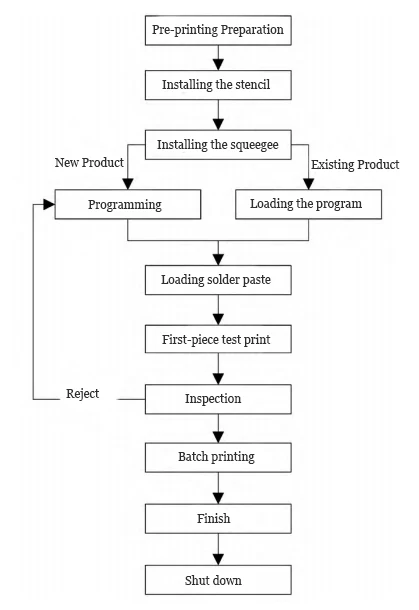
Pre-printing preparations include:
1) Completing the drying process for the PCB (lead-containing plating for the HASL process) at (105 ± 5)°C for 4 hours;
2) Verifying that the printing equipment is in good working order and that the squeegee meets specifications;
3) Inspecting the stencil to ensure it is clean, dry, and free of warping;
4) Retrieving solder paste according to the “first-in, first-out” principle, allowing it to acclimate for at least 4 hours, and automatically stirring it for approximately 2 minutes.
2. Solder Paste Usage Procedures and Requirements
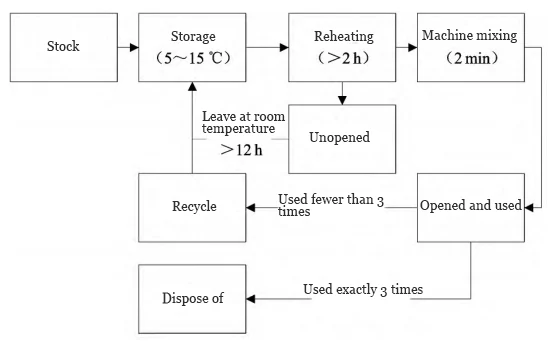
Solder paste must be transported and stored at a temperature between 5°C and 15°C.
When recycling solder paste, used paste must not be mixed with new paste during storage.
The specific usage procedures and requirements are shown in Figure 3.
3. Solder Paste Printing Process Parameters
The determination of printing process parameters primarily depends on the characteristics of the printing machine, the stencil design parameters, and the properties of the solder paste.
1) Squeegee Length:
Generally, a length approximately 50 mm longer than the maximum aperture length of the stencil is optimal.
For this product type, the maximum aperture length of the stencil is 240 mm.
Engineers select 300 mm and 350 mm squeegees for comparative testing.
During the printing process, engineers require 300 g of solder paste when they use a 350 mm squeegee to maintain a consistent print diameter, while they require 250 g of solder paste when they use a 300 mm squeegee.
To reduce the amount of solder paste added and the surface area of solder paste exposed to air, engineers select a 300 mm squeegee.
2) Squeegee Pressure:
Technicians set the ideal squeegee speed and pressure so that the squeegee just scrapes solder paste clean from the stencil surface.
Based on empirical formulas, technicians initially apply 1 kg of pressure per 50 mm of squeegee. They then gradually reduce the pressure until solder paste begins to remain on the screen (i.e., it is not fully scraped clean). At that point, they increase the pressure by 1 kg.
3) Squeegee Speed:
Squeegee speed affects the viscosity of the solder paste and the filling time. Increasing the speed helps improve production efficiency.
However, if the speed is too high, the time the squeegee spends passing through the stencil openings will be too short, preventing the solder paste from fully penetrating the openings and potentially causing missed prints.
Engineers ensure that the maximum printing speed produces uniform and complete solder paste deposition on SOP pads in both longitudinal and transverse directions; they typically control it between 20–50 mm/s.
Based on the package sizes of the SOP and PLCC components for this product type, and balancing both quality and efficiency, engineers set the printing speed to 40 mm/s.
4) Release Speed:
Generally, the faster the release speed, the lower the viscosity of the solder paste at the hole walls, making it easier to separate from the stencil.
However, when the speed exceeds a certain threshold, the overall viscosity of the solder paste decreases, causing the stencil to carry away the formed solder paste and disrupt the solder paste pattern.
When setting the release speed, consider the minimum lead pitch and solder paste viscosity.
For fine pitches ≤0.5 mm, set the release speed to 0.3–0.8 mm/s; for standard pitches, set it to 0.8–2 mm/s.
Therefore, the demolding speeds for stations 1, 3, and 4 of this product type are set to 1 mm/s, and station 2 is set to 0.3 mm/s.
5) Screen wiping frequency:
Fine-pitch ICs are prone to solder paste residue buildup, so operators clean solder paste residue in the mesh openings promptly.
Technicians set the value to the higher range while ensuring that they thoroughly clean the stencil.
For fine pitch ≤0.5 mm, the setting is generally 1–7; for standard pitch, it is 5–12.
For this product type, the setting for 0.5 mm fine pitch is 6, while others are set to 10. The cleaning mode is wet wipe/vacuum/dry wipe.
6) Other Precautions:
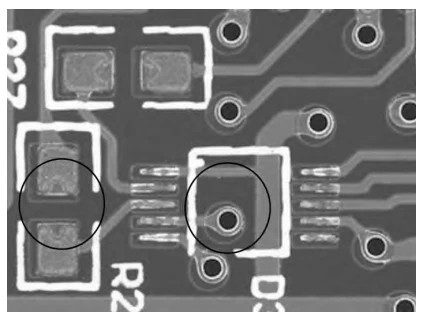
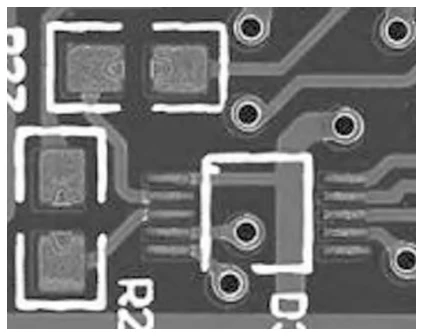
Testing has shown that if the printing interval exceeds 30 minutes, the solder paste pattern becomes incomplete (see Figure 4).
In this case, repeat the printing process or perform a solder paste stirring procedure (the complete state is shown in Figure 5).
After each production run, clean and dry the stencil and squeegee, then cover them with a stainless steel protective film for protection.
Military products have a wide variety of types and are produced in small batch sizes. Therefore, manufacturers recycle and reuse solder paste.
Solder paste manufacturers state that, in principle, they allow this type of solder paste to be reused two to three times.
Operators collect used solder paste into empty containers with different colors according to usage count.
They assign green containers for one use, yellow containers for two uses, and red containers for three uses.
After the third use, operators scrap the solder paste. The production team gives priority to using the next batch of yellow solder paste.
To ensure traceability, engineers establish monitoring points at each production stage. Quality teams maintain detailed records of final product quality.
They compile comprehensive documentation that includes solder paste production dates, storage conditions, usage requirements, pre-process and post-process quality verification results, product testing data, rework process conditions, and defect statistics.
Testing and Inspection
After reflow soldering, the PCB assembly for this military product passed a series of environmental tests, including thermal shock (–60°C to +70°C, 6 hours, 3 cycles), low-temperature (–55°C, 26 hours), and high-temperature (60°C, 48 hours) tests.
The test results met all product requirements and satisfied the acceptability criteria for Grade 3 products as specified in GJB 3243-1998.
Additionally, to fully evaluate the soldering quality, the PCBA underwent third-party testing, which included visual inspection, metallographic section analysis, SEM, and EDS analysis.
Inspectors observed effective connections between the solder and the pads, as well as between the solder and the component terminals, in the inspected solder joints.
The PCB-side interface IMC consisted of a tin-copper alloy, and it exhibited a uniform and continuous morphology; inspectors did not observe obvious wetting defects, grain coarsening, or solder joint cracking.
This PCBA also passed small-batch trial production as well as tests for resistance to high overloads and extreme environments, further indicating that the process parameters selected for the test are reasonable and feasible.
Conclusion
In summary, to ensure manufacturing quality and implement proactive measures in the production of modern electronic products, it is essential to master electronic assembly and interconnection technologies.
This involves researching how to utilize optimized production processes and the most appropriate technical methods to meet market demands as quickly as possible, while minimizing costs and reducing the consumption of human and material resources.
The ultimate goal is to provide society with modern electronic products that are of high quality and reliability.