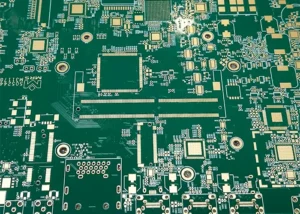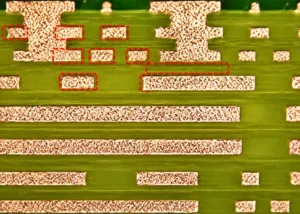
5G communication and Internet of Things technologies are developing rapidly, pushing electronic devices toward higher operating frequencies and exacerbating electromagnetic interference problems.
Electromagnetic radiation from 28 GHz 5G base stations reaches 55 dBμV/m.
Traditional metal-based shielding materials exhibit poor performance at high frequencies, and their shielding effectiveness may decrease by as much as 30%.
New shielding materials and structural designs can improve the reliability of electronic devices.
Investigations into these shielding materials for high-frequency circuits carry substantial value and offer key support for the electromagnetic compatibility design of electronic products.
Research Background
Characteristics of Electromagnetic Shielding
When electromagnetic waves propagate through space and encounter conductive materials, they induce currents.
The counter-phase electromagnetic field generated by these induced currents cancels out the incident electromagnetic waves, thereby achieving electromagnetic shielding.
Shielding effectiveness (SE) acts as the core metric for shielding material assessment.
It describes the logarithmic ratio between incident and transmitted electromagnetic wave intensity.
The measurement unit is decibel (dB). Equation (1) gives the corresponding calculation formula.

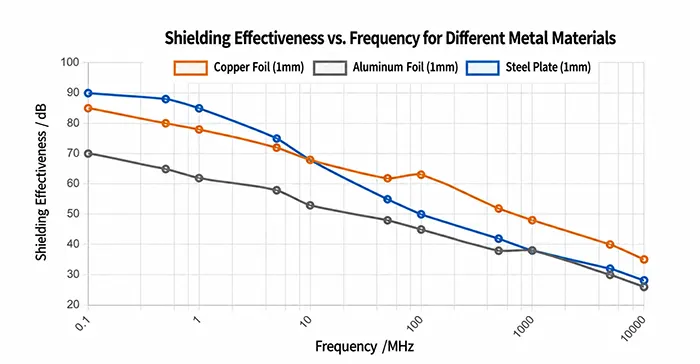
Measured data show that at a frequency of 100 MHz, 1 mm-thick copper foil can achieve an SE value of over 60 dB, while aluminum foil can reach approximately 45 dB.
The SE value exhibits a nonlinear relationship with frequency, as shown in Figure 1.
While it generally decreases as frequency increases, resonance peaks may occur in certain frequency bands.
In practical applications, the design of shielding structures must take into account factors such as grounding and overlap;
A good ground connection can improve the SE value by 15 to 20 dB.
Shielding Mechanisms
Electromagnetic shielding involves three primary mechanisms: reflection, absorption, and multiple reflections.
Copper has an electrical conductivity of 5.8 × 10⁷ S/m. It generates 40 dB of reflection loss at 1 GHz.
Its absorption loss reaches 8.686 dB at the skin-depth thickness.
A nickel-based composite sample is 0.5 mm thick. Tests cover the frequency band from 2 GHz to 18 GHz.
Reflection loss contributes 65% of its total shielding performance.
Absorption loss takes up 30% of the total shielding effect. Multiple reflection loss accounts for the remaining 5%.
Adjusting the material composition will alter the relative contributions of these various shielding mechanisms across different frequency bands.
Impact of Material Properties on Shielding Performance
A material’s electrical conductivity, magnetic permeability, and thickness are key parameters affecting shielding performance.
Measured test data reveal clear performance trends. Raising electrical conductivity by one order of magnitude boosts reflection loss by 10 dB.
This rule holds under the tested conditions.
Relative magnetic permeability also affects absorption loss greatly. When it rises from 1 to 100, absorption loss increases by 40 dB at 1 GHz.
Carbon fiber composites exhibit a nonlinear effect of thickness at 5 GHz;
As the thickness increases from 0.5 mm to 2 mm, the shielding performance improves from 35 dB to 65 dB.
Nanocomposites in the 5G communication band have a relative magnetic permeability of 15 and a conductivity of 10⁴ S/m, with an average shielding performance of 70 dB.
Characteristics of High-Frequency Electronic Circuits
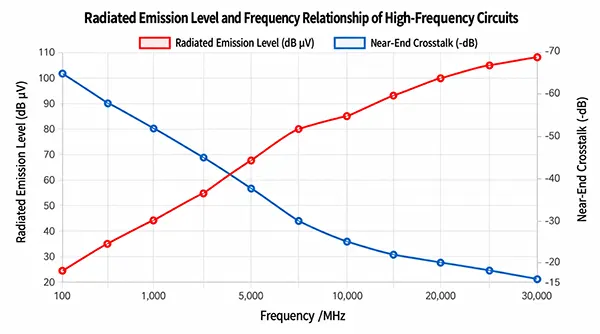
High-frequency electronic circuits operating in the RF and microwave bands are characterized by high signal transmission speeds and wide bandwidth, as shown in Figure 2.
A 0.1 mm-wide signal trace on a printed circuit board can generate a radiation level of 85 dBμV at a frequency of 10 GHz, while near-end crosstalk between adjacent signal traces can reach -20 dB at 20 GHz.
A 5G RF module operating at 28 GHz can experience a signal-to-noise ratio degradation of up to 15 dB in the absence of proper shielding.
Electromagnetic compatibility (EMC) analysis and stack-up optimization during the circuit design phase can reduce crosstalk effects by more than 40%.
Applications of Electromagnetic Shielding Materials in High-Frequency Electronic Circuits
Shielding Design in Power Modules
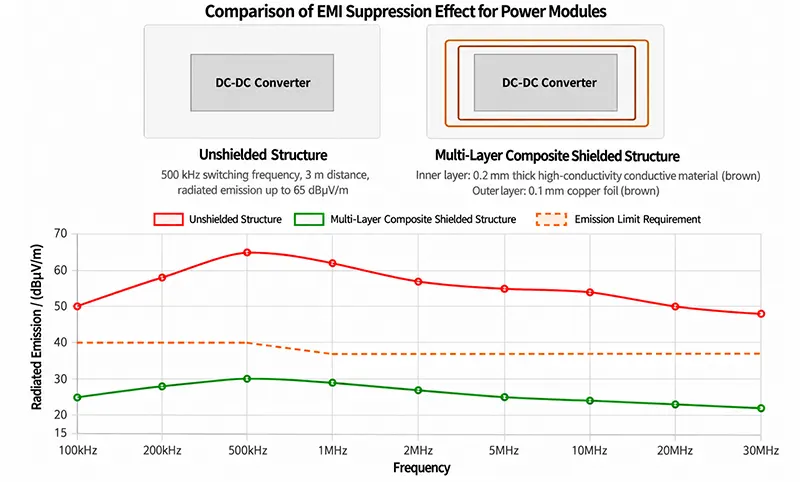
A DC-DC converter with a switching frequency of 500 kHz generates 65 dBμV/m of radiated interference at a test distance of 3 m when unshielded.
This multilayer composite forms a shielding structure. Its inner layer is high-permeability ferrite with a thickness of 0.2 mm. The outer layer adopts 0.1 mm tin-plated copper foil.
The structure delivers an average shielding effectiveness of 45 dB. Test frequencies cover 100 kHz to 30 MHz. Figure 3 records this result.
Improvements to the location and number of ground points resulted in a shielding gain of 15 dB at 10 MHz.
The performance of this shielding design degraded by less than 8% at 85°C, and its effectiveness decreased by no more than 5% after 1,000 hours of high-temperature aging.
Shielding Solutions for RF Circuits
RF circuits work in specific frequency bands. These applications demand high-performance shielding materials.
5G communication modules run at 28 GHz. Their background noise reaches −90 dBm. The required isolation for signal integrity exceeds 60 dB.
The nano-silver-coated cavity shielding structure, with a thickness of 5 μm and a surface resistivity of 0.01 Ω/□, achieves a shielding effectiveness of 65–75 dB in the 18–40 GHz frequency range and a crosstalk suppression value of -65 dB.
The improved cavity structure maintains a standing wave ratio (SWR) of 1.2 at 28 GHz, with an insertion loss of only 0.3 dB.
Researchers integrate this new shielding structure into the Mini-PCIe RF module. The system noise floor rises by 15 dB.
Transmission power stability improves by 20 percent. Receiver sensitivity gains 3 dB. Manufacturing costs drop by 30 percent.
Applications in Sensors and Wireless Communication Devices
In urban environments, background electromagnetic noise in the 2.4 GHz band reaches –85 dBm.
The graphene/silver nanowire composite has a thickness of 0.1 mm.
It achieves shielding effectiveness between 45 dB and 55 dB across 1–6 GHz.
Its performance drops by less than 3 dB after 1000 bending cycles.
This shielding material brings multiple benefits to wearable devices. It raises signal reception sensitivity by 5 dB.
The communication range expands by 30 percent. Device power consumption falls by 15 percent.
Environmental sensors also gain advantages from this material. Their measurement accuracy improves by 40%.
Measurement stability increases by 50%. Its mass production cost equals 70% of the cost of conventional metal shielding materials.
Packaging and Shielding of Electronic Components
The performance and reliability of high-frequency electronic components are significantly affected by the effectiveness of their packaging shielding.
The three-layer composite shielding structure consists of a conductive adhesive layer (5 μm), a magnetic material layer (20 μm), and a metal layer (10 μm).
Experimental measurements confirm that the composite structure achieves a shielding effectiveness exceeding 70 dB in the 30–40 GHz frequency band, with a thermal conductivity of 15 W/m•K.
The interlayer bond strength reaches 15 MPa, and the performance degradation rate in thermal cycling tests (-40 to 125°C, 1,000 cycles) is less than 5%.
Performance tests on BGA packages showed a 45% reduction in crosstalk and a 35% improvement in signal integrity.
Production costs were reduced by 30% compared to traditional metal shields, and automation efficiency increased by 50%.
After 2,000 hours of aging testing under conditions of 85°C and 85% relative humidity, the shielding performance retention rate remained above 95%.
Future Development Directions
The development of electromagnetic shielding materials is moving toward multifunctional integration, intelligence, and cost-effectiveness.
Graphene-based smart composites hold strong application potential. Experimental data support this conclusion.
Researchers tune material properties via rare-earth element doping.
External field excitation enables dynamic adjustment of shielding performance.
The adjustable shielding effectiveness ranges from 20 dB to 45 dB.
AI-based material design methods have significantly improved the efficiency of new material development.
Computational simulation results indicate that optimized nanocomposites can achieve shielding performance exceeding 80 dB in the 30–50 GHz frequency band.
There is an urgent demand for flexible, transparent shielding materials in the wearable devices sector;
Silver nanowire/graphene composite films have already achieved 35 dB of shielding performance at 90% light transmittance.
Significant progress has been made in the research of environmentally friendly shielding materials;
Bio-based composites achieve a shielding performance of 40 dB in the 1–10 GHz frequency band, while reducing production costs by 40%.
Market analysis indicates that by 2027, the global market for electromagnetic shielding materials will reach $8.5 billion, with a compound annual growth rate (CAGR) of over 12%, driven primarily by the 5G communications and new energy vehicle sectors.
Conclusion
Published data summarize the performance of electromagnetic shielding materials.
Conductive materials reach 75–85 dB of shielding effectiveness. This performance covers the frequency range of 1–10 GHz.
Magnetic materials target magnetic field shielding. Their shielding effectiveness falls between 40 dB and 60 dB.
The valid frequency band is 100 Hz to 100 kHz.
Carbon nanotube/polymer composites achieve a shielding effectiveness of 45 dB in the 8–12 GHz frequency band.
Application cases of high-frequency circuits verify the shielding effect. Multilayer composite shielding structures cut radiation interference from power modules by 35 dB.
Nano-silver coatings serve as another effective shielding solution. They help RF circuits reach 70 dB shielding effectiveness at 28 GHz.
Flexible shielding materials improve sensor signal reception sensitivity by 5 dB, while a three-layer composite structure reduces crosstalk in component packaging by 45%.
These improvements in material performance have driven advancements in electromagnetic compatibility (EMC) technology for high-frequency electronic devices;
The development of smart, controllable materials and the optimization of low-cost manufacturing processes will be key areas of future research.